
I remember sitting across from my accountant, staring at a number that made my stomach drop. Despite earning more than ever, I had less saved than I did three years prior. The money was coming in faster, but it was also flowing out faster. I was working harder, but getting nowhere.
“How did this happen?” I asked.
He looked at me and said something I’ve never forgotten: “You don’t have a money problem. You have a money management problem.”
That conversation changed everything. Over the next year, I implemented the smart money management strategies I’m about to share with you. I didn’t earn more. I didn’t get lucky. I just stopped letting money control me and started controlling my money.
The truth is, most of us were never taught how to manage money. School taught us algebra and Shakespeare but never explained budgeting, investing, or compound interest. We’re expected to figure it out on our own, and most of us figure it out wrong.
These smart money management strategies aren’t complicated. They’re not get-rich-quick schemes. They’re the simple, boring, proven principles that actually work. They’ve helped me build savings, eliminate debt, and sleep better at night.
Whether you’re just starting out or trying to get back on track, these smart money management strategies will give you a roadmap.
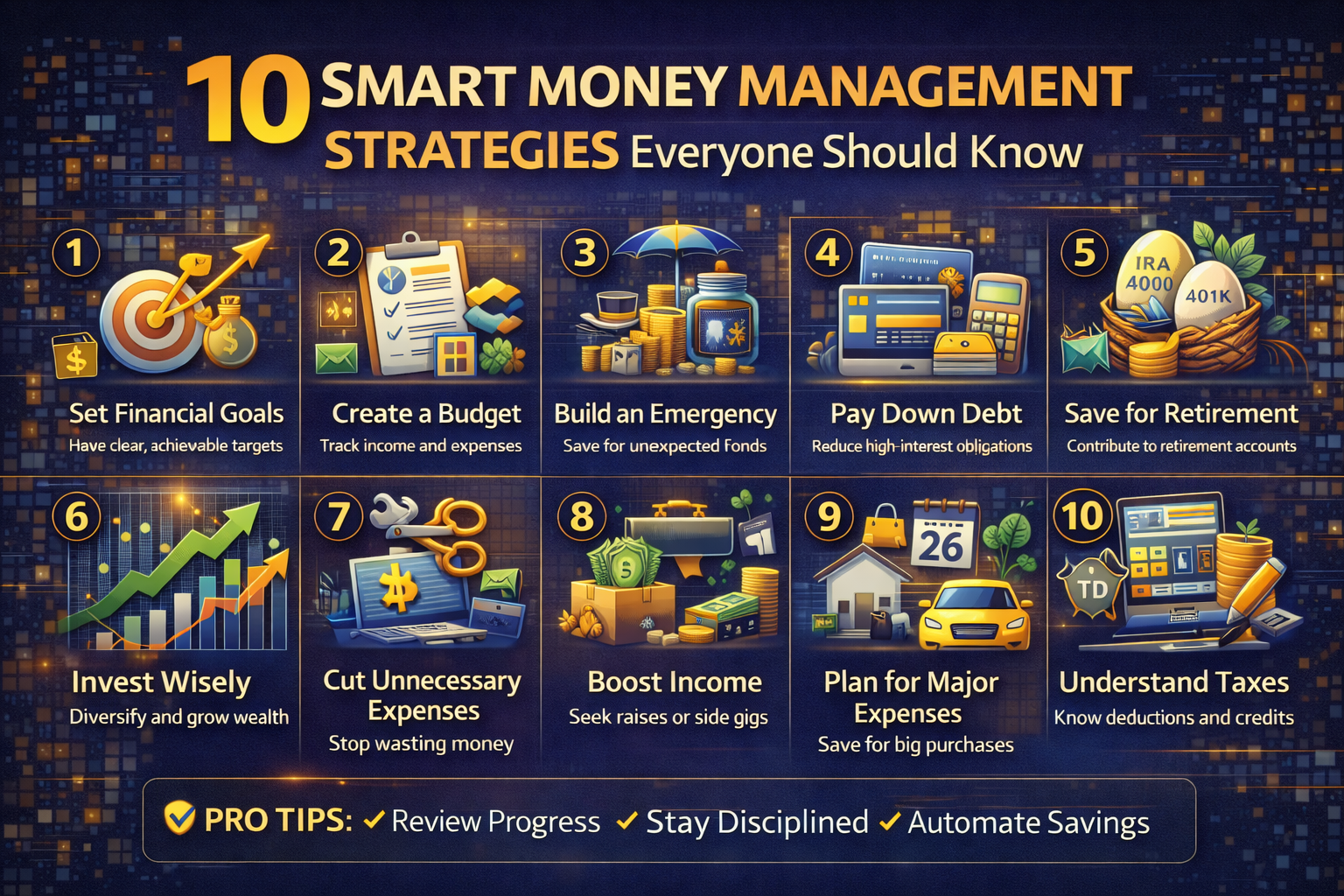
Let’s dive into the 10 strategies that everyone should know.
Part 1: The Foundation of Smart Money Management
Before we get into specific smart money management strategies, we need to understand what money management actually means.
What Money Management Is NOT
| Myth | Reality |
|---|---|
| “I need to earn more” | Earning more without managing better won’t help |
| “I’m bad with money” | It’s a skill, not a personality trait |
| “I’ll start next month” | The best time to start was years ago |
| “It’s too complicated” | The basics are simple |
What Money Management Actually Is
Money management is the practice of making deliberate decisions about your money instead of letting your money dictate your decisions. It’s about:
- Knowing where your money goes
- Choosing what matters to you
- Building systems that work automatically
- Planning for the future while living in the present
Strategy #1: Set Financial Goals
Based on the image you shared, the first of the smart money management strategies is setting clear, achievable targets.
Why Goals Matter
Without goals, you’re just drifting. You save because you “should.” You invest without purpose. You cut spending without knowing why.
With goals, every financial decision has context. “Should I buy this?” becomes “Does this bring me closer to my goal?”
Types of Financial Goals
| Time Horizon | Examples | Approach |
|---|---|---|
| Short-term (under 1 year) | Vacation, new laptop, holiday gifts | Save in high-yield savings |
| Medium-term (1-5 years) | Down payment, wedding, car | Save in conservative investments |
| Long-term (5+ years) | Retirement, child’s college | Invest in diversified portfolio |
How to Set SMART Financial Goals
| Letter | Meaning | Example |
|---|---|---|
| Specific | “Save $10,000 for a down payment” not “save money” | |
| Measurable | Track progress monthly | |
| Achievable | Realistic given your income | |
| Relevant | Aligned with your values | |
| Time-bound | “By December 2027” |
Action step: Write down 3 financial goals: one short-term, one medium-term, one long-term. Put them somewhere you’ll see daily.
Strategy #2: Create a Budget
The second of the smart money management strategies is tracking income and expenses.
Why Budgeting Matters
A budget isn’t a restriction. It’s permission to spend. When you know your money is allocated to what matters, you can spend freely on those things without guilt.
The Zero-Based Budget
Every dollar gets assigned a job before the month begins.
| Category | Amount |
|---|---|
| Income | $4,000 |
| Rent | -$1,200 |
| Utilities | -$200 |
| Groceries | -$400 |
| Transportation | -$300 |
| Savings (Goal #1) | -$400 |
| Savings (Goal #2) | -$300 |
| Debt payments | -$500 |
| Fun money | -$400 |
| Miscellaneous | -$300 |
| Remaining | $0 |
The 50/30/20 Budget (Simpler Alternative)
| Category | Percentage | Example ($4,000 income) |
|---|---|---|
| Needs (housing, utilities, groceries, minimum debt) | 50% | $2,000 |
| Wants (dining out, entertainment, hobbies) | 30% | $1,200 |
| Savings & Debt (emergency fund, retirement, extra debt) | 20% | $800 |
Action step: Choose a budgeting method. Track every expense for 30 days. Then create your first budget.
Strategy #3: Build an Emergency Fund
The third of the smart money management strategies is saving for unexpected funds.
How Much?
| Stage | Amount | Purpose |
|---|---|---|
| Starter | $1,000 | Most common emergencies |
| 3 months | 3 months of expenses | Job loss cushion |
| 6 months | 6 months of expenses | Full security |
Where to Keep It
| Location | Pros | Cons |
|---|---|---|
| High-yield savings | Earns interest (4-5%), accessible | Not instant (1-2 days) |
| Money market | Similar to HYSA | May have minimums |
| Checking | Instant access | No interest, too easy to spend |
The $1,000 Starter Fund
Don’t feel overwhelmed by 6-month goals. Start with $1,000. It covers most emergencies:
- Car repair: $500-$1,000
- Medical bill: $100-$500
- Unexpected travel: $500-$1,000
Action step: Save $1,000 as fast as possible. Cut expenses, sell unused items, work extra hours. Then build to 3-6 months.
Strategy #4: Pay Down Debt
The fourth of the smart money management strategies is reducing high-interest obligations.
The Debt Avalanche Method
List debts by interest rate, highest to lowest. Pay minimums on everything. Throw every extra dollar at the highest rate debt.
| Debt | Balance | Interest | Minimum | Extra |
|---|---|---|---|---|
| Credit Card A | $5,000 | 22% | $150 | $300 |
| Credit Card B | $3,000 | 18% | $100 | $0 |
| Student Loan | $15,000 | 6% | $200 | $0 |
Why it works: Mathematically optimal. You pay the least total interest.
The Debt Snowball Method
List debts by balance, smallest to largest. Pay minimums on everything. Attack the smallest balance first.
| Debt | Balance | Interest | Minimum | Extra |
|---|---|---|---|---|
| Credit Card B | $3,000 | 18% | $100 | $300 |
| Credit Card A | $5,000 | 22% | $150 | $0 |
| Student Loan | $15,000 | 6% | $200 | $0 |
Why it works: Psychologically motivating. Quick wins build momentum.
Action step: List all your debts with balances and interest rates. Choose avalanche or snowball. Start today.
Strategy #5: Save for Retirement
The fifth of the smart money management strategies is contributing to retirement accounts.
The Power of Compounding
| Start Age | Monthly Investment | Value at 65 (7% return) |
|---|---|---|
| 25 | $500 | $1.2 million |
| 35 | $500 | $567,000 |
| 45 | $500 | $245,000 |
Waiting ten years costs over $600,000. Start as early as possible.
Where to Save
| Account | Best For | Limits |
|---|---|---|
| 401(k) (especially with match) | Retirement through employer | $23,500 |
| IRA (Traditional or Roth) | Retirement on your own | $7,500 |
| HSA | Medical expenses + retirement | $4,300 (individual) |
The Order of Operations
| Step | Action |
|---|---|
| 1 | Contribute enough to 401(k) to get full employer match |
| 2 | Max out HSA (if eligible) |
| 3 | Max out Roth IRA |
| 4 | Return to 401(k) to increase contributions |
Action step: If you have a 401(k) match, contribute at least enough to get it. That’s free money.
Strategy #6: Invest Wisely
The sixth of the smart money management strategies is diversifying and growing wealth.
The Simple Path
| Step | Action |
|---|---|
| 1 | Open a brokerage account (Vanguard, Fidelity, Schwab) |
| 2 | Buy low-cost index funds (VTI, VOO, VT) |
| 3 | Set up automatic monthly purchases |
| 4 | Ignore the noise |
| 5 | Hold for decades |
Why Index Funds?
| Advantage | Explanation |
|---|---|
| Low costs | Expense ratios as low as 0.03% |
| Diversification | Own thousands of companies |
| Simplicity | One decision, forever |
| Performance | Beats most active funds |
The Simple Portfolio
| Fund | Allocation | Example Ticker |
|---|---|---|
| Total US stock market | 60% | VTI |
| Total international stock | 20% | VXUS |
| Total US bond market | 20% | BND |
Action step: Open a brokerage account. Set up $100/month automatic investment into VTI.
Strategy #7: Cut Unnecessary Expenses
The seventh of the smart money management strategies is stopping wasteful spending.
The Subscription Audit
Most people have subscriptions they forgot about.
| Category | Average Monthly Cost |
|---|---|
| Streaming services | $50 |
| Gym membership | $40 |
| Software subscriptions | $30 |
| Meal kits | $60 |
| Box subscriptions | $30 |
| Total | $210 |
The Latte Factor
Small daily expenses add up.
| Expense | Daily Cost | Monthly Cost | Yearly Cost |
|---|---|---|---|
| Coffee shop | $5 | $150 | $1,800 |
| Lunch out | $12 | $360 | $4,320 |
| After-work drink | $10 | $300 | $3,600 |
| Snacks | $3 | $90 | $1,080 |
The 30-Day Rule
| Threshold | Wait Time |
|---|---|
| Under $50 | 24 hours |
| $50-$200 | 48 hours |
| Over $200 | 30 days |
Action step: Log into your bank account and credit cards. List every recurring charge. Cancel anything you don’t use weekly.
Strategy #8: Boost Income
The eighth of the smart money management strategies is seeking raises or side gigs.
Income Growth Strategies
| Strategy | Potential Impact |
|---|---|
| Negotiate your salary | 5-20% increase |
| Change jobs every 2-4 years | 10-30% increase |
| Develop high-value skills | 20-50% increase over time |
| Start a side business | $500-$5,000+/month |
| Freelance or consult | $50-$200/hour |
The Salary Negotiation Script
| Step | What to Say |
|---|---|
| 1 | “I’m excited about this role and the value I can bring.” |
| 2 | “Based on my research and experience, I was expecting something in the range of [X-Y].” |
| 3 | “Is there flexibility to get closer to that range?” |
| 4 | “What other components (bonus, equity, benefits) could we discuss?” |
Side Hustle Ideas
| Side Hustle | Time Required | Potential Income |
|---|---|---|
| Freelance writing | 5-10 hours/week | $500-$2,000/month |
| Tutoring | 5 hours/week | $400-$1,000/month |
| Pet sitting | Weekends | $200-$500/month |
| Ride sharing | 10 hours/week | $500-$1,000/month |
| Digital products | Upfront, then passive | $100-$2,000+/month |
Action step: If you haven’t asked for a raise in the last year, prepare your case. Or start one side hustle this month.
Strategy #9: Plan for Major Expenses
The ninth of the smart money management strategies is saving for big purchases.
Types of Major Expenses
| Expense | Typical Cost | Time to Save |
|---|---|---|
| Car | $15,000-$30,000 | 1-3 years |
| Down payment | $30,000-$100,000 | 3-10 years |
| Wedding | $20,000-$40,000 | 1-3 years |
| Vacation | $3,000-$10,000 | 6-12 months |
| Home repair | $5,000-$15,000 | 6-12 months |
The Sinking Fund Method
| Step | Action |
|---|---|
| 1 | Estimate the total cost |
| 2 | Divide by months until purchase |
| 3 | Save that amount monthly |
| 4 | Keep in separate savings account |
Example: $12,000 vacation in 24 months = $500/month.
Action step: List any major expenses you expect in the next 5 years. Create a sinking fund for each.
Strategy #10: Understand Taxes
The tenth of the smart money management strategies is knowing deductions and credits.
Tax-Advantaged Accounts
| Account | Benefit |
|---|---|
| 401(k) | Tax-deferred growth; employer match |
| Traditional IRA | Tax-deductible contributions |
| Roth IRA | Tax-free withdrawals in retirement |
| HSA | Triple tax advantage |
| 529 plan | Tax-free growth for education |
Common Deductions and Credits
| Deduction/Credit | Who It’s For |
|---|---|
| Student loan interest deduction | Anyone paying student loans |
| Retirement contribution credit | Low-to-moderate income savers |
| Child tax credit | Parents |
| Earned income tax credit | Low-to-moderate income workers |
| Mortgage interest deduction | Homeowners (if itemizing) |
Tax-Efficient Investing
| Strategy | Benefit |
|---|---|
| Hold investments over a year | Lower capital gains rates |
| Use tax-advantaged accounts first | Shield from taxes |
| Tax-loss harvesting | Offset gains with losses |
| Don’t trade frequently | More trades = more taxes |
Action step: Review your tax withholding. Adjust if you owed or got a large refund. Consider consulting a tax professional.
Part 2: Putting It All Together
These smart money management strategies work together as a system.
The Monthly Rhythm
| Week | Focus |
|---|---|
| Week 1 | Pay bills, check budget, pay yourself first |
| Week 2 | Review spending, adjust if needed |
| Week 3 | No action (let the system run) |
| Week 4 | Plan next month’s budget, review goals |
The Annual Rhythm
| Quarter | Focus |
|---|---|
| Q1 | Review annual goals, adjust budget |
| Q2 | Check investment performance, rebalance |
| Q3 | Plan for holiday spending |
| Q4 | Tax planning, review next year’s goals |
Part 3: Common Mistakes to Avoid
| Mistake | Why It’s Dangerous | Fix |
|---|---|---|
| Not tracking spending | You don’t know where money goes | Track for 30 days |
| Using credit cards irresponsibly | Interest charges compound | Pay statement balance in full |
| No emergency fund | Surprises become crises | Save $1,000 starter fund |
| Investing without a plan | Buy high, sell low | Automate index fund investing |
| Trying to keep up with others | Financial stress | Your only competition is yourself |
Conclusion
Let’s bring this together.
These smart money management strategies—setting financial goals, creating a budget, building an emergency fund, paying down debt, saving for retirement, investing wisely, cutting unnecessary expenses, boosting income, planning for major expenses, and understanding taxes—aren’t complicated. They’re not secret. They’re the simple, boring principles that actually work.
You don’t need to do all ten at once. Pick one. Master it. Then add another.
The people who succeed financially aren’t the ones who made the most money. They’re the ones who managed what they had.
Start today.











Leave a Reply