

I still remember my first Bitcoin purchase. It was 2017, and I’d just watched a YouTube video explaining how to buy crypto. I opened a Coinbase account, linked my bank, and nervously bought $500 worth of Bitcoin at around $8,000 per coin. I had no idea what I was doing. I didn’t understand private keys, wallets, or blockchain. I just knew that everyone was talking about it, and I didn’t want to miss out.
What followed was a roller coaster I wasn’t prepared for. Bitcoin soared to $19,000. I felt like a genius. Then it crashed to $6,000. I felt like an idiot. I sold at the bottom, locked in my losses, and swore I’d never touch crypto again.
But something kept pulling me back. The technology fascinated me. The potential to disrupt finance, create new forms of ownership, and build decentralized systems—it felt like watching the early internet. So I went back, but this time I did it right. I learned the fundamentals. I understood what I was buying. I built a strategy.
This cryptocurrency investing guide for beginners is everything I wish I’d known before I bought my first Bitcoin. We’ll cover what cryptocurrency actually is, how to buy it, how to store it safely, how to build a portfolio, and most importantly—how to avoid the mistakes that cost beginners millions every year.
Whether you’re completely new or have dabbled and want to understand more, this guide will give you the foundation you need. Let’s demystify crypto investing together.
Part 1: What Is Cryptocurrency?
Before we get into cryptocurrency investing, we need to understand what we’re actually buying.
The Basics
Cryptocurrency is digital money that operates on decentralized networks called blockchains. Unlike traditional currency (dollars, euros, yen), crypto isn’t controlled by any government or central bank. Instead, it’s secured by cryptography and maintained by a global network of computers.
Key Characteristics:
| Characteristic | What It Means |
|---|---|
| Decentralized | No single entity controls it |
| Digital-only | Exists only electronically |
| Borderless | Send anywhere in the world instantly |
| Transparent | All transactions are recorded on public ledgers |
| Limited supply | Many cryptocurrencies have fixed maximum supplies |
| Self-custody | You can hold your own keys (no bank needed) |
How It Works
At its core, cryptocurrency runs on blockchain technology. Think of a blockchain as a digital ledger that records every transaction ever made. This ledger is copied across thousands of computers worldwide, making it nearly impossible to alter or hack.
When you send Bitcoin to someone, that transaction is verified by network participants (miners or validators), added to a “block,” and permanently recorded. No one can reverse it or fake it.
The Difference Between Bitcoin and Everything Else
| Category | Examples | What They Do |
|---|---|---|
| Store of Value | Bitcoin (BTC) | Digital gold—scarce, secure, decentralized |
| Smart Contract Platforms | Ethereum (ETH), Solana (SOL) | Enable applications, DeFi, NFTs |
| Payment Coins | Litecoin (LTC), XRP | Fast, cheap transactions |
| Stablecoins | USDC, USDT | Pegged to dollar; less volatile |
| Memecoins | Dogecoin (DOGE), Shiba Inu | Community-driven, highly speculative |
Part 2: Why Invest in Cryptocurrency?
Understanding the “why” is essential for any cryptocurrency investing guide for beginners.
Potential for High Returns
Cryptocurrency has delivered some of the highest returns in financial history. Bitcoin went from $0.0008 in 2010 to over $60,000 in 2021. Ethereum went from $0.30 in 2015 to over $4,800 in 2021. These returns are extraordinary—and come with extraordinary risk.
Portfolio Diversification
Crypto has historically had low correlation with traditional assets like stocks and bonds. Adding a small allocation (1-5%) can potentially improve your portfolio’s risk-adjusted returns.
Hedge Against Inflation
Bitcoin has a fixed supply of 21 million coins. Unlike fiat currency, which can be printed endlessly, Bitcoin’s scarcity makes it attractive to those concerned about inflation and currency debasement.
Technological Innovation
Investing in crypto isn’t just about price speculation. It’s betting on blockchain technology that could reshape finance, supply chains, identity, and digital ownership.
Part 3: The Risks You Need to Understand
Before you invest a single dollar, you need to understand what you’re getting into. No cryptocurrency investing guide for beginners is complete without covering the risks.
Volatility
| Asset | Typical Daily Move | 2022 Peak-to-Trough Drop |
|---|---|---|
| Bitcoin | 3-5% | -77% |
| Ethereum | 5-8% | -80% |
| Stocks (S&P 500) | 0.5-1% | -25% |
Crypto can drop 30% in a week. If that sounds terrifying, you need to be prepared—or consider a smaller allocation.
Regulatory Risk
Governments are still figuring out how to regulate crypto. Bans, new tax rules, and restrictions could impact prices and accessibility. This is an evolving landscape.
Security Risk
If you lose your private keys, your crypto is gone forever. If you leave crypto on an exchange and it collapses (like FTX), you could lose everything. Self-custody comes with responsibility.
Scams and Fraud
The crypto space is full of scams—fake exchanges, phishing sites, rug pulls, Ponzi schemes. For beginners, sticking to well-established coins and platforms is essential.
Part 4: How Much Should You Invest?
This is one of the most common questions in any cryptocurrency investing guide for beginners.
The 1-5% Rule
Most financial advisors suggest allocating 1-5% of your total investment portfolio to crypto. This is small enough to limit downside risk but large enough to matter if crypto continues to grow.
| Risk Tolerance | Suggested Allocation |
|---|---|
| Conservative | 0-1% |
| Moderate | 1-3% |
| Aggressive | 3-5% |
| Speculative | 5-10%+ |
The “Fun Money” Approach
If you’re just starting, consider using “fun money”—money you can afford to lose. This removes emotional pressure and lets you learn without stress.
Dollar-Cost Averaging
Instead of buying a large lump sum, invest a fixed amount regularly (weekly, monthly). This smooths out volatility and removes the pressure of timing the market.
Part 5: How to Buy Your First Cryptocurrency
Let’s walk through the practical steps of cryptocurrency investing.
Step 1: Choose a Reputable Exchange
| Exchange | Best For | Features |
|---|---|---|
| Coinbase | Beginners | Simple interface, educational content, high fees |
| Kraken | Security | Strong reputation, good customer support |
| Binance.US | Low fees | Lower fees, more coins (US version limited) |
| Gemini | Security | Regulated, insured hot wallet |
Step 2: Create and Verify Your Account
- Provide email and create strong password
- Complete identity verification (KYC)—requires government ID
- Enable two-factor authentication (2FA) immediately
- Use an authenticator app (Google Authenticator, Authy) not SMS
Step 3: Fund Your Account
- Link your bank account (ACH transfer, wire)
- Deposit funds (typically 1-5 business days for ACH)
- Some exchanges allow instant purchases with debit card (higher fees)
Step 4: Make Your First Purchase
- Navigate to the trading page
- Choose the cryptocurrency you want (start with Bitcoin or Ethereum)
- Enter the amount (can be fractional—you don’t need to buy a whole coin)
- Review fees
- Place your order
Practical tip: Start with a small amount—$50 or $100. Get comfortable with the process before committing larger sums.
Part 6: Where to Store Your Crypto
This is one of the most important sections of any cryptocurrency investing guide for beginners. Where you store your crypto matters enormously.
Exchange Wallet (Custodial)
| Pros | Cons |
|---|---|
| Convenient | “Not your keys, not your coins” |
| Good for small amounts | Exchange can freeze or lose funds |
| Easy to trade | Risk of exchange collapse (FTX) |
Best for: Small amounts, active trading, beginners learning.
Software Wallet (Non-Custodial)
| Pros | Cons |
|---|---|
| You control your keys | You’re responsible for security |
| More secure than exchange | Risk of malware/phishing |
| Good for daily use | Not immune to online threats |
Popular options: Trust Wallet, MetaMask, Exodus
Best for: Moderate amounts, active use, DeFi.
Hardware Wallet (Cold Storage)
| Pros | Cons |
|---|---|
| Keys never touch internet | Cost ($50-$200) |
| Immune to online attacks | Less convenient for trading |
| Most secure option | You must keep seed phrase safe |
Popular options: Ledger, Trezor
Best for: Long-term storage, large amounts.
The Rule of Thumb
| Amount | Storage Method |
|---|---|
| Under $500 | Exchange or software wallet |
| $500-$5,000 | Software wallet |
| Over $5,000 | Hardware wallet |
Part 7: Building Your Crypto Portfolio
How should you allocate within crypto? This is a key consideration for cryptocurrency investing.
Conservative Portfolio (80% Bitcoin, 20% Ethereum)
| Asset | Allocation |
|---|---|
| Bitcoin (BTC) | 80% |
| Ethereum (ETH) | 20% |
Rationale: Bitcoin and Ethereum are the most established, most secure, and have the longest track records. This portfolio prioritizes safety over moonshot potential.
Balanced Portfolio (50% BTC, 30% ETH, 20% Large-Cap Alts)
| Asset | Allocation |
|---|---|
| Bitcoin (BTC) | 50% |
| Ethereum (ETH) | 30% |
| Solana (SOL) | 10% |
| Other large-cap | 10% |
Rationale: Adds exposure to promising layer-1 blockchains while keeping core in Bitcoin and Ethereum.
Aggressive Portfolio (30% BTC, 30% ETH, 40% Alts)
| Asset | Allocation |
|---|---|
| Bitcoin (BTC) | 30% |
| Ethereum (ETH) | 30% |
| Solana (SOL) | 15% |
| Polygon (MATIC) | 10% |
| Other (DeFi, gaming) | 15% |
Rationale: Higher risk, higher potential reward. Suitable for those who believe in broader crypto adoption.
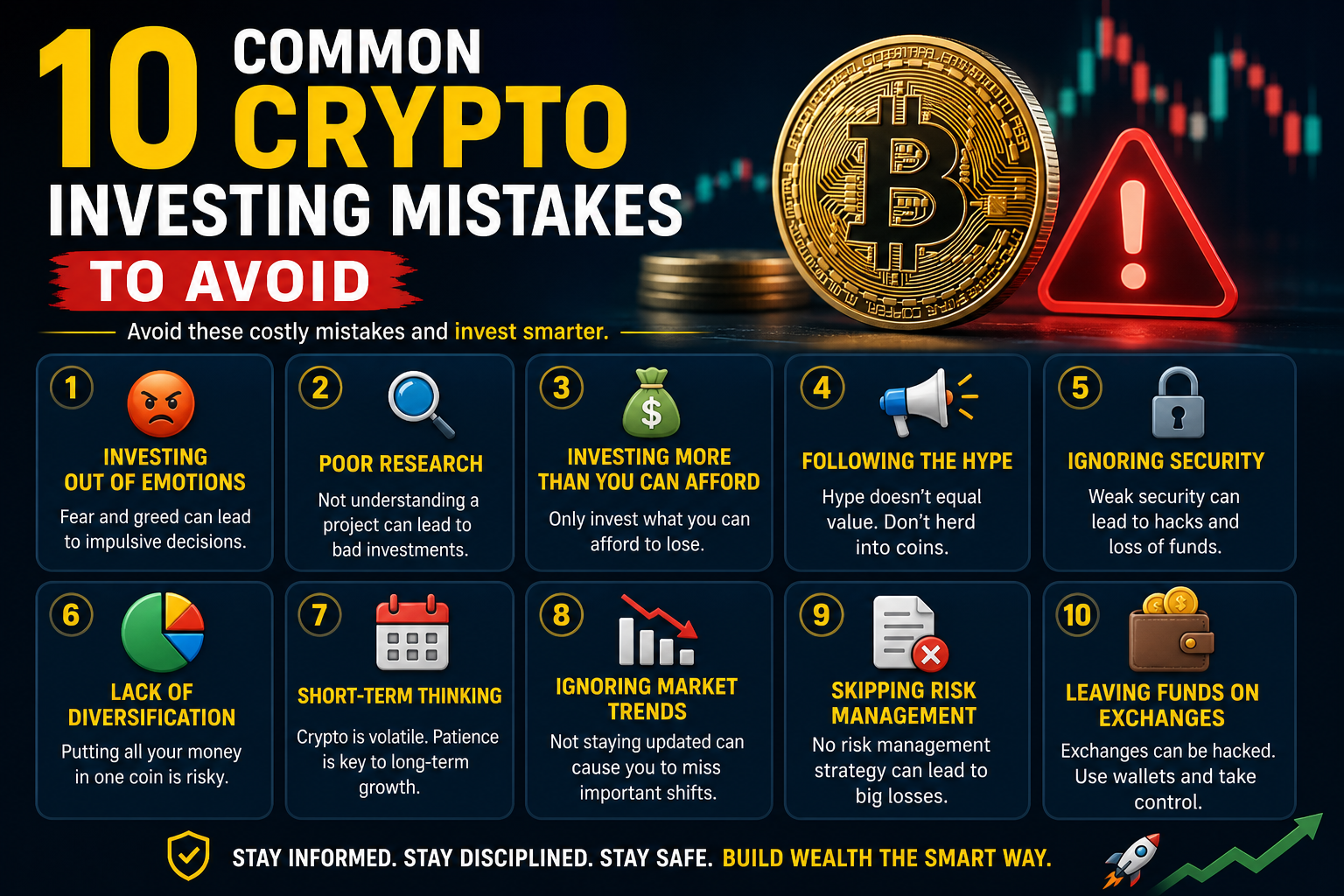
Part 8: Common Mistakes to Avoid
Learning from others’ errors is essential in any cryptocurrency investing guide for beginners.
Mistake #1: FOMO Buying
Buying after a massive rally because “everyone else is making money” is buying at the peak.
Fix: Dollar-cost average. Buy consistently regardless of price.
Mistake #2: Panic Selling
Selling during a crash locks in losses. Crypto has recovered from every major crash in history.
Fix: Have a long-term mindset. Zoom out. Don’t make emotional decisions.
Mistake #3: Leaving Crypto on Exchanges
FTX, Mt. Gox, and others collapsed with customer funds. Don’t let it happen to you.
Fix: Move significant holdings to self-custody (software or hardware wallet).
Mistake #4: Chasing Memecoins
Dogecoin, Shiba Inu, and others can pump 1000% and crash just as fast. Most beginners lose money chasing these.
Fix: Stick to established coins (BTC, ETH) until you understand the space.
Mistake #5: Ignoring Security
Weak passwords, no 2FA, sharing seed phrases—these lead to lost funds.
Fix: Use strong passwords, enable 2FA, never share your seed phrase.
Mistake #6: Investing More Than You Can Afford to Lose
Crypto is volatile. If you need the money in the next 3-5 years, don’t put it in crypto.
Fix: Only invest money you can afford to lose entirely.
Part 9: Tax Implications
In most countries, crypto is taxable. This section of our cryptocurrency investing guide for beginners covers the basics.
Taxable Events
| Event | Taxable? |
|---|---|
| Buying with fiat | No |
| Selling for fiat | Yes (capital gains) |
| Trading one crypto for another | Yes |
| Spending crypto | Yes |
| Staking rewards | Taxed as income |
| Airdrops | Taxed as income |
Holding Period Matters
| Holding Period | Tax Rate |
|---|---|
| Less than 1 year | Short-term capital gains (ordinary income rates) |
| More than 1 year | Long-term capital gains (0-20% depending on income) |
Record Keeping
You need to track every transaction: date, amount, cost basis, proceeds. Tools like CoinTracker, Koinly, or TaxBit can help.
Part 10: How to Stay Informed
The crypto space moves fast. Here’s how to stay informed without getting overwhelmed.
Follow These People (Not Influencers)
| Source | Why |
|---|---|
| Lyn Alden | Macro analysis, Bitcoin |
| Anthony Pompliano | Market commentary |
| Raoul Pal | Macro, long-term trends |
| Vitalik Buterin | Ethereum ecosystem |
| Messari | Research and data |
Read These Sources
| Source | Focus |
|---|---|
| CoinDesk | News |
| The Block | Research |
| Messari | Data and reports |
| Bitcoin Magazine | Bitcoin-focused |
Avoid
- Crypto Twitter hype accounts
- “Get rich quick” promises
- Telegram groups promising guaranteed returns
- Anyone asking for your seed phrase
Part 11: The Long-Term Mindset
Successful cryptocurrency investing requires patience.
Think in Years, Not Days
Bitcoin has had multiple 80%+ drawdowns. Each time, it recovered and went to new highs. The people who made the most money are those who held through the volatility.
Ignore the Noise
Daily price movements are noise. News cycles create fear and greed. Your long-term thesis shouldn’t change because of a week’s price action.
Rebalance Annually
If your crypto allocation grows beyond your target, consider taking profits. If it shrinks, consider adding. Annual rebalancing keeps your risk in check.
Part 12: What to Expect in Your First Year
Let’s set realistic expectations for your first year of cryptocurrency investing.
Month 1-3: The Learning Phase
- You’ll make your first purchase
- You’ll set up wallets
- You’ll experience your first 10% drop
- You’ll feel excited and nervous
Month 4-6: The Volatility Phase
- You’ll see your portfolio swing 20-50%
- You’ll be tempted to trade
- You’ll learn to hold through volatility
Month 7-12: The Discipline Phase
- You’ll have a routine
- You’ll understand your risk tolerance
- You’ll stop checking prices daily
- You’ll focus on long-term trends
Conclusion
Let’s bring this together.
Cryptocurrency investing for beginners isn’t about getting rich overnight. It’s about understanding a new asset class, managing risk, and building a position you can hold for years.
Start small. Use money you can afford to lose. Buy Bitcoin and Ethereum first. Store your crypto safely. Dollar-cost average. Ignore the noise. Think in years, not days.
The people who succeed in crypto aren’t the ones who time the market perfectly. They’re the ones who stay invested through the crashes, learn from their mistakes, and keep building.
Your journey starts today. Open that exchange account. Buy your first $50. Set up a wallet. Learn one new thing about crypto each week. In a year, you’ll know more than 90% of investors—and you’ll have a position that could change your life.
The future of finance is being built right now. Be part of it.










Leave a Reply