
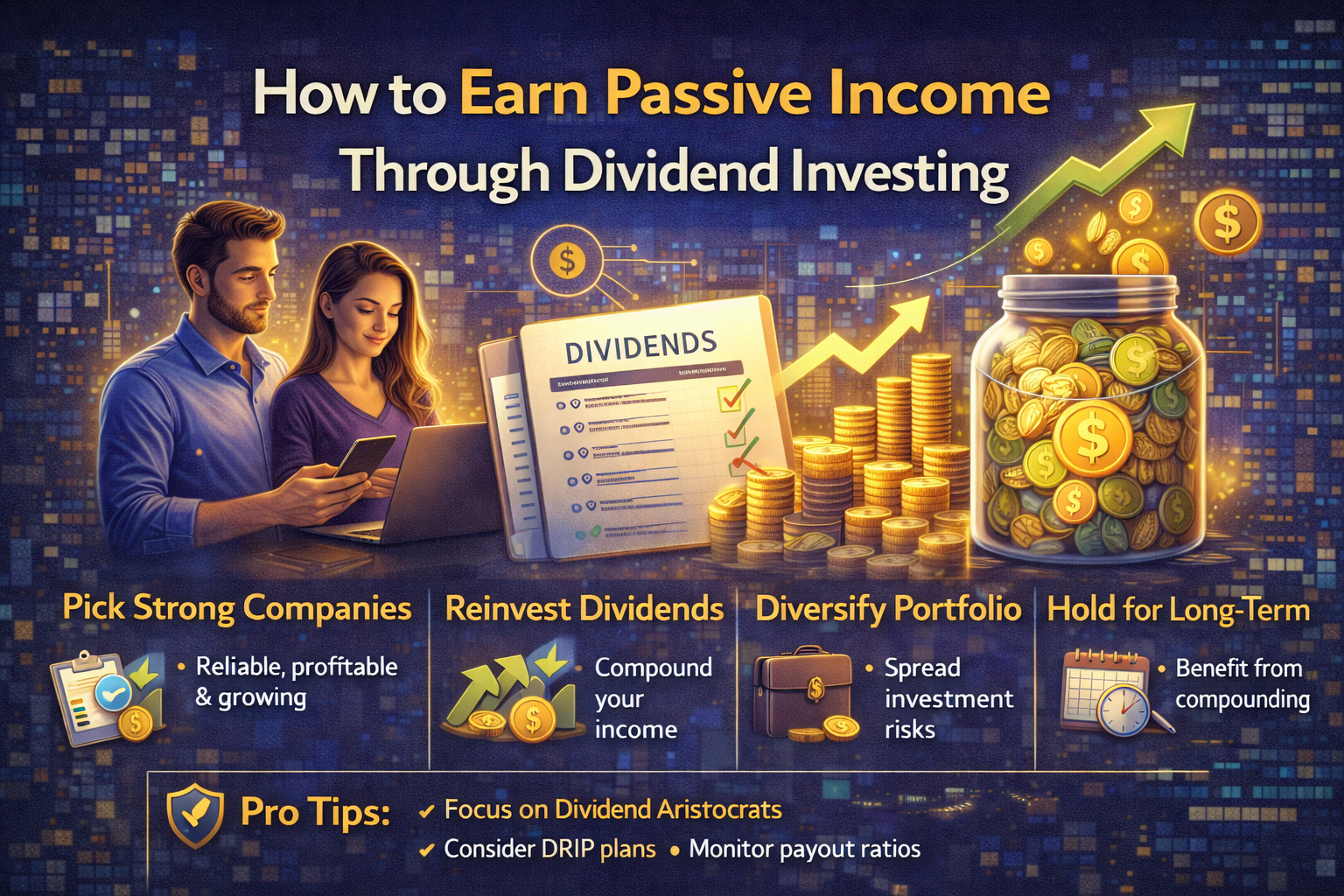
I still remember the day I received my first dividend payment. It was only $12.47, deposited into my brokerage account from a utility company I’d bought shares in months earlier. I hadn’t done anything to earn that money. I hadn’t clocked in, answered emails, or completed a task. I just owned a small piece of a business that shared its profits with me.
That tiny payment changed how I thought about money.
For years, I believed the only way to earn income was to trade my time for dollars. Work an hour, get paid an hour. That equation had a ceiling—there are only so many hours in a day. But dividend investing offered something different: earn passive income through dividend investing meant my money could work while I slept.
Fast forward to today. My dividend portfolio generates enough quarterly income to cover my basic living expenses. I still work—because I enjoy it—but I no longer have to. The passive income stream I built over a decade gives me freedom, security, and options I didn’t have when I started.
In this guide, I’ll show you exactly how to earn passive income through dividend investing. We’ll cover what dividend stocks are, how to choose them, how to build a portfolio, and how to reinvest your dividends to accelerate your wealth. Whether you’re just starting with $50 a month or have a larger sum to invest, dividend investing is accessible to everyone.
Let’s build your passive income machine.
Part 1: What Is Dividend Investing?
Before we get into how to earn passive income through dividend investing, we need to understand what dividend stocks actually are.
The Basics
When you buy a stock, you become a partial owner of a company. Some companies choose to share their profits with shareholders through dividends—regular cash payments, typically every quarter.
Think of it like owning a rental property. The property generates rent (passive income). You don’t work for that rent—you just own the asset. Dividend stocks work the same way. You own a piece of a business, and that business sends you a portion of its profits.
Why Companies Pay Dividends
| Reason | Explanation |
|---|---|
| Mature business | Company has more cash than it can reinvest profitably |
| Shareholder loyalty | Dividends attract long-term investors |
| Discipline | Paying dividends forces management to be efficient |
| Signal of health | Consistent dividends signal stable earnings |
Not all companies pay dividends. Fast-growing companies often reinvest all profits into expansion. Mature, stable companies are more likely to pay dividends.
Types of Dividends
| Type | Description |
|---|---|
| Cash dividends | Direct cash payment to your account |
| Stock dividends | Additional shares instead of cash |
| Special dividends | One-time payment, often from unusual profits |
| Qualified dividends | Taxed at lower capital gains rates |
| Ordinary dividends | Taxed as regular income |
For passive income, focus on cash dividends—qualified if possible for tax efficiency.
Part 2: Why Dividend Investing for Passive Income?
How to earn passive income through dividend investing is one of the most reliable methods available.
The Benefits
| Benefit | Why It Matters |
|---|---|
| Passive | Once invested, dividends arrive automatically |
| Growing income | Many companies increase dividends annually |
| Tax-advantaged | Qualified dividends taxed at lower rates |
| Less volatile | Dividend stocks tend to be more stable |
| Inflation protection | Dividends typically grow faster than inflation |
| No tenants, no toilets | Unlike real estate, no management hassles |
The Power of Compounding
When you reinvest dividends, you buy more shares. More shares generate more dividends. More dividends buy more shares. The cycle accelerates over time.
| Year | Investment | Annual Dividend (4% yield) | Cumulative Income |
|---|---|---|---|
| 1 | $10,000 | $400 | $400 |
| 5 | $14,860 | $594 | $2,500 |
| 10 | $24,700 | $988 | $7,800 |
| 20 | $61,000 | $2,440 | $28,000 |
| 30 | $150,000 | $6,000 | $80,000 |
These numbers assume 7% annual growth and reinvested dividends. The longer you hold, the more powerful the compounding.
Part 3: How Much Passive Income Can You Generate?
Setting realistic expectations is essential for how to earn passive income through dividend investing.
The Quick Math
| Monthly Income Goal | Required Investment (4% yield) | Required Investment (5% yield) |
|---|---|---|
| $100 | $30,000 | $24,000 |
| $500 | $150,000 | $120,000 |
| $1,000 | $300,000 | $240,000 |
| $2,000 | $600,000 | $480,000 |
| $5,000 | $1,500,000 | $1,200,000 |
These numbers can feel intimidating. But remember: you don’t need to reach your goal overnight. Small, consistent investments compound over decades.
Realistic Starting Point
| Monthly Investment | After 10 Years (4% yield) | After 20 Years (4% yield) | After 30 Years (4% yield) |
|---|---|---|---|
| $50 | $7,400 portfolio → $300/year | $24,500 → $980/year | $62,000 → $2,480/year |
| $100 | $14,800 → $590/year | $49,000 → $1,960/year | $124,000 → $4,960/year |
| $200 | $29,600 → $1,180/year | $98,000 → $3,920/year | $248,000 → $9,920/year |
| $500 | $74,000 → $2,960/year | $245,000 → $9,800/year | $620,000 → $24,800/year |
Key takeaway: Consistency beats intensity. A $100 monthly investment for 30 years generates nearly $5,000 in annual passive income.
Part 4: Types of Dividend Stocks
How to earn passive income through dividend investing starts with understanding the different categories of dividend stocks.
Dividend Aristocrats
| Characteristic | Details |
|---|---|
| Definition | S&P 500 companies that have increased dividends for 25+ consecutive years |
| Examples | Procter & Gamble, Coca-Cola, Johnson & Johnson, McDonald’s |
| Yield range | 2-4% |
| Risk level | Low |
| Best for | Core portfolio, safety, reliability |
Dividend Aristocrats are the gold standard. They’ve proven their ability to grow dividends through recessions, wars, and market crashes.
Dividend Kings
| Characteristic | Details |
|---|---|
| Definition | Companies with 50+ consecutive years of dividend increases |
| Examples | Procter & Gamble, Coca-Cola, Johnson & Johnson, Lowe’s |
| Yield range | 2-3.5% |
| Risk level | Very low |
| Best for | Ultra-conservative investors |
Dividend Kings have increased dividends through every major economic event for half a century.
High-Yield Dividend Stocks
| Characteristic | Details |
|---|---|
| Definition | Stocks yielding 5%+ |
| Examples | REITs, utilities, telecoms |
| Yield range | 5-8% |
| Risk level | Moderate to high |
| Best for | Income-focused investors |
Be careful with high yields. Sometimes a high yield signals a struggling company whose stock price has fallen (yield = dividend / price). A falling price drives yield up—but the dividend may be cut.
Dividend Growth Stocks
| Characteristic | Details |
|---|---|
| Definition | Lower current yield, rapid dividend growth |
| Examples | Apple, Microsoft, Visa, Home Depot |
| Yield range | 0.5-2% |
| Risk level | Low to moderate |
| Best for | Long-term growth of income |
These companies pay modest dividends now but grow them quickly. A 1% yield today could be 4% on your original cost in a decade.
Part 5: How to Choose Dividend Stocks
How to earn passive income through dividend investing requires knowing what to look for.
The Dividend Checklist
| Factor | What to Look For | Why It Matters |
|---|---|---|
| Dividend yield | 2-5% | Too low = minimal income; too high = potential risk |
| Payout ratio | Under 60% | Company can afford dividend even in tough times |
| Dividend growth | 5%+ annual increase | Income keeps pace with inflation |
| Years of increases | 10+ | Proven track record |
| Earnings growth | Positive, consistent | Growing profits support growing dividends |
| Debt levels | Manageable | Debt doesn’t threaten dividend |
| Free cash flow | Positive, growing | Cash, not accounting tricks, pays dividends |
Key Metrics Explained
| Metric | Calculation | Healthy Range |
|---|---|---|
| Payout Ratio | Annual Dividend / Annual Earnings | Under 60% for most industries; under 80% for utilities/REITs |
| Dividend Yield | Annual Dividend / Stock Price | 2-5% typically; depends on sector |
| Dividend Growth Rate | (Current Dividend / Prior Dividend) – 1 | 5%+ annually |
Where to Find Information
| Source | What It Provides |
|---|---|
| Morningstar | Dividend history, payout ratios |
| Seeking Alpha | Dividend analysis, peer comparisons |
| Simply Safe Dividends | Dividend safety scores |
| Company investor relations | Annual reports, dividend history |
| SEC filings (10-K) | Official financial data |
Part 6: Building Your Dividend Portfolio
How to earn passive income through dividend investing is about building a diversified portfolio that can weather any market.
Sample Portfolio: Conservative (Income Focus)
| Holding | Allocation | Yield |
|---|---|---|
| Procter & Gamble | 10% | 2.5% |
| Johnson & Johnson | 10% | 3.0% |
| Coca-Cola | 10% | 3.0% |
| McDonald’s | 10% | 2.5% |
| PepsiCo | 10% | 3.0% |
| Realty Income (REIT) | 10% | 5.5% |
| Verizon | 10% | 6.5% |
| Southern Company (utility) | 10% | 4.0% |
| Dividend ETF (SCHD) | 20% | 3.5% |
| Portfolio Yield | 3.7% |
Sample Portfolio: Growth (Future Income Focus)
| Holding | Allocation | Yield |
|---|---|---|
| Apple | 15% | 0.5% |
| Microsoft | 15% | 0.8% |
| Visa | 10% | 0.7% |
| Home Depot | 10% | 2.3% |
| Costco | 10% | 0.6% |
| Nvidia | 10% | 0.1% |
| Broadcom | 10% | 1.5% |
| Dividend ETF (DGRO) | 20% | 2.2% |
| Portfolio Yield | 1.1% |
The growth portfolio yields less today but grows dividends much faster. In 10 years, the income could exceed the conservative portfolio.
Sample Portfolio: ETF Only (Simplest)
| Holding | Allocation | Yield |
|---|---|---|
| SCHD (US Dividend) | 40% | 3.5% |
| VIG (Dividend Growth) | 30% | 1.8% |
| VYM (High Yield) | 30% | 3.0% |
| Portfolio Yield | 2.8% |
This approach requires no stock picking. Just buy, hold, and reinvest dividends.
Part 7: Dividend Reinvestment (DRIP)
The most powerful tool in how to earn passive income through dividend investing is automatic dividend reinvestment.
What Is a DRIP?
A Dividend Reinvestment Plan (DRIP) automatically uses your dividend payments to buy more shares of the same stock. Most brokers offer this for free.
Why DRIP Accelerates Wealth
| Without DRIP | With DRIP |
|---|---|
| Dividends go to cash | Dividends buy more shares |
| Portfolio grows only by price appreciation | Portfolio grows by price + additional shares |
| Compounding limited | Full compounding |
The Math of DRIP
| Year | Without DRIP | With DRIP |
|---|---|---|
| 1 | $10,000 | $10,000 |
| 5 | $14,000 | $15,000 |
| 10 | $19,700 | $24,000 |
| 20 | $38,700 | $62,000 |
| 30 | $76,100 | $162,000 |
Assumes 7% price appreciation, 4% yield, reinvested dividends. The difference after 30 years is over $85,000.
How to Enable DRIP
- Log into your brokerage account
- Find “Dividend Reinvestment” or “DRIP” settings
- Select individual positions or “all holdings”
- Confirm and save
Part 8: Tax Considerations for Dividend Income
How to earn passive income through dividend investing requires understanding the tax implications.
Qualified vs. Ordinary Dividends
| Type | Tax Rate | Requirements |
|---|---|---|
| Qualified | 0%, 15%, or 20% | Held stock for 60+ days; US or qualified foreign company |
| Ordinary | Your marginal tax rate (10-37%) | Doesn’t meet qualified requirements |
Most dividends from US companies are qualified if you’ve held the stock long enough.
Tax-Efficient Account Placement
| Account Type | Best For | Why |
|---|---|---|
| Roth IRA | High-yield dividend stocks | Dividends grow tax-free; withdrawals tax-free |
| Traditional IRA | Dividend stocks | Dividends grow tax-deferred |
| Taxable brokerage | Qualified dividends | Lower tax rates; access before retirement |
| Taxable brokerage | High-yield stocks | Not ideal—ordinary income rates |
The $47,000 Threshold
For single filers in 2025, the 0% long-term capital gains and qualified dividend rate applies up to $47,000 of taxable income. That means many investors pay zero tax on their dividend income.
Part 9: Common Mistakes to Avoid
Even with the best intentions, mistakes happen. Here’s what to avoid in how to earn passive income through dividend investing.
Mistake #1: Chasing High Yield
High yield often means high risk. A 10% yield might look attractive—until the company cuts the dividend and the stock crashes.
Fix: Focus on dividend safety and growth, not just yield.
Mistake #2: Ignoring Dividend Cuts
A dividend cut often signals company trouble. The stock price typically falls dramatically.
Fix: Monitor your holdings. If a company cuts dividends, reconsider the investment.
Mistake #3: Not Diversifying
All your dividend stocks in one sector (like energy or banking) is risky. A sector downturn kills your income.
Fix: Spread across consumer staples, healthcare, utilities, tech, industrials, REITs.
Mistake #4: Selling During Downturns
Dividend stocks can fall 20-40% during bear markets. Panic selling locks in losses.
Fix: If the dividend is safe, hold. You’re being paid to wait.
Mistake #5: Ignoring Total Return
Don’t focus only on yield. A stock with 2% yield and 10% annual growth beats a 6% yield with no growth.
Fix: Consider dividend growth, capital appreciation, and yield together.
Mistake #6: Starting Too Late
The biggest mistake is waiting. Every year you delay costs you years of compounding.
Fix: Start today. Even $50 a month.
Part 10: Sample Journey from $0 to $1,000 Monthly
Let’s map out a realistic journey for how to earn passive income through dividend investing.
The Investor
- Age: 30
- Goal: $1,000 monthly passive income by age 60
- Monthly investment: $300 (increasing 3% annually with raises)
- Average yield: 3.5%
- Average growth: 7% annually
The Timeline
| Age | Monthly Investment | Portfolio Value | Annual Dividend Income |
|---|---|---|---|
| 30 | $300 | $3,600 | $126 |
| 35 | $350 | $28,000 | $980 |
| 40 | $400 | $65,000 | $2,275 |
| 45 | $450 | $120,000 | $4,200 |
| 50 | $500 | $200,000 | $7,000 |
| 55 | $550 | $310,000 | $10,850 |
| 60 | $600 | $460,000 | $16,100 |
Result: At 60, portfolio generates $1,340 monthly—exceeding the $1,000 goal.
What If You Start at 40?
| Age | Monthly Investment | Portfolio Value | Annual Dividend Income |
|---|---|---|---|
| 40 | $500 | $6,000 | $210 |
| 45 | $550 | $45,000 | $1,575 |
| 50 | $600 | $105,000 | $3,675 |
| 55 | $650 | $195,000 | $6,825 |
| 60 | $700 | $315,000 | $11,025 |
Still possible—just need higher monthly savings.
Part 11: Best Dividend ETFs for Beginners
If picking individual stocks feels overwhelming, ETFs are the answer. Here are the best for how to earn passive income through dividend investing.
| ETF | Ticker | Yield | Expense Ratio | Focus |
|---|---|---|---|---|
| Schwab US Dividend Equity | SCHD | 3.5% | 0.06% | Quality US dividend stocks |
| Vanguard Dividend Appreciation | VIG | 1.8% | 0.06% | Companies growing dividends |
| Vanguard High Dividend Yield | VYM | 3.0% | 0.06% | Higher-yielding US stocks |
| iShares Select Dividend | DVY | 3.8% | 0.38% | High-yield US stocks |
| Global X SuperDividend | SDIV | 8%+ | 0.58% | Global high yield (higher risk) |
Simple Starter Portfolio (ETFs only)
| ETF | Allocation | Yield |
|---|---|---|
| SCHD | 50% | 3.5% |
| VIG | 30% | 1.8% |
| VYM | 20% | 3.0% |
| Portfolio Yield | 2.9% |
One decision. One portfolio. Decades of passive income.
Part 12: Monitoring Your Dividend Portfolio
How to earn passive income through dividend investing includes ongoing monitoring.
Quarterly Tasks
- Verify dividends were paid correctly
- Check for dividend changes (increases or cuts)
- Review payout ratios
- Ensure DRIP is working
Annual Tasks
- Rebalance to target allocations
- Research new dividend stock candidates
- Review portfolio performance against benchmarks
- Adjust monthly contributions if possible
- Check tax documents
When to Sell
| Reason | Action |
|---|---|
| Dividend cut | Investigate. Often a sell signal |
| Payout ratio >80% | Dividend may be at risk |
| Business fundamentals deteriorating | Consider selling |
| Found a better opportunity | Rotate capital |
Conclusion
Let’s bring this together.
How to earn passive income through dividend investing is one of the most reliable paths to financial freedom. It doesn’t require real estate management, business building, or constant attention. It requires consistency, patience, and a long-term perspective.
The formula is simple:
- Buy quality dividend stocks or ETFs
- Reinvest dividends automatically
- Add money consistently
- Hold for decades
- Watch your passive income grow
The results aren’t instant. You won’t get rich next month or next year. But over decades, the compounding of reinvested dividends transforms modest savings into substantial passive income.
Start where you are. $50 a month is enough to begin. Use a low-cost brokerage. Buy a dividend ETF like SCHD or VIG. Enable DRIP. Add more when you can. Increase contributions with every raise.
In five years, you’ll have meaningful income. In ten years, you’ll have serious income. In twenty years, you’ll have freedom.
Your future self—the one with quarterly dividend payments covering your bills, the one who can choose work instead of needing it—is waiting.
Start today.







Leave a Reply