
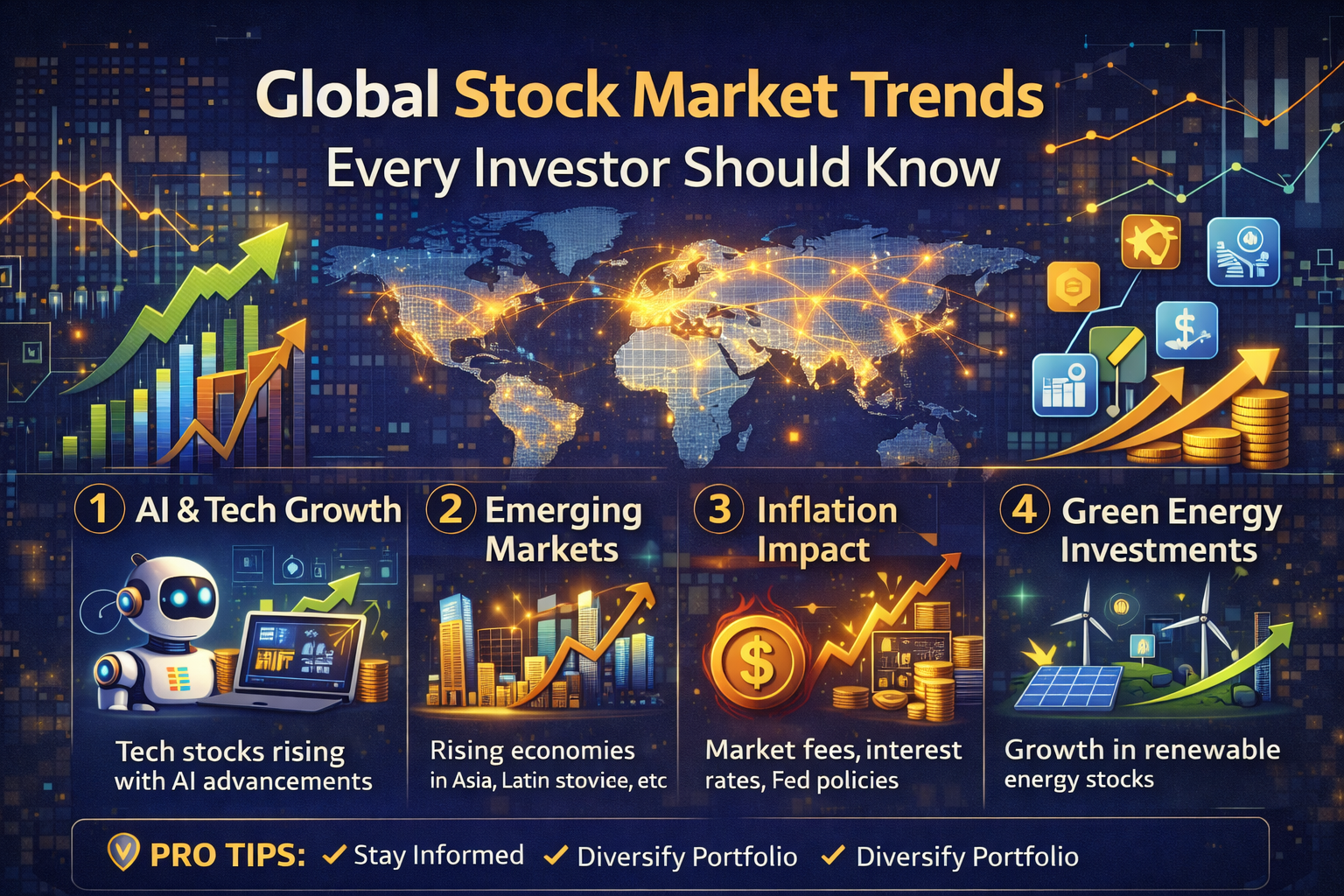
I remember sitting in a coffee shop in 2019, listening to a friend explain why he was putting all his money into U.S. tech stocks. “The rest of the world is a mess,” he said. “Europe is stagnant. China is risky. Japan is aging. Why invest anywhere else?”
At the time, it seemed like a smart take. U.S. stocks had crushed international markets for a decade. Tech was unstoppable. Why complicate things?
Then 2022 happened. U.S. tech stocks got cut in half. Meanwhile, energy stocks soared. Emerging markets held up better than expected. International value stocks outperformed U.S. growth. The “U.S. only” strategy suddenly didn’t look so smart.
That experience taught me something important: understanding global stock market trends isn’t about predicting the future. It’s about being prepared for different scenarios. It’s about knowing what’s happening around the world so you can position your portfolio accordingly.
The global stock market is more interconnected than ever. What happens in China affects your 401(k). Interest rates in Europe impact your bond portfolio. Currency fluctuations in Japan change your international returns.
In this guide, I’ll walk you through the most important global stock market trends shaping and beyond. We’ll look at regional performance, sector rotations, thematic trends, and practical implications for your portfolio. Whether you’re a seasoned investor or just starting, understanding these trends will help you make better decisions.
Let’s explore the global stock market trends that matter right now.
Main Content
Part 1: Why Global Stock Market Trends Matter
Before we dive into specific global stock market trends, let’s understand why you should care.
The Home Country Bias
Most investors suffer from “home country bias”—the tendency to overweight investments in their own country.
| Country | Global Market Cap | Average Domestic Allocation |
|---|---|---|
| United States | 60% | 70-80% |
| United Kingdom | 4% | 50-60% |
| Japan | 5% | 60-70% |
| Australia | 2% | 70-80% |
Investors are overexposed to their home markets. This creates risk when their home market underperforms.
The Case for Global Diversification
| Benefit | Why It Matters |
|---|---|
| Reduced volatility | Different markets perform differently at different times |
| Access to growth | Fastest-growing economies may be outside your home country |
| Currency diversification | Protects against home currency weakness |
| Sector exposure | Some sectors are better represented overseas |
Part 2: Regional Performance Trends
Let’s examine global stock market trends by region.
United States
| Metric | Data |
|---|---|
| Market cap | $50T+ (60% of global) |
| 10-year return | ~12% annually |
| Current P/E | ~22 (above historical average) |
| Key sectors | Tech, healthcare, consumer discretionary |
Trends to watch:
- AI dominance continues (Nvidia, Microsoft, Google)
- Tech regulation increasing
- Interest rates stabilizing
- Small caps catching up after underperformance
Europe (Developed)
| Metric | Data |
|---|---|
| Market cap | $12T+ |
| 10-year return | ~8% annually |
| Current P/E | ~15 (below U.S.) |
| Key sectors | Financials, industrials, consumer goods |
Trends to watch:
- Energy transition investments
- Defense spending increasing (Ukraine war impact)
- Banking sector consolidation
- Luxury goods strength (LVMH, Hermès)
Japan
| Metric | Data |
|---|---|
| Market cap | $6T+ |
| 10-year return | ~9% annually |
| Current P/E | ~16 |
| Key sectors | Tech, autos, financials |
Trends to watch:
- Corporate governance reforms (shareholder value focus)
- Weak yen boosting exporters
- Aging population challenges
- Robotics and automation leadership
China
| Metric | Data |
|---|---|
| Market cap | $8T+ |
| 10-year return | ~5% annually |
| Current P/E | ~12 (cheap by historical standards) |
| Key sectors | Tech, financials, industrials |
Trends to watch:
- Regulatory environment stabilizing
- Property sector challenges
- Domestic consumption growth
- Geopolitical tensions with US
India
| Metric | Data |
|---|---|
| Market cap | $4T+ |
| 10-year return | ~14% annually |
| Current P/E | ~22 |
| Key sectors | Financials, tech, energy |
Trends to watch:
- Fastest-growing major economy
- Demographic dividend (young population)
- Digital infrastructure boom
- Manufacturing growth (China+1 strategy)
Emerging Markets (ex-China, ex-India)
| Region | Key Markets | Trends |
|---|---|---|
| Latin America | Brazil, Mexico | Commodity exporters, interest rates falling |
| Southeast Asia | Indonesia, Vietnam | Manufacturing shift from China |
| Eastern Europe | Poland, Hungary | EU integration, defense spending |
| Middle East | Saudi Arabia, UAE | Oil diversification, sovereign wealth funds |
Part 3: Sector Rotation Trends
Global stock market trends vary significantly by sector.
Technology
| Trend | Impact |
|---|---|
| AI everywhere | Every company is an AI company now |
| Semiconductor cycle | Boom and bust, currently in growth phase |
| Cloud maturation | Growth slowing from pandemic highs |
| Cybersecurity | Secular growth, accelerating |
Global leaders: US dominates (Nvidia, Microsoft, Apple, Google). Taiwan (TSMC), South Korea (Samsung), Netherlands (ASML).
Healthcare
| Trend | Impact |
|---|---|
| GLP-1 drugs | Weight loss drugs transforming healthcare (Novo Nordisk, Eli Lilly) |
| Aging populations | Demand increasing in developed markets |
| AI drug discovery | Accelerating pipelines |
| Gene editing | CRISPR therapies advancing |
Global leaders: US (Eli Lilly, Pfizer, J&J), Europe (Novo Nordisk, Roche, Novartis), Japan (Takeda).
Energy
| Trend | Impact |
|---|---|
| Oil prices | Volatile but range-bound ($70-$90) |
| Renewables | Solar, wind, battery storage growing |
| Nuclear | Small modular reactors gaining interest |
| Energy security | Geopolitics driving investment |
Global leaders: US (Exxon, Chevron), Europe (Shell, BP, TotalEnergies), Saudi Arabia (Saudi Aramco).
Financials
| Trend | Impact |
|---|---|
| Interest rates | Higher for longer = better bank profits |
| Regional bank stress | Consolidation continues |
| Fintech disruption | Slowing, but still impacting |
| Trading volumes | Volatility drives activity |
Global leaders: US (JPMorgan, Berkshire), Europe (HSBC, UBS), China (ICBC, China Construction Bank).
Industrials
| Trend | Impact |
|---|---|
| Manufacturing reshoring | Bringing production closer to home |
| Defense spending | Increasing globally (Ukraine, Taiwan tensions) |
| Infrastructure spending | US, EU, China all investing |
| Aerospace recovery | Post-COVID travel boom |
Global leaders: US (GE, Honeywell, Caterpillar), Europe (Siemens, Airbus), Japan (Hitachi).
Part 4: Thematic Global Stock Market Trends
Beyond regions and sectors, several themes are shaping global stock market trends.
Trend #1: AI Everywhere
AI is no longer a sector—it’s a theme across every industry.
| Industry | AI Impact |
|---|---|
| Tech | Core products (Microsoft Copilot, Google Gemini) |
| Healthcare | Drug discovery, diagnostics |
| Finance | Fraud detection, trading algorithms |
| Manufacturing | Predictive maintenance, quality control |
| Retail | Personalization, inventory optimization |
Investment implications: Own the enablers (Nvidia, TSMC, ASML) and the adopters (Microsoft, Salesforce, Adobe).
Trend #2: Energy Transition
The shift from fossil fuels to renewables is accelerating.
| Energy Source | Trend |
|---|---|
| Solar | Costs continue falling, deployment accelerating |
| Wind | Offshore wind growing |
| Batteries | Storage is the bottleneck; investment increasing |
| Nuclear | SMRs gaining interest |
| Grid infrastructure | Needed for all of the above |
Investment implications: Utilities, grid equipment, battery manufacturers, renewable developers.
Trend #3: Aging Population
Developed markets are getting older. This creates both challenges and opportunities.
| Impact | Winners | Losers |
|---|---|---|
| Healthcare demand | Pharma, devices, senior care | |
| Labor shortages | Robotics, automation | Consumer discretionary |
| Savings drawdown | Asset managers | |
| Housing | Real estate (ex-senior housing) |
Investment implications: Healthcare, robotics, senior housing REITs.
Trend #4: Reshoring and Supply Chain Resilience
COVID and geopolitical tensions exposed supply chain vulnerabilities.
| Industry | Reshoring Impact |
|---|---|
| Semiconductors | US, EU, Japan building fabs |
| Pharmaceuticals | Reducing reliance on China |
| Critical minerals | Diversifying sources |
| Manufacturing | Mexico, Vietnam, India beneficiaries |
Investment implications: Industrial real estate, automation, domestic manufacturers.
Part 5: Currency Trends and Their Impact
Currency fluctuations can significantly impact international returns.
US Dollar Strength
| Scenario | Impact on International Stocks (USD-based investor) |
|---|---|
| Dollar strengthens | International returns reduced |
| Dollar weakens | International returns enhanced |
2026 outlook: Dollar likely range-bound after historic strength.
Hedging Considerations
| Approach | Best For |
|---|---|
| Unhedged | Long-term investors, belief in currency diversification |
| Hedged | Short-term investors, currency risk avoidance |
Practical tip: Most international ETFs offer both hedged and unhedged versions (e.g., EFA vs. HEFA).
Part 6: Interest Rates and Global Markets
Interest rates are the most important driver of global stock market trends.
The Relationship
| Rate Environment | Stock Market Impact |
|---|---|
| Falling rates | Growth stocks outperform, multiples expand |
| Rising rates | Value stocks outperform, multiples compress |
| Stable rates | Quality and dividends outperform |
Global Rate Outlook (2026)
| Region | Rate Direction | Implication |
|---|---|---|
| US (Fed) | Cutting gradually | Support for growth stocks |
| Europe (ECB) | Cutting slowly | Support for cyclicals |
| Japan (BOJ) | Raising from negative | Historic shift, impacts global yields |
| China (PBOC) | Cutting to support economy | Stimulus for Chinese stocks |
| Emerging markets | Mostly cutting | Support for local currencies, stocks |
Part 7: Geopolitical Trends
Geopolitics increasingly drives global stock market trends.
US-China Relations
| Issue | Market Impact |
|---|---|
| Tech restrictions | Winners: US chip equipment, Japanese semiconductor materials |
| Tariffs | Supply chain shifts to Mexico, Vietnam, India |
| Taiwan tensions | Semiconductors (TSMC) at risk |
Europe
| Issue | Market Impact |
|---|---|
| Ukraine war | Defense spending up, energy independence focus |
| Energy transition | Renewables, grid infrastructure |
| EU unity | Fiscal integration, banking union |
Emerging Markets
| Issue | Market Impact |
|---|---|
| Commodity prices | Oil, copper, lithium exporters benefit |
| US dollar | Strong dollar hurts EM debt |
| China slowdown | Reduces demand for EM exports |
Part 8: How to Invest in Global Stock Market Trends
Understanding global stock market trends is one thing. Acting on them is another.
Option 1: Total World ETF (Simplest)
| ETF | Ticker | Expense Ratio | What It Does |
|---|---|---|---|
| VT (Vanguard Total World) | VT | 0.07% | Owns global stocks at market weight (60% US, 40% international) |
Best for: Hands-off investors who want global diversification with no decisions.
Option 2: Core + Satellite
| Component | Allocation | Example |
|---|---|---|
| Core (US) | 40% | VTI (US total market) |
| Core (International developed) | 30% | VEA (developed ex-US) |
| Core (Emerging markets) | 15% | VWO (emerging markets) |
| Satellite (Thematic) | 15% | AI ETF, robotics ETF, etc. |
Best for: Investors who want some control but don’t want to pick individual stocks.
Option 3: Individual Stock Picking
For those who want to invest in specific global stock market trends directly.
| Theme | Stocks to Research |
|---|---|
| AI | Nvidia, Microsoft, TSMC, ASML |
| Energy transition | NextEra Energy, Enphase, Vestas |
| Healthcare/aging | Novo Nordisk, Eli Lilly, Intuitive Surgical |
| Reshoring | Caterpillar, Union Pacific, automated warehouse companies |
| Defense | Lockheed Martin, Rheinmetall, BAE Systems |
Part 9: Common Mistakes to Avoid
| Mistake | Why It’s Dangerous | Fix |
|---|---|---|
| Home country bias | Missing out on non-US growth | Target 20-40% international |
| Chasing past performance | Buying what’s already expensive | Rebalance to targets |
| Ignoring currency risk | Returns reduced by dollar strength | Consider hedged ETFs |
| Overweighting familiar names | US tech is only part of the world | Diversify globally |
| Not rebalancing | Winners become too large a percentage | Rebalance annually |
Part 10: Sample Global Portfolios
Conservative (30% stocks, 70% bonds)
| Allocation | ETF | Percentage |
|---|---|---|
| US stocks | BND | 50% |
| International bonds | BNDX | 20% |
| US stocks | VTI | 15% |
| International stocks | VXUS | 10% |
| Emerging markets | VWO | 5% |
Moderate (60% stocks, 40% bonds)
| Allocation | ETF | Percentage |
|---|---|---|
| US stocks | VTI | 35% |
| International developed | VEA | 15% |
| Emerging markets | VWO | 10% |
| US bonds | BND | 30% |
| International bonds | BNDX | 10% |
Aggressive (80% stocks, 20% bonds)
| Allocation | ETF | Percentage |
|---|---|---|
| US stocks | VTI | 45% |
| International developed | VEA | 20% |
| Emerging markets | VWO | 15% |
| US bonds | BND | 15% |
| International bonds | BNDX | 5% |
Part 11: Resources for Tracking Global Markets
| Resource | What It Provides |
|---|---|
| Bloomberg | Real-time data, news |
| Financial Times | Global perspective, analysis |
| WSJ | US-centric, but good global coverage |
| Morningstar | Fund research, international coverage |
| Trading Economics | Economic data by country |
Conclusion
Let’s bring this together.
Global stock market trends are complex, but the implications for investors are simple: diversify globally, stay disciplined, and don’t try to predict the future.
The U.S. has outperformed for the past decade. That doesn’t mean it will outperform for the next decade. International stocks have lower valuations and could see a turnaround. Emerging markets offer growth potential but come with higher risk.
The most sensible approach for most investors is a globally diversified portfolio with a fixed allocation to U.S., developed international, and emerging markets. Rebalance annually. Ignore the noise. Stay invested.
You don’t need to predict which market will outperform next year. You just need to own all of them.








Leave a Reply