
I still remember the exact moment I realized I needed an emergency fund. It was 3 a.m. on a Tuesday, and I was staring at my car, which had just died in the middle of an empty parking lot. The tow truck was $150. The repair estimate came back at $2,800. I had $400 in my checking account.
I called my dad, humiliated. He loaned me the money, but the conversation that followed was worse than the repair bill. “What would you have done if I couldn’t help?” he asked. I didn’t have an answer.
That experience taught me something I should have known all along: how to build emergency savings isn’t just about money—it’s about freedom. It’s about not having to ask for help when life goes sideways. It’s about sleeping through the night knowing that a broken transmission, a medical bill, or a layoff won’t derail your life.
Over the next year, I made building an emergency fund my top priority. I cut expenses, picked up extra work, and saved every dollar I could. When I finally hit my goal of $10,000, I felt something I hadn’t felt in years: security.
In this guide, I’ll walk you through everything I learned about how to build emergency savings. We’ll cover how much you need, where to keep it, how to save when money is tight, and how to use it when emergencies happen. Whether you’re starting from zero or rebuilding after a setback, this guide will give you a clear path forward.
Let’s get you the peace of mind you deserve.
Main Content
Part 1: What Is an Emergency Fund and Why Do You Need One?
Before we get into how to build emergency savings, let’s be clear about what we’re building.
What an Emergency Fund Is
An emergency fund is money set aside specifically for unexpected expenses. It’s not for:
- Planned vacations
- Holiday gifts
- A new TV (even if it’s on sale)
- Upgrading your car
- Investing
It’s for:
- Car repairs
- Medical bills
- Job loss
- Home repairs
- Unexpected travel (funerals, family emergencies)
- Dental emergencies
- Pet emergencies
Why You Need One
| Reason | Why It Matters |
|---|---|
| Avoids debt | Without savings, emergencies go on credit cards (15-25% interest) |
| Reduces stress | Knowing you have a cushion changes everything |
| Protects investments | You won’t have to sell investments during market downturns |
| Provides options | You can leave a bad job, take time to find the right next role |
| Builds confidence | Financial security changes how you move through the world |
The Statistics
| Statistic | What It Means |
|---|---|
| 56% of Americans can’t cover a $1,000 emergency with savings | Most people are one unexpected expense from financial crisis |
| The average car repair costs $500-$1,000 | Even a minor emergency can derail finances |
| Job loss lasts an average of 5-6 months | You need enough to cover extended unemployment |
Part 2: How Much Do You Really Need?
The most common question about how to build emergency savings is “how much?” The answer depends on your situation.
The Standard Guidelines
| Situation | Recommended Emergency Fund |
|---|---|
| Single, stable job, low expenses | 3 months of expenses |
| Single, variable income | 6 months of expenses |
| Single income household with dependents | 6-9 months of expenses |
| Dual income, stable jobs | 3-6 months of expenses |
| Self-employed or commission-based | 6-12 months of expenses |
| Near retirement | 12-24 months of expenses |
How to Calculate Your Target
Step 1: Calculate your monthly essential expenses
| Category | Monthly Amount |
|---|---|
| Housing (rent/mortgage) | $_____ |
| Utilities | $_____ |
| Food (groceries, not restaurants) | $_____ |
| Transportation | $_____ |
| Insurance (health, auto, etc.) | $_____ |
| Minimum debt payments | $_____ |
| Childcare | $_____ |
| Phone/internet | $_____ |
| Total | $_____ |
Step 2: Multiply by your target months
If your monthly essentials are $3,000 and you want a 6-month fund:
$3,000 × 6 = $18,000
The Starter Fund
If a full 3-6 month fund feels overwhelming, start with a starter fund:
| Stage | Amount | Goal |
|---|---|---|
| Mini fund | $1,000 | Covers most common emergencies |
| Starter fund | 1 month of expenses | Provides real breathing room |
| Full fund | 3-6 months of expenses | True security |
Practical tip: Start with $1,000. It’s achievable, and having it changes your relationship with money.
Part 3: Where to Keep Your Emergency Fund
How to build emergency savings isn’t just about the amount—it’s about where you keep it.
The Right Place
| Location | Pros | Cons | Best For |
|---|---|---|---|
| High-yield savings account | Liquid, earns interest (4-5%), FDIC insured | Not instant access (1-2 days transfer) | Primary emergency fund |
| Money market account | Similar to HYSA, sometimes higher rates | May have minimums | Primary emergency fund |
| Checking account | Instant access | Earns little to no interest | Portion for immediate needs |
| CDs (laddered) | Higher rates | Penalty for early withdrawal | Part of larger fund |
| Investment account | Potential growth | Can lose value when you need it | NOT for emergency fund |
The Wrong Place
| Location | Why It’s Wrong |
|---|---|
| Under the mattress | No interest, risk of loss |
| Stocks/crypto | Can drop when you need the money most |
| Retirement accounts | Penalties for early withdrawal |
| Checking account without separation | Too easy to spend |
The Ladder Strategy
For larger emergency funds, consider a CD ladder:
| Time Horizon | Where to Keep |
|---|---|
| Immediate needs | High-yield savings or checking |
| 1-3 months | 3-month CD |
| 3-6 months | 6-month CD |
| 6-12 months | 12-month CD |
This way, part of your fund is always accessible while the rest earns higher interest.
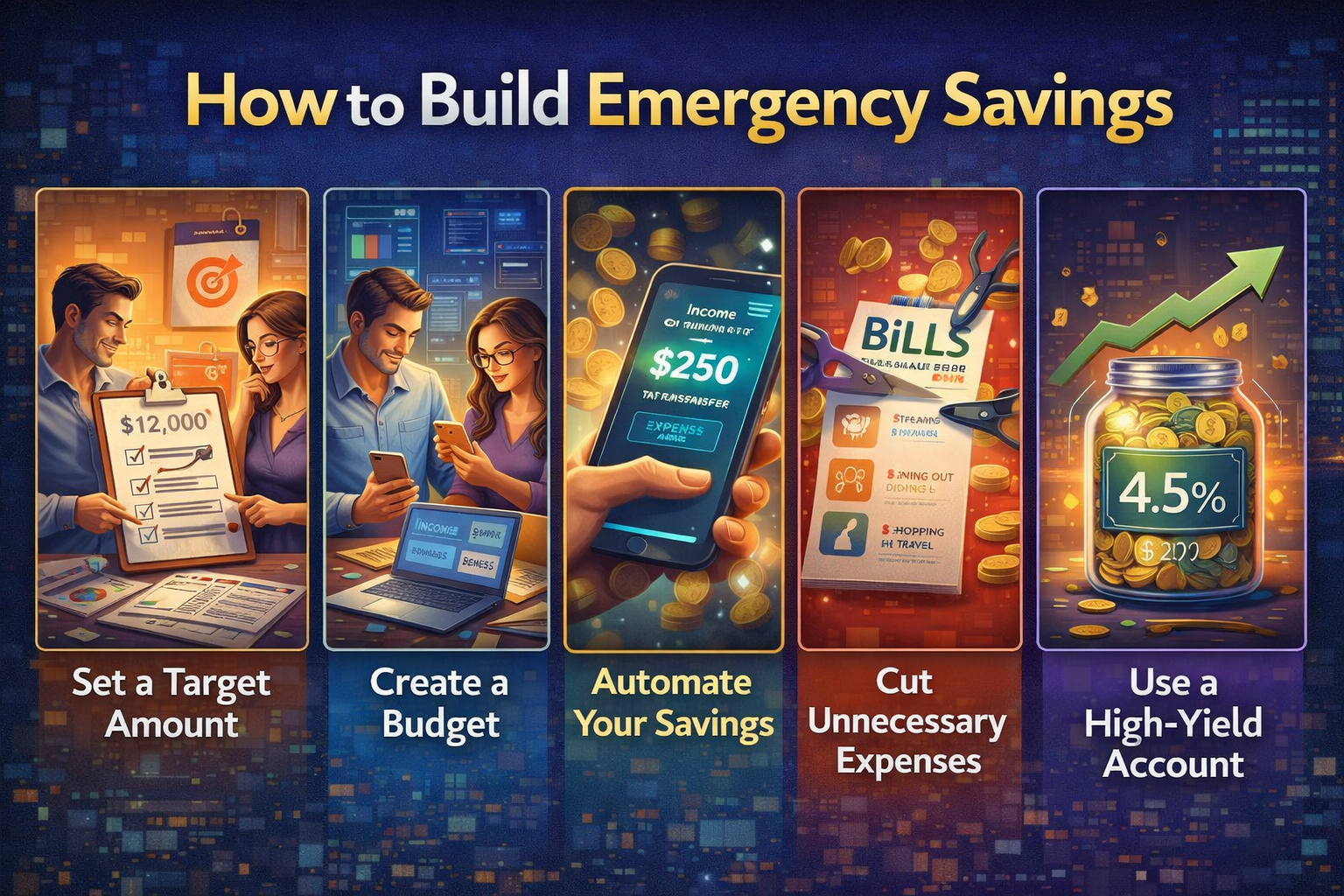
Part 4: How to Build Your Emergency Fund
Now we get to the core of how to build emergency savings: the actual saving.
The Automation Method
This is the most effective way to save. You don’t rely on willpower—you rely on systems.
| Step | Action |
|---|---|
| 1 | Determine how much you can save each month |
| 2 | Set up an automatic transfer from checking to savings on payday |
| 3 | Treat it like a bill—non-negotiable |
| 4 | Increase the amount with every raise |
| 5 | Celebrate milestones along the way |
Example: If you can save $200 per paycheck (bi-weekly), you’ll have $5,200 in a year.
The Windfall Method
Use unexpected money to accelerate your savings:
| Source | How to Use |
|---|---|
| Tax refund | Direct to emergency fund |
| Work bonus | 50-100% to emergency fund |
| Gifts | Consider adding to your fund |
| Side hustle income | Dedicated to emergency fund |
| Sold items | Direct to savings |
The Challenge Method
Make saving a game:
| Challenge | How It Works |
|---|---|
| 52-week challenge | Save $1 week 1, $2 week 2… $52 week 52 = $1,378 |
| No-spend month | Only essentials for 30 days; all extra to savings |
| $5 challenge | Save every $5 bill you get |
| Spare change | Use apps that round up purchases to savings |
The Expense-Cut Method
Free up money by cutting expenses:
| Category | Action | Potential Savings |
|---|---|---|
| Subscriptions | Cancel unused streaming, apps, gym | $50-200/month |
| Food | Cook at home, meal prep | $100-400/month |
| Transportation | Bike, public transit, carpool | $50-200/month |
| Insurance | Shop rates annually | $50-200/month |
| Phone | Switch to cheaper plan | $30-100/month |
| Banking | Avoid fees, use no-fee accounts | $10-50/month |
Real example: A friend cut $300 in monthly expenses (canceled unused subscriptions, switched phone plans, cooked at home) and directed that $300 to her emergency fund. In one year, she saved $3,600.
Part 5: Realistic Savings Timelines
How to build emergency savings takes time. Here are realistic timelines.
Scenario 1: Tight Budget (Saving $100/month)
| Timeframe | Amount Saved |
|---|---|
| 3 months | $300 |
| 6 months | $600 |
| 12 months | $1,200 |
| 24 months | $2,400 |
| 36 months | $3,600 |
Strategy: Start with a mini fund ($1,000). Takes about 10 months. Then continue to full goal.
Scenario 2: Moderate Budget (Saving $300/month)
| Timeframe | Amount Saved |
|---|---|
| 3 months | $900 |
| 6 months | $1,800 |
| 12 months | $3,600 |
| 24 months | $7,200 |
Strategy: Reach $1,000 in 3-4 months. Full 3-month fund in 6-12 months.
Scenario 3: Aggressive Saving (Saving $500/month)
| Timeframe | Amount Saved |
|---|---|
| 3 months | $1,500 |
| 6 months | $3,000 |
| 12 months | $6,000 |
| 18 months | $9,000 |
Strategy: $1,000 in 2 months. Full fund in 1-2 years.
Scenario 4: Windfall Accelerated
If you receive a $5,000 tax refund or bonus, you can jump-start your fund instantly.
| Starting Point | After Windfall |
|---|---|
| $0 | $5,000 (starter fund complete) |
| $1,000 | $6,000 (close to full fund) |
| $3,000 | $8,000 (full fund) |
Part 6: How to Save When Money Is Tight
This is the hardest part of how to build emergency savings. When you’re barely making ends meet, saving feels impossible.
The Mindset Shift
- Every dollar counts. $10 saved is $10 you won’t have to borrow.
- Small wins add up. Consistency beats intensity.
- This is temporary. The goal is to build security, then invest, then build wealth.
Creative Ways to Save
| Method | How It Works |
|---|---|
| Side hustle | Uber, DoorDash, tutoring, pet sitting—even $50/week adds up |
| Sell unused items | Clothes, electronics, furniture on Facebook Marketplace |
| Reduce housing cost | Roommate, negotiate rent, move to cheaper area |
| Food banks | If you’re struggling, use them. That’s what they’re for. |
| Utility assistance | Many areas have programs for low-income households |
| Transportation | Bike, bus, carpool to reduce costs |
The Snowball Approach
- Month 1-3: Focus on cutting expenses
- Month 4-6: Add a side hustle
- Month 7-9: Redirect all savings to emergency fund
- Month 10-12: Reach $1,000 starter fund
Part 7: Common Obstacles and How to Overcome Them
Building an emergency fund isn’t easy. Here are common challenges and solutions.
Obstacle #1: “I Can’t Afford to Save”
Solution: Start smaller than you think. Even $10 per paycheck matters. It builds the habit. Increase when you can.
Obstacle #2: “I Keep Dipping Into It”
Solution: Define what counts as an emergency before you need it. Write it down. Keep the fund in a separate bank from your checking.
Obstacle #3: “Life Keeps Happening”
Solution: Emergencies happen. That’s why you’re saving. When you use the fund, rebuild it before resuming other goals.
Obstacle #4: “It’s Taking Too Long”
Solution: Track progress. Celebrate milestones ($100, $500, $1,000). Remember: slow progress is still progress.
Obstacle #5: “I Have Debt—Should I Save or Pay Debt?”
| Interest Rate | Priority |
|---|---|
| Credit cards (15-30%) | Pay minimums while building starter fund, then attack debt |
| Student loans (4-7%) | Build full emergency fund while paying minimums |
| Mortgage (3-6%) | Build full emergency fund first |
Part 8: When to Use Your Emergency Fund
This is crucial. If you use your emergency fund for non-emergencies, you’re back to square one.
Emergency (Use Fund)
| Situation | Why It’s an Emergency |
|---|---|
| Car breaks down | Without transportation, you can’t work |
| Medical bill | Health comes first |
| Job loss | Need to cover expenses while searching |
| Home repair (leak, heat) | Essential to safety and habitability |
| Unexpected travel (death in family) | Family emergencies require immediate response |
Not an Emergency (Don’t Use Fund)
| Situation | Alternative |
|---|---|
| Vacation | Save separately |
| New phone/TV | Save separately |
| Holiday gifts | Budget for them |
| Wedding | Save separately |
| “Great deal” on something | If it’s a deal today, it will be again |
Part 9: After You Build It—What’s Next?
Once you’ve mastered how to build emergency savings, you have options.
Step 1: Celebrate
You’ve accomplished something most people haven’t. Acknowledge it.
Step 2: Reassess
Is your fund still the right size? Has your life changed? More dependents? New job? Adjust if needed.
Step 3: Redirect Savings
| Goal | What to Do |
|---|---|
| Invest | Start or increase retirement contributions |
| Pay down debt | Attack high-interest debt aggressively |
| Save for goals | House, car, travel, education |
| Build wealth | Brokerage account, real estate |
Step 4: Maintain
| Frequency | Action |
|---|---|
| Quarterly | Check that your fund is intact |
| Annually | Recalculate target (expenses change) |
| After use | Rebuild before resuming other goals |
Part 10: Real-World Examples
Let’s see how to build emergency savings in action.
Case Study 1: The Recent Graduate
Name: Alex
Situation: New grad, $45,000 salary, $30,000 student loans, $500 rent with roommates
Strategy:
- Automated $200/month to high-yield savings
- Used tax refund ($1,200) to boost fund
- Side hustle tutoring ($100/month)
- Result: $1,000 starter fund in 4 months; $5,000 in 18 months
Case Study 2: The Single Parent
Name: Maria
Situation: Single mom, $60,000 salary, one child, mortgage
Strategy:
- Cut subscriptions, switched phone plan ($100/month)
- Meal planning reduced food costs ($150/month)
- Side hustle weekends ($200/month)
- Result: $1,000 in 3 months; $6,000 (3 months expenses) in 2 years
Case Study 3: The Career Changer
Name: James
Situation: Unemployed, living on credit, $0 savings
Strategy:
- Took temporary job ($3,000/month)
- Lived on $2,000, saved $1,000/month
- Sold unused items ($500)
- Result: $1,000 in 1 month; $10,000 in 9 months
Conclusion
Let’s bring this together.
How to build emergency savings isn’t complicated, but it does require discipline. It’s about making the choice, month after month, to put money aside for the future you. It’s about saying no to things today so you can say yes to security tomorrow.
The path looks different for everyone. Some will save aggressively, hitting their goal in months. Others will build slowly, over years. Both paths lead to the same destination: peace of mind.
Start where you are. If you have nothing, start with $10. If you have debt, build a starter fund while paying minimums. If you have a full fund, maintain it and redirect your savings to investing and wealth building.
The most important step is the first one. Open that savings account. Set up that automatic transfer. Make the choice today that your future self will thank you for.
You can do this. One dollar at a time, one month at a time, you’re building something that no one can take from you: security.
Start today.










Leave a Reply