
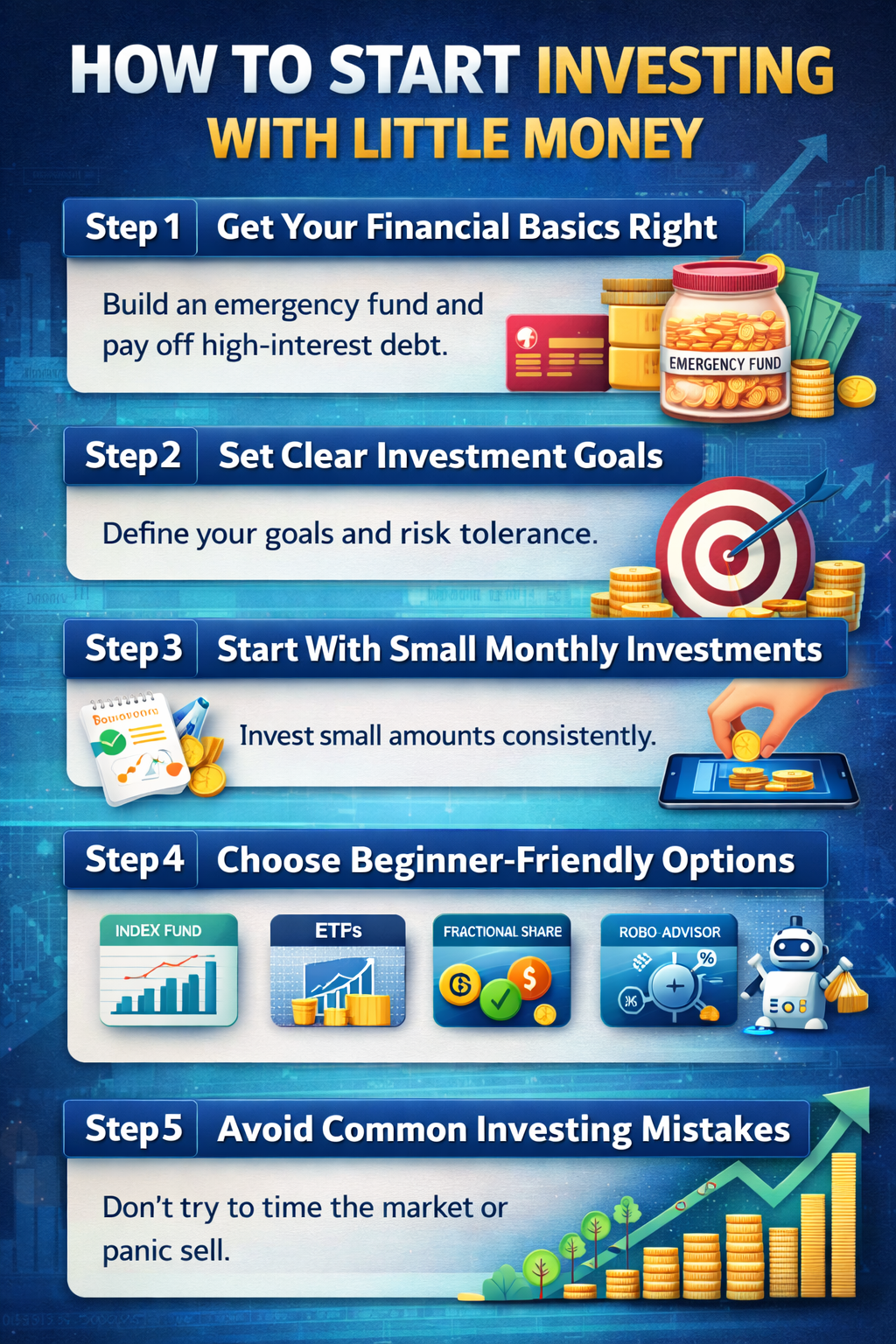
I still remember the exact moment I convinced myself I couldn’t invest. I was twenty-three, making an entry-level salary, and every personal finance article I read seemed to assume I had thousands of dollars just sitting around. The message was clear: investing is for people with money. People like me need to wait.
So I waited. For years.
And here’s what I learned the hard way: waiting was the only real mistake I made.
The truth is, you don’t need a lot of money to start investing. You don’t need to wait until you’ve “made it” or until you have a five-figure sum gathering dust in your checking account. In fact, starting with a small amount might actually be better than starting with a large one. Small money means small mistakes, small lessons, and small stakes while you’re learning .
The most important thing isn’t how much you invest. It’s that you start at all .
Today, thanks to zero-fee brokerages, fractional shares, and micro-investing apps, you can begin your investment journey with as little as one dollar . The barriers that kept previous generations out of the market have crumbled. The only thing standing between you and your first investment is deciding to begin.
In this guide, I’ll walk you through exactly how to start investing with little money—the practical steps, the best options, the common pitfalls, and the mindset shifts that turn small contributions into lasting wealth. No jargon, no judgment, just a friendly roadmap to your first investment.
Let’s get started.
Part 1: Why Starting Small Is Actually Brilliant
Before we dive into the how, let’s talk about the why. Because if you’re like most people, you probably think investing small amounts isn’t worth the trouble. The fees will eat you alive. The returns will be tiny. What’s the point?
I get it. But this thinking misses something crucial.
Investing is a habit, not a one-time event.
Think about exercise. Nobody walks into the gym on day one and deadlifts three hundred pounds. They start with small weights, learn the movements, build the routine. The goal isn’t the first workout. The goal is becoming the kind of person who shows up consistently .
Investing works exactly the same way.
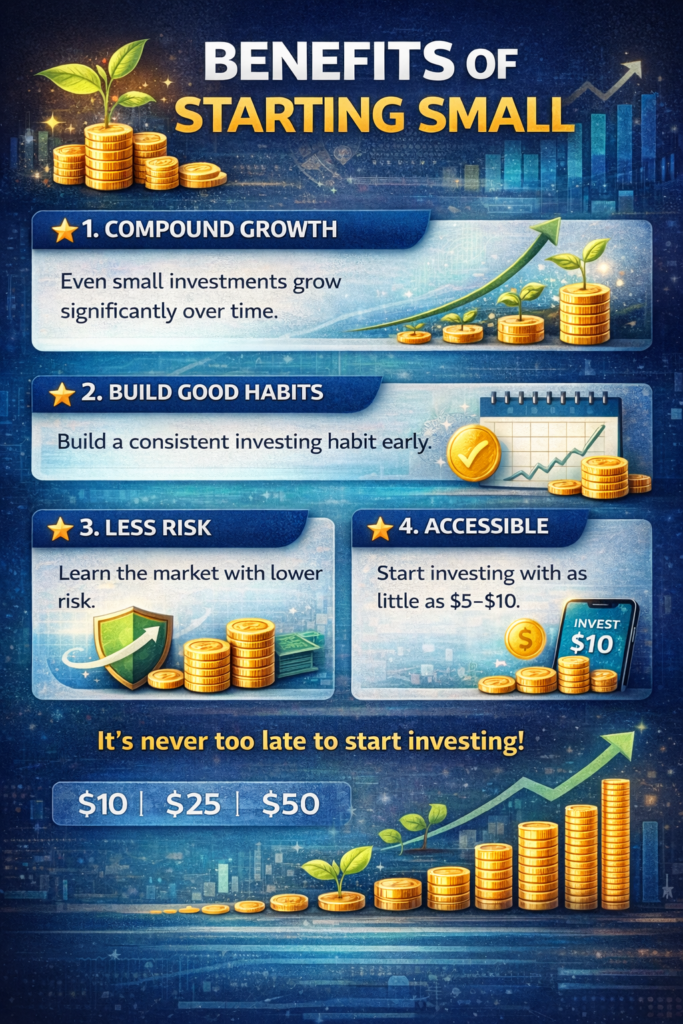
When you start with a small amount—even just twenty or fifty dollars a month—you’re not just buying assets. You’re building the muscle of regular investing. You’re learning how markets move while the stakes are low. You’re discovering your own risk tolerance without losing sleep .
Small amounts compound into big ones.
Here’s a number that stopped me in my tracks: if you invest just $100 at a 10% average annual return, in thirty years it becomes nearly $1,750—without adding another penny . Add a modest $50 monthly contribution to that same scenario, and after thirty years you’re looking at over $115,000 .
That’s not magic. That’s compound interest. And the only way to access it is to start early.
Mistakes are cheaper when you’re small.
Every investor makes mistakes. You’ll buy something that drops. You’ll sell something that soars. You’ll second-guess yourself. That’s not failure—that’s tuition . And when you’re investing small amounts, that tuition is affordable. You learn the lessons without derailing your financial future.
So no, investing with little money isn’t pointless. It’s the smartest way to begin.
Part 2: Before You Invest—The Prerequisites
I know you’re eager to jump in. But let’s pause for just a moment and make sure the foundation is solid. Investing is powerful, but it works best when the rest of your financial house is in order.
Step 1: Deal with High-Interest Debt
If you’re carrying credit card debt at 18%, 22%, or higher, that’s your first priority. Paying down that debt is the best guaranteed return you’ll ever find—because every dollar you send to the credit card company is a dollar you’re not paying interest on .
The general rule: if your debt interest rate is above 7-8%, focus on eliminating it before investing significant amounts .
Step 2: Build a Small Emergency Fund
Life happens. Cars break. Laptops die. Root canals appear. Before you tie up money in investments, make sure you have a cushion .
You don’t need six months of expenses right now. Start with one month. Even $1,000 set aside in a high-yield savings account means that when something unexpected happens, you won’t have to sell investments at a bad time or rack up more debt .
Step 3: Look for Free Money
Before you put a dollar into the stock market, check if your employer offers a 401(k) match. If they do, contributing at least enough to get the full match is the single best investment you can make .
Think about it: if your employer matches 50% of your contributions up to a certain amount, that’s an instant 50% return on your money. No stock in history guarantees that. Don’t leave it on the table .
Part 3: Your Investment Options with Little Money
Once the prerequisites are handled, it’s time to choose where to put your money. The good news: you have more options than ever.
Option 1: Fractional Shares of Stocks
Remember when buying a share of a company meant paying the full share price? If Amazon was $3,000 a share, you needed $3,000 to own it. Those days are over.
Fractional shares let you buy a piece of a stock for as little as one dollar . Want to own a slice of Apple, Google, or Nvidia without hundreds of dollars? Fractional shares make it possible. You get the exact same proportional return as someone who owns a full share—just scaled to your investment amount .
Best for: People who want to own specific companies they believe in.
Option 2: Index ETFs
If you’d rather not pick individual companies—and honestly, most people shouldn’t—index ETFs are your friend .
An ETF (exchange-traded fund) is like a basket of investments. When you buy one share of an ETF, you’re buying tiny pieces of dozens, hundreds, or even thousands of different companies . That’s instant diversification with a single purchase.
Take the Vanguard Total Stock Market ETF (VTI). With one investment, you own a slice of essentially the entire U.S. stock market . You can buy it for as little as one dollar through brokers that offer fractional ETF shares .
Why experts love them: Low costs, instant diversification, and you don’t have to be a stock-picking genius .
Option 3: Micro-Investing Apps
Apps like Acorns, Raiz, and Stash have made investing almost passive. They connect to your debit or credit card, round up your purchases to the nearest dollar, and invest the spare change .
Buy a coffee for $4.50? Your card is charged $5, and fifty cents goes into your investment account. It doesn’t feel like saving, but over time, it adds up .
Some platforms let you start with as little as $5 and offer pre-built portfolios based on your risk tolerance .
Caveat: Watch the fees. Some micro-investing apps charge monthly fees that can eat into very small balances . If you’re investing $20 a month and paying $3 in fees, that’s 15% gone before you start.
Option 4: Retirement Accounts (IRAs)
If your goal is long-term wealth, an Individual Retirement Account (IRA) gives you tax advantages that regular brokerage accounts don’t .
With a traditional IRA, your contributions may be tax-deductible now, and your money grows tax-deferred until retirement. With a Roth IRA, you contribute after-tax money, but withdrawals in retirement are completely tax-free .
Many brokers let you open an IRA with no minimum balance. Your first $100 can be the start of your retirement nest egg .
Option 5: Money Market Funds
If you’re not quite ready for stock market volatility, money market funds offer a middle ground. They invest in short-term, high-quality debt like U.S. Treasuries, providing stability and modest returns .
Think of them as a stepping stone—a place to park cash while you learn and build confidence .
Part 4: Step-by-Step—How to Make Your First Investment
Enough theory. Let’s walk through the actual steps to get your money into the market.
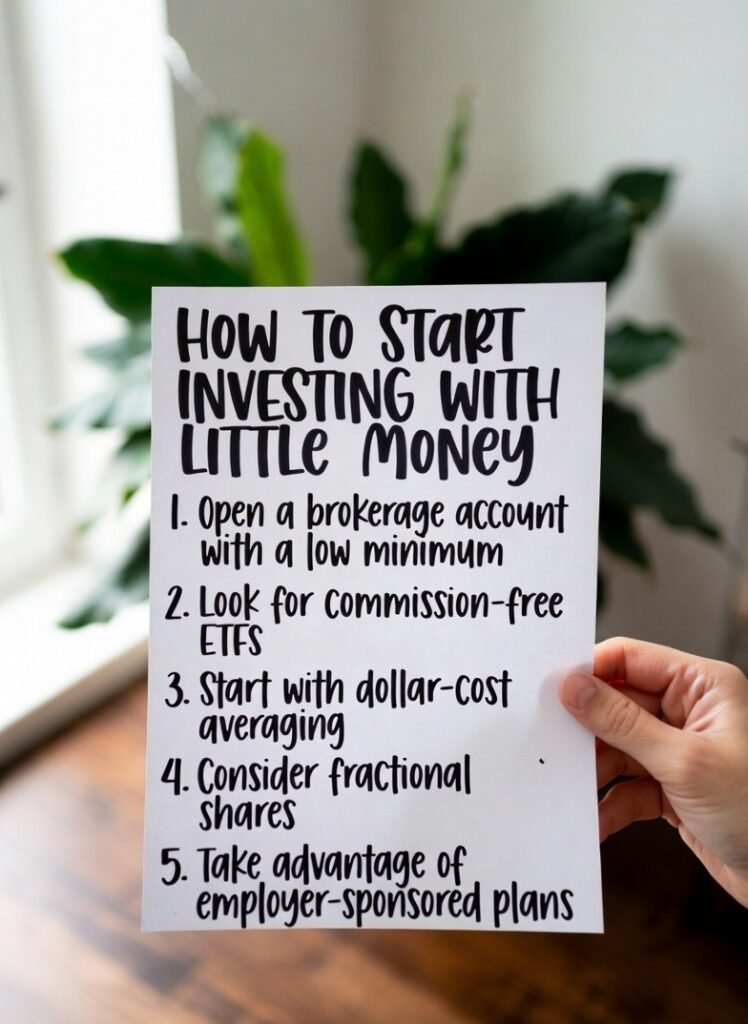
Step 1: Choose a Brokerage
You need a place to buy investments. Look for a broker that offers:
- No minimum balance fees
- No commissions or low fees
- Fractional share investing
- A user-friendly app or website
Popular options include Fidelity, Charles Schwab, Vanguard, and newer apps like Robinhood or Webull. Compare a few and pick one that feels right.
Step 2: Fund Your Account
Link your bank account and transfer your first amount. Maybe it’s $50. Maybe it’s $20. Maybe it’s $5. The number doesn’t matter . What matters is that you’re in the game.
Step 3: Pick Your First Investment
Start simple. A broad market ETF like VTI or a global ETF like VT gives you instant diversification with one click . You can always add individual stocks later.
Step 4: Place Your Order
Decide how many shares or dollars’ worth you want to buy. With fractional shares, you can just type “$50 of VTI” and own exactly that amount.
Step 5: Set Up Automatic Contributions
This is the secret sauce. Set up an automatic transfer from your bank to your brokerage every month—$25, $50, whatever fits . Then set up automatic investments into your chosen fund.
Now you’re investing on autopilot. No willpower required. Just consistent contributions month after month .
Step 6: Reinvest Dividends
If your investments pay dividends, opt for automatic reinvestment . That way, your dividends buy more shares, which generate more dividends, which buy more shares—compounding in action.
Part 5: The Micro-Investing Trade-Offs
Micro-investing has opened doors for millions of people, but it’s not without drawbacks. Let’s be honest about both sides so you can decide what’s right for you.
The Pros
The Cons
The key is knowing your timeline and goals. For short-term learning and habit-building, micro-investing apps are fantastic. For long-term wealth, you may eventually want to move to a traditional brokerage with lower fees and more control .
Part 6: Common Questions—Answered
Q: How much do I really need to start?
A: As little as one dollar. Seriously . Some brokerages and apps have literally zero minimums.
Q: Should I pay off debt or invest first?
A: High-interest debt (credit cards, payday loans) first. Low-interest debt (mortgage, student loans at reasonable rates) can wait while you invest .
Q: What if the market crashes right after I invest?
A: Then you’ll buy more at lower prices next month. Market downturns are painful but normal. If you’re investing consistently over decades, short-term drops become buying opportunities .
Q: Isn’t $20 a month too small to matter?
A: $20 a month invested for 30 years at 8% grows to about $30,000. It’s not nothing. And as your income grows, you’ll increase that amount. The habit matters more than the number .
Q: Should I pick individual stocks or funds?
A: For most beginners, broad market funds are the smarter choice . They’re diversified, low-cost, and don’t require you to predict which companies will win. Once you have a foundation, you can experiment with individual stocks using “fun money.”
Part 7: The Mindset That Makes It Work
The technical side of investing is simple. The psychological side is where most people stumble. Here are the mental habits that separate successful investors from the rest.
1. Focus on what you can control.
You can’t control the market. You can’t control the economy. You can’t control what the Fed does or what some CEO tweets. What you can control is your savings rate, your investment choices, and your decision to stay invested .
2. Think in decades, not days.
The stock market is the only place where people run for the exits when things go on sale. If you’re investing for the long term, market drops are just temporary markdowns on the companies you’re buying .
3. Automate and ignore.
The best investors are often the most bored. They set up automatic investments, ignore the financial news, and let compounding do its work . You don’t need to check your portfolio daily. Monthly is plenty.
4. Be patient with yourself.
You’ll make mistakes. You’ll buy things that go down. You’ll sell things that go up. That’s normal. Learn the lesson and keep going . The goal isn’t perfection—it’s persistence.
Conclusion
Let’s circle back to where we started.
You don’t need a lot of money to start investing. You don’t need to wait until you’re “ready” or until you have thousands of dollars saved. The only thing you need is the willingness to begin.
Start with whatever you have—twenty dollars, fifty dollars, even five dollars. Open that account. Make that first purchase. Set up that automatic transfer. The amount matters far less than the act itself .
Because here’s what happens when you start small: you build the habit. You learn the ropes. You experience market ups and downs while the stakes are low. And over time, through consistent contributions and the magic of compounding, those small amounts grow into something substantial .
The investor you’ll be in ten years starts with the choice you make today.
So here’s your assignment: before this week ends, take one step. Open a brokerage account. Download a micro-investing app. Set up a $10 automatic transfer. Whatever it is, do it now. Not when you have more money. Not when you understand everything. Now.
Your future self—the one with the growing portfolio and the compound interest tailwind—is counting on you.



Leave a Reply