
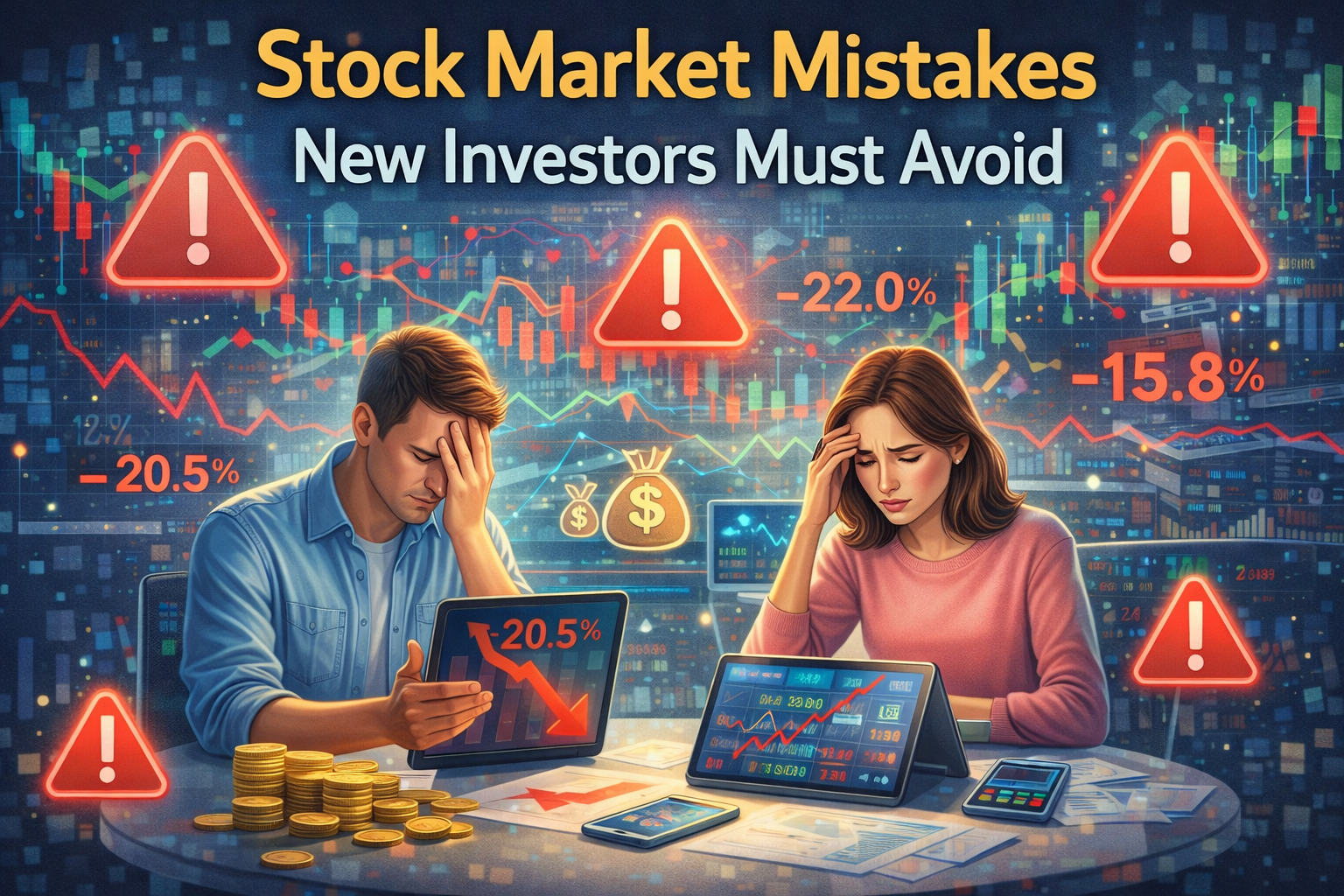
I still remember the exact moment I made my first stock market mistake. I was twenty-four, newly graduated, and convinced I’d discovered a sure thing. A friend had told me about a biotech company that was “about to announce a breakthrough.” The stock had already doubled in the past month, but surely it would double again. I threw in $5,000—most of my savings—without reading a single financial statement, without understanding the science, without even knowing what the company actually did.
The breakthrough never came. Within six months, the stock was down 80%. I sold in a panic, locking in my losses, and swore I’d never invest again.
That experience taught me something valuable: stock market mistakes new investors must avoid aren’t just about picking the wrong stocks. They’re about the behaviors, the mindsets, the emotional traps that lead smart people to do dumb things with their money.
Over the past decade, I’ve made most of the mistakes you’ll read about here. I’ve also watched friends, family, and clients make them. And I’ve learned that the difference between successful investors and unsuccessful ones isn’t intelligence or luck. It’s avoiding the predictable errors that derail so many people.
In this guide, I’ll walk you through the most common stock market mistakes new investors must avoid. Some you’ll recognize immediately. Others might surprise you. All of them can cost you dearly—or save you from costly lessons if you heed them now.
Let’s dive in.
Part 1: The “Get Rich Quick” Mentality
This is the mother of all mistakes. The belief that you can turn a few thousand dollars into a fortune overnight is the entry point for nearly every other investing error.
The Reality Check
The stock market is not a casino. It’s a system where patient, disciplined investors earn returns that compound over decades. The average annual return of the S&P 500 over the past century is about 10% . That means a $10,000 investment grows to about $25,000 in ten years, $67,000 in twenty years, and $174,000 in thirty years.
That’s not “get rich quick.” It’s “get wealthy slowly.”
The get-rich-quick mentality leads to:
- Chasing hot tips from friends, social media, or “gurus”
- Buying stocks that have already skyrocketed (FOMO)
- Trading frequently, generating commissions and taxes
- Holding speculative investments long after they should have been sold
- Panic-selling when the hype fades
How to avoid this mistake: Reframe your expectations. Understand that building wealth through investing is a marathon, not a sprint. If someone promises you fast returns, they’re probably trying to sell you something—or trying to sell to you.
Part 2: Failing to Diversify
The “all in” approach—putting your entire portfolio into one stock, one sector, or one idea—is the fastest way to destroy wealth.
Why It’s So Tempting
When you’re excited about an investment, it’s easy to convince yourself that this is the one. You’ve done your research. You believe in the company. You want to maximize your returns. Why spread your money around when you’re so confident?
Because you’re wrong more often than you think. Even the best investors in the world have losing positions. Warren Buffett, arguably the greatest investor of all time, has had investments that went to zero. The difference is that he never put his entire portfolio into any single idea.
The Solution
| Diversification Strategy | How to Implement |
|---|---|
| Across companies | Own at least 20-30 stocks if picking individually; better yet, use index funds |
| Across sectors | Don’t let one sector dominate; tech, healthcare, consumer goods, financials, etc. |
| Across geographies | Include international exposure; the U.S. is only part of the global market |
| Across asset classes | Consider bonds, real estate, and cash alongside stocks |
| Across time | Invest consistently over time rather than all at once |
How to avoid this mistake: Before you buy any stock, ask yourself: “If this went to zero tomorrow, would my portfolio be okay?” If the answer is no, your position is too large. A single stock should rarely exceed 5-10% of your portfolio.
Part 3: Trying to Time the Market
The idea that you can predict when to buy and when to sell is seductive. Buy low, sell high—it sounds so simple. But in practice, market timing is a fool’s errand.
The Data
A study by Dalbar found that the average investor significantly underperforms the market because they buy high and sell low . The S&P 500 returned about 10% annually over the past 30 years, but the average investor earned about 3.5%. The difference? Behavior. They sold during crashes, bought during peaks, and missed the best days.
Consider this: if you missed just the 10 best days in the market over the past 30 years, your returns would be cut in half . The problem is that the best days often come right after the worst days. If you’re out of the market during a crash, you’re likely out for the recovery too.
The Solution
Instead of trying to time the market, practice time in the market.
- Dollar-cost average: Invest a fixed amount at regular intervals regardless of market conditions
- Stay invested: History shows markets go up over long periods. Missing the up days costs more than avoiding the down days.
- Ignore the news: Daily market movements are noise. Focus on your long-term plan.
How to avoid this mistake: Set up automatic investments from your paycheck. You’ll buy more shares when prices are low and fewer when prices are high—without having to predict anything.
Part 4: Investing with Emotion
Fear and greed are the investor’s worst enemies. They cause us to buy at the worst times and sell at the worst times.
Greed
Greed whispers: “Everyone else is making money. You need to get in now before it’s too late.” This leads to buying at market peaks, chasing hot stocks, and taking excessive risk.
Fear
Fear screams: “The market is crashing! Get out before you lose everything!” This leads to selling at market bottoms, locking in losses, and missing the recovery.
The Behavioral Data
Studies show that individual investors consistently underperform the funds they invest in because of emotional decision-making. When a fund is doing well, money pours in. When it’s doing poorly, money pours out. Investors chase performance and then bail when performance falters—exactly the opposite of what works.
How to avoid this mistake: Create an investment plan and stick to it regardless of market conditions. Write it down. Include your target allocation, your rebalancing schedule, and your reasons for selling. When emotions run high, refer back to your plan.
Part 5: Ignoring Investment Costs
A 1% fee doesn’t sound like much. But over 30 years, it consumes nearly 20% of your returns.
How Costs Compound Against You
| Expense Ratio | Impact on $10,000 over 30 Years (7% return) |
|---|---|
| 0.03% (index fund) | $74,000 |
| 0.50% (moderate active fund) | $66,000 |
| 1.00% (typical active fund) | $59,000 |
| 2.00% (expensive fund) | $46,000 |
The difference between the lowest-cost and highest-cost options is nearly $30,000—on a $10,000 initial investment. The more you invest, the larger the gap.
Costs to Watch
| Cost Type | What It Is | How to Minimize |
|---|---|---|
| Expense ratios | Annual fund management fees | Choose index funds with expense ratios under 0.10% |
| Trading commissions | Fees per trade | Use commission-free brokers |
| Taxes | Capital gains on sales | Hold investments long-term; use tax-advantaged accounts |
| Mutual fund loads | Sales commissions | Avoid load funds; use no-load funds |
| Advisory fees | Fees for financial advice | Understand what you’re paying; consider fee-only advisors |
How to avoid this mistake: Focus on what you can control. You can’t control market returns. You can control costs. Choose low-cost index funds, trade infrequently, and use tax-advantaged accounts.
Part 6: Chasing Past Performance
Investors love to buy whatever has done well recently. The problem is that past performance is a terrible predictor of future results.
The Evidence
A 2019 study by Morningstar found that over a 10-year period, only 23% of top-quartile funds remained in the top quartile . Performance persistence is rare. The funds that were hot last year are often cold this year.
Why? Because sectors rotate. Styles rotate. What worked in the past decade may not work in the next. Buying yesterday’s winners often means buying at peak valuations.
The FOMO Trap
Fear of missing out (FOMO) drives investors to buy after stocks have already skyrocketed. They see friends making money, hear stories about life-changing gains, and convince themselves they need to get in before it’s too late.
The result? Buying at the peak. When the hype fades, they’re left holding expensive stocks that may take years to recover—if they ever do.
How to avoid this mistake: Instead of chasing what has done well, build a diversified portfolio that owns everything. You’ll capture whatever sectors and styles perform well in the future without having to predict them.
Part 7: Overconfidence
After a few winning trades, it’s easy to start believing you’re a genius. This overconfidence leads to taking larger risks, trading more frequently, and ignoring warning signs.
The Dunning-Kruger Effect
The Dunning-Kruger effect describes how people with limited knowledge often overestimate their ability. In investing, this means new investors who’ve had a few lucky picks assume they’ve figured out the market. They haven’t. They’ve just been lucky.
The Danger
Overconfident investors:
- Take outsized positions in single stocks
- Trade frequently (generating costs and taxes)
- Ignore diversification
- Hold losing positions too long (because they can’t admit they were wrong)
- Fail to learn from mistakes
How to avoid this mistake: Humility is an investment superpower. Acknowledge that you don’t know what markets will do tomorrow, what sector will lead next year, or which stock will outperform. Build a portfolio that doesn’t require you to be right.
Part 8: Neglecting an Emergency Fund
Investing is important. But investing before you have a safety net is a recipe for disaster.
Why It’s a Mistake
Without an emergency fund, any unexpected expense—car repair, medical bill, job loss—forces you to sell investments at the worst possible time. You might be forced to sell during a market downturn, locking in losses you’d otherwise ride out.
The Right Approach
Before you invest a single dollar in the stock market:
- Build an emergency fund covering 3-6 months of expenses
- Keep it in a high-yield savings account (not the stock market)
- Only invest money you won’t need for at least 5-7 years
How to avoid this mistake: Treat your emergency fund as non-negotiable. It’s not “money that could be invested.” It’s insurance against having to sell investments at bad times.
Part 9: Panic Selling
When markets drop, the instinct to sell is powerful. It feels like taking action, doing something, protecting yourself. But selling during a downturn is often the worst possible move.
What History Shows
Every market crash in history has eventually been followed by a recovery. The 2008 financial crisis saw the S&P 500 drop over 50%. Within five years, it had recovered. Investors who sold at the bottom locked in losses. Investors who stayed invested recovered their losses and went on to new highs.
The Math of Panic Selling
| Scenario | Outcome |
|---|---|
| Hold through crash and recovery | No realized loss; portfolio recovers |
| Sell at bottom, wait to reinvest | Lock in losses; often miss the recovery |
| Sell at bottom, reinvest after recovery | Sell low, buy high—the opposite of what works |
How to avoid this mistake: When markets drop, remind yourself that downturns are normal and temporary. If you have a long time horizon, lower prices are opportunities, not reasons to panic.
Part 10: Investing Without a Plan
Driving without a destination, building without blueprints, investing without a plan—all lead to the same place: nowhere good.
What a Plan Includes
| Element | Why It Matters |
|---|---|
| Goal | What are you investing for? Retirement? A house? Education? |
| Time horizon | When will you need the money? |
| Risk tolerance | How much volatility can you stomach? |
| Target allocation | What percentage stocks, bonds, cash? |
| Contribution schedule | How much, how often? |
| Rebalancing plan | When and how will you rebalance? |
| Sell criteria | Under what conditions will you sell? |
Without a Plan
Without a plan, you’re reactive. You buy what’s hot, sell what’s scary, and make decisions based on emotion rather than strategy. You’re not investing—you’re gambling.
How to avoid this mistake: Write down your investment plan. Share it with someone you trust. Revisit it when markets get volatile. Let your plan, not your emotions, guide your decisions.
Part 11: Ignoring Tax Implications
Taxes can eat a significant portion of your returns if you’re not careful.
Tax-Efficient Investing
| Strategy | Benefit |
|---|---|
| Hold investments over a year | Long-term capital gains rates are lower than short-term |
| Use tax-advantaged accounts | 401(k), IRA, HSA shield investments from taxes |
| Put tax-inefficient assets in tax-advantaged accounts | Bonds and REITs generate ordinary income; hold them in retirement accounts |
| Harvest tax losses | Sell losing positions to offset gains |
| Avoid frequent trading | More trades = more taxable events |
How to avoid this mistake: Think about taxes before you trade. Holding for a year instead of eleven months can save you 10-15% in taxes. Use tax-advantaged accounts for as much of your investing as possible.
Part 12: Following the Crowd
The crowd is often wrong at market extremes. Buying when everyone else is buying and selling when everyone else is selling is a recipe for buying high and selling low.
The Contrarian Approach
Sir John Templeton, one of history’s great investors, famously said: “The time of maximum pessimism is the best time to buy, and the time of maximum optimism is the best time to sell.”
When everyone is talking about how easy it is to make money in stocks, be cautious. When everyone is predicting doom, be opportunistic.
How to Avoid This Mistake
- Ignore financial media: Their job is to make you feel something—fear or greed—so you keep watching. That’s not helpful for investing.
- Tune out friends and family: Your brother-in-law’s hot tip is not a research report.
- Focus on your plan: What’s your allocation? What’s your rebalancing schedule? Stick to it regardless of what the crowd is doing.
Part 13: Not Understanding What You Own
If you can’t explain in one sentence what a company does and why it will be profitable, you don’t understand it well enough to own it.
The Danger
When you don’t understand what you own, you can’t evaluate whether the price is reasonable. You can’t tell when something has fundamentally changed. You have no basis for holding when the stock drops.
The Solution
For individual stocks:
- Read the annual report (10-K)
- Understand the business model
- Know the competition
- Identify the risks
- Have a clear reason for owning
For funds:
- Know what index it tracks (for index funds)
- Understand the strategy (for active funds)
- Know the costs
- Understand what you’re exposed to
How to avoid this mistake: Before you buy anything, write down your investment thesis. What are you buying? Why? What would make you sell? If you can’t answer these questions, you’re not ready to buy.
Part 14: Letting Taxes Drive Decisions
While tax efficiency matters, letting tax concerns prevent you from making good investment decisions is a mistake.
The Balance
Don’t hold a losing investment just to avoid paying taxes on gains. Don’t avoid rebalancing because you don’t want a tax bill. Paying taxes means you made money—that’s a good problem to have.
How to avoid this mistake: Make good investment decisions first. Then consider tax implications. Taxes shouldn’t be the tail that wags the dog.
Part 15: Starting Too Late
The most expensive mistake is also the simplest: waiting.
The Cost of Waiting
| Start Age | Monthly Investment | Value at 65 (7% return) |
|---|---|---|
| 25 | $500 | $1.2 million |
| 35 | $500 | $567,000 |
| 45 | $500 | $245,000 |
Waiting ten years costs over $600,000. Waiting twenty years costs nearly $1 million.
Why We Wait
We wait until we understand more. Until we have more money. Until the “right time.” But the right time is now. You don’t need to understand everything to start. You don’t need thousands of dollars to begin. You just need to start.
How to avoid this mistake: Start today. Open an account. Set up automatic contributions. Invest what you can, even if it’s $50 a month. The habit matters more than the amount.
Conclusion
Let’s bring this together.
The stock market mistakes new investors must avoid aren’t complicated. They’re the same errors investors have been making for generations: chasing quick riches, failing to diversify, trying to time the market, letting emotions drive decisions, ignoring costs, chasing past performance, overconfidence, neglecting an emergency fund, panic selling, investing without a plan, ignoring taxes, following the crowd, not understanding what you own, letting taxes drive decisions, and starting too late.
The good news is that avoiding these mistakes is simple—if not always easy. It requires discipline, patience, and a willingness to learn from others rather than repeating their errors.
The successful investors you read about didn’t get there because they were smarter or luckier. They got there because they avoided the mistakes that derail most people. They diversified. They stayed disciplined. They ignored the noise. They started early and stayed invested.
You can do the same.
Start with a plan. Diversify broadly. Keep costs low. Stay invested through cycles. And remember that the most important factor in your investment success isn’t the markets—it’s you.
Your future self is counting on you to start today.




Crypto vs Stocks: Which Investment Is Better for You?
[…] Stock Market Mistakes New Investors Must Avoid […]