

Value Investing vs Growth Investing: Which Is Better?
Money Strategy Lab >> Finance>>Investing>> Value Investing vs Growth Investing: Which Is Better?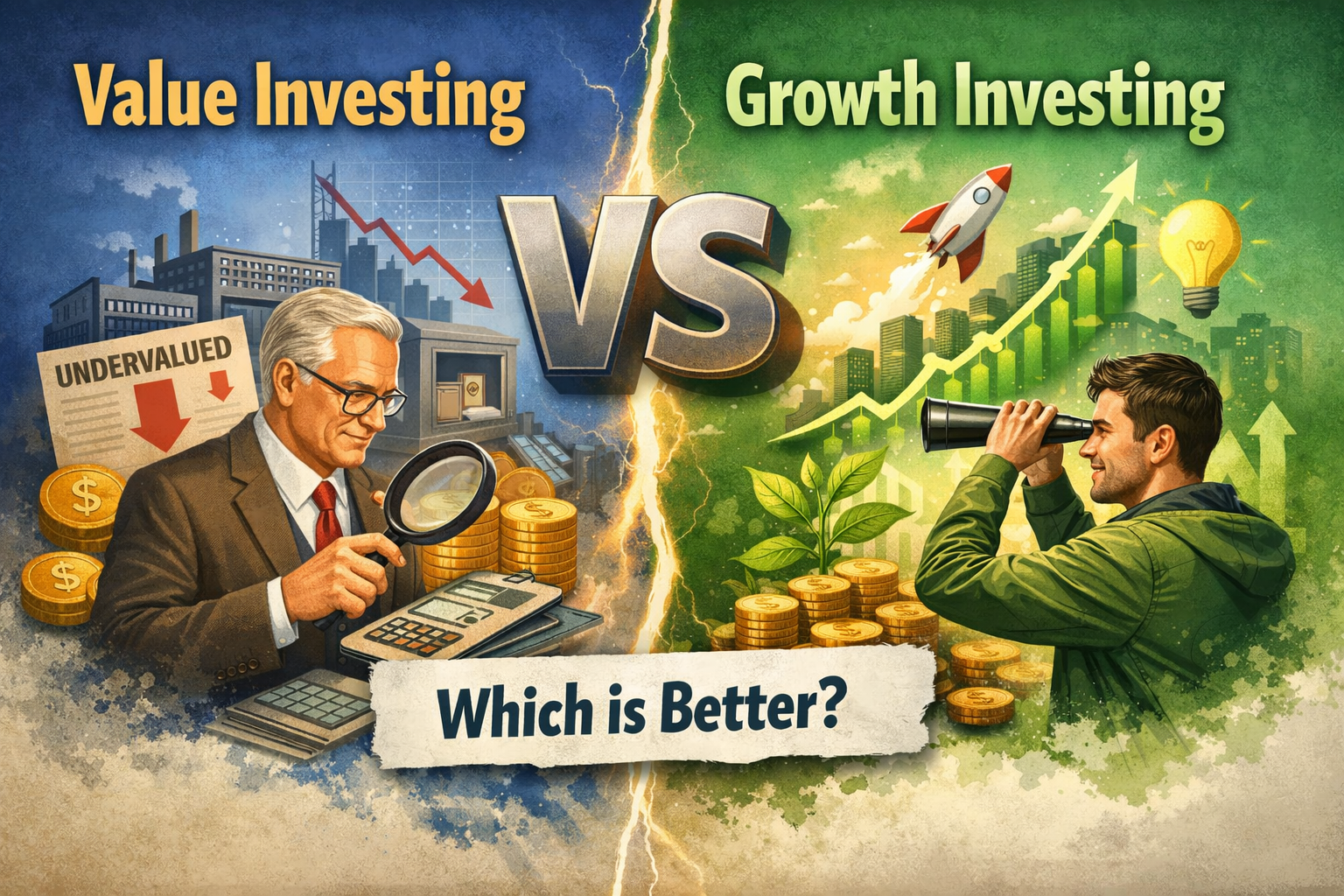
Value Investing vs Growth Investing: Which Is Better?
The debate has raged for decades. On one side, the value investors—disciples of Benjamin Graham and Warren Buffett—argue that buying quality companies at discount prices is the surest path to wealth. On the other, the growth investors—believers in companies that can expand faster than the economy—insist that capturing tomorrow’s leaders matters more than today’s bargains.
I’ve been on both sides of this debate. Early in my investing journey, I was all growth—buying whatever tech stock was soaring, convinced I’d found the next Amazon. Then I discovered value investing and swung hard the other way, only buying companies with low price-to-earnings ratios, regardless of their prospects.
Both approaches made me money. Both lost me money. And over time, I realized the question “value investing vs growth investing: which is better?” might be the wrong question entirely.
The better question is: which approach fits your temperament, your time horizon, and your goals? Because both have made fortunes. Both have generated legendary returns. And both have had extended periods where they’ve been dead money.
In this guide, we’ll explore the philosophy behind each approach, the evidence for and against each, the risks you need to understand, and—most importantly—how to think about combining them in a way that works for you.
Let’s settle the value investing vs growth investing debate once and for all.
Part 1: Understanding Value Investing
Value investing is the approach made famous by Benjamin Graham in the 1930s and later popularized by his most famous student, Warren Buffett.
The Core Philosophy
Value investing operates on a simple premise: markets are emotional. Sometimes they get too excited about a company and drive its price above its intrinsic value. Sometimes they get too pessimistic and drive its price below what it’s truly worth. The value investor’s job is to identify those undervalued companies, buy them, and wait for the market to recognize their true worth.
As Benjamin Graham wrote in “The Intelligent Investor”: “The investor’s chief problem—and even his worst enemy—is likely to be himself.” Value investing isn’t just about finding cheap stocks. It’s about having the discipline to buy when others are fearful and hold while the market catches up.
Key Metrics Value Investors Use
| Metric | What It Measures | Typical Value Range |
|---|---|---|
| Price-to-Earnings (P/E) | Price relative to earnings per share | Lower than market average |
| Price-to-Book (P/B) | Price relative to net assets | Below 1.0 or low relative to history |
| Price-to-Sales (P/S) | Price relative to revenue | Historically low |
| Dividend Yield | Annual dividend as percentage of price | Above average |
| Debt-to-Equity | Company leverage | Low compared to peers |
The Margin of Safety
The cornerstone of value investing is the “margin of safety”—buying at a significant discount to intrinsic value so that even if you’re somewhat wrong about the company, you still don’t lose money. If a stock is worth $100 and you buy it for $50, you have a 50% margin of safety. If you buy it for $90, you have only a 10% margin of safety.
Warren Buffett puts it simply: “Rule No. 1: Never lose money. Rule No. 2: Never forget Rule No. 1.”
Famous Value Investors
- Benjamin Graham: Father of value investing; author of “The Intelligent Investor” and “Security Analysis”
- Warren Buffett: The most successful investor of the modern era; built Berkshire Hathaway using value principles
- Charlie Munger: Buffett’s partner; emphasized buying wonderful companies at fair prices rather than fair companies at wonderful prices
- Seth Klarman: Author of “Margin of Safety”; runs the Baupost Group
- Joel Greenblatt: Created the “Magic Formula” combining value and quality
Part 2: Understanding Growth Investing
Growth investing takes a different approach. Instead of focusing on current price relative to current value, growth investors focus on future potential.
The Core Philosophy
Growth investors believe that the most spectacular returns come from companies that can grow their earnings faster than the overall economy. They’re willing to pay premium prices today for the promise of much larger profits tomorrow.
The logic is straightforward: a company that grows earnings at 20% annually will, in ten years, have earnings more than six times higher than today. Even if you pay a high multiple now, that growth can justify the price.
Key Metrics Growth Investors Use
| Metric | What It Measures | What Growth Investors Look For |
|---|---|---|
| Revenue Growth | Year-over-year sales increase | 15%+ annually |
| Earnings Growth | Year-over-year profit increase | 20%+ annually |
| Price-to-Earnings Growth (PEG) | P/E divided by growth rate | Below 1.0 or 1.5 |
| Gross Margins | Profitability of core business | High and expanding |
| Total Addressable Market | Potential market size | Large and growing |
The Growth Mindset
Growth investors think about the future. They ask questions like:
- What industries will dominate the next decade?
- Which companies have the best products, the strongest networks, the most defensible moats?
- Where will earnings be in five or ten years?
They’re willing to tolerate high current valuations if they believe the future justifies them.
Famous Growth Investors
- Philip Fisher: Author of “Common Stocks and Uncommon Profits”; emphasized understanding businesses deeply
- Peter Lynch: Managed Fidelity’s Magellan Fund to 29% annual returns; popularized “buy what you know”
- Thomas Rowe Price Jr.: Founded T. Rowe Price; pioneered growth investing
- Catherine Wood: Founder of ARK Invest; focuses on disruptive innovation
Part 3: Head-to-Head Performance
The value investing vs growth investing debate is often settled by looking at historical performance. The answer, as with many things, is “it depends on when you look.”
Long-Term Historical Returns
Over very long periods, value has modestly outperformed growth. A 2017 study by Fidelity examined data from 1972-2016 and found that large-cap value stocks returned 12.3% annually compared to 10.5% for large-cap growth . The gap narrows when including small-cap stocks.
However, the performance hasn’t been consistent. There have been decades where growth dominated (the 1990s tech boom, the 2010s) and decades where value dominated (the 1970s, the early 2000s after the dot-com crash).
Decade-by-Decade Performance
| Decade | Value Performance | Growth Performance | Winner |
|---|---|---|---|
| 1970s | Strong | Weak | Value |
| 1980s | Strong | Strong | Tie |
| 1990s | Moderate | Exceptional | Growth |
| 2000s | Strong | Weak | Value |
| 2010s | Moderate | Exceptional | Growth |
| 2020s (so far) | Mixed | Mixed | Mixed |
What This Tells Us
The data reveals a pattern: value and growth take turns leading. Neither is permanently superior. Trying to predict which will outperform in the next decade is essentially market timing—something most investors are terrible at.
Part 4: Key Differences Summarized
Let’s put value investing vs growth investing side by side.
| Factor | Value Investing | Growth Investing |
|---|---|---|
| Focus | Current price relative to intrinsic value | Future earnings potential |
| Valuation | Looks for stocks trading below intrinsic value | Willing to pay premium for growth |
| Time horizon | Can take years for market to recognize value | Can take years for growth to materialize |
| Risk | Value traps—stocks that stay cheap for good reason | Overvaluation—stocks priced for perfection |
| Typical sectors | Financials, industrials, energy, consumer staples | Technology, healthcare, consumer discretionary |
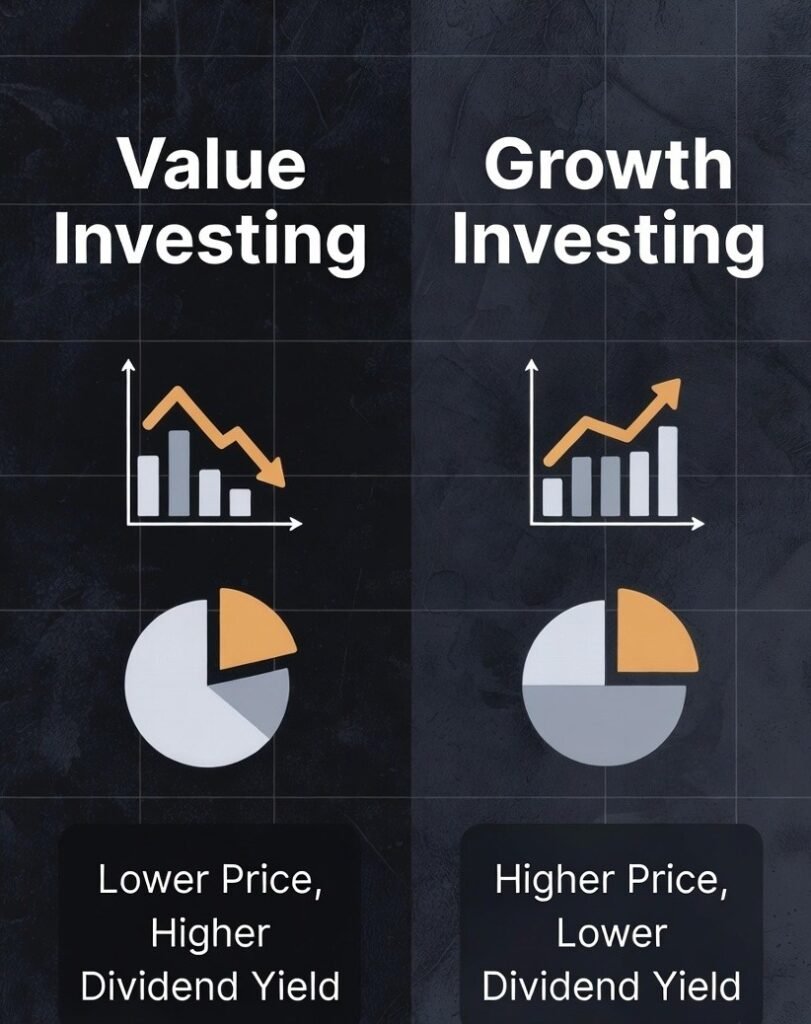
| Dividends | Often higher | Often lower or none |
| Volatility | Moderate | Often higher |
| Psychological challenge | Patience—waiting for market to recognize value | Conviction—holding through periods of doubt |
Part 5: The Case for Value Investing
Let’s look at why investors might choose the value approach.
Advantage #1: The Margin of Safety
The margin of safety is value investing’s greatest strength. When you buy a stock at a significant discount to its intrinsic value, you have a cushion against being wrong. If the company performs as expected, you profit. If it performs somewhat worse, you still may not lose money.
Advantage #2: Behavioral Edge
Value investing forces you to buy when others are selling—when sentiment is negative, when fear is high. This is emotionally difficult but historically profitable. As Baron Rothschild reportedly said, “The time to buy is when there’s blood in the streets.”
Advantage #3: Downside Protection
Value stocks, by definition, are already cheap. They may have less room to fall than expensive growth stocks when markets turn. During the 2000-2002 bear market, value stocks lost about half as much as growth stocks .
Disadvantage #1: Value Traps
The biggest risk in value investing is the “value trap”—a stock that looks cheap for good reason. Perhaps the industry is in permanent decline. Perhaps management is incompetent. Perhaps the company’s competitive position is eroding. Cheap stocks often stay cheap.
Disadvantage #2: Extended Periods of Underperformance
Value investors need patience. There have been years—even decades—where value has lagged growth. The 1990s were brutal for value investors who watched growth stocks soar while their cheap stocks did nothing.
Part 6: The Case for Growth Investing
Now let’s look at why investors choose growth.
Advantage #1: Compounding at High Rates
When a company can grow earnings at 20% or more annually, even a high starting valuation can look cheap over time. A $100 stock growing earnings 20% annually will have $250 in earnings in five years. If the multiple contracts from 50x to 20x, the stock could still be higher.
Advantage #2: Participating in Transformational Trends
Growth investing lets you invest in the companies reshaping the economy. The investors who bought Microsoft in the 1980s, Amazon in the 1990s, or Nvidia in the 2010s captured returns that value investors could only dream of.
Advantage #3: Momentum
Growth stocks often have momentum. When a company is growing rapidly, more investors want to own it, pushing the price higher. This can create returns that compound far beyond the company’s actual earnings growth.
Disadvantage #1: Valuation Risk
Growth stocks trade at high multiples, which means they’re priced for perfection. If growth slows even slightly—if earnings grow 25% instead of 30%—the multiple can contract sharply, causing the stock to fall even as the business grows.
Disadvantage #2: Crowded Trades
When a growth story catches on, everyone wants in. This can lead to bubbles where prices detach from fundamentals. The dot-com bubble destroyed many growth investors who bought at the peak.
Part 7: What the Experts Say
Let’s hear from the masters on value investing vs growth investing.
Warren Buffett (Value)
“I am a better investor because I am a businessman, and a better businessman because I am an investor.” Buffett’s approach evolved from buying “cigarette butts” (cheap, mediocre companies) to buying wonderful companies at fair prices—blending value and growth.
Peter Lynch (Growth)
“Go for a business that any idiot can run—because sooner or later, any idiot is probably going to run it.” Lynch found growth opportunities in companies with simple business models, expanding markets, and strong management.
Charlie Munger (Value + Quality)
“All intelligent investing is value investing—acquiring more than you are paying for.” Munger pushed Buffett away from “cigar butt” investing toward buying quality companies at reasonable prices.
Phil Fisher (Growth)
“The stock market is filled with individuals who know the price of everything, but the value of nothing.” Fisher emphasized understanding businesses deeply, focusing on competitive advantages, and holding for the long term.
Part 8: The Hybrid Approach
Here’s the secret the value investing vs growth investing debate often misses: you don’t have to choose. Many successful investors combine both approaches.
GARP—Growth at a Reasonable Price
GARP investing sits in the middle. It seeks companies growing earnings at a reasonable rate (say, 10-15% annually) trading at reasonable valuations (P/E below 20). This approach captures some of growth’s upside while maintaining value’s margin of safety.
The Core-Satellite Approach
Use value funds or ETFs as your core portfolio—the foundation that provides stability and downside protection. Then add growth stocks or funds as satellites—higher-risk, higher-potential positions that can drive outperformance.
Buffett’s Evolution
Warren Buffett himself evolved from pure value to a hybrid approach. Early in his career, he bought cheap companies like Berkshire Hathaway (a struggling textile mill) and Dempster Mill Manufacturing. Later, he shifted to buying wonderful companies at fair prices—Coca-Cola, American Express, Apple. Today, Berkshire owns growth stocks like Apple alongside value positions.
Part 9: How to Choose for Yourself
The question isn’t “value investing vs growth investing: which is better?” It’s “which is better for me?”
Consider Your Temperament
| If you… | Consider… |
|---|---|
| Hate seeing losses in your portfolio | Value (more downside protection) |
| Can tolerate volatility for potential upside | Growth |
| Prefer steady dividends | Value (dividend-paying companies) |
| Want to own tomorrow’s leaders | Growth |
| Have a shorter time horizon (5-10 years) | Value (less valuation risk) |
| Have a longer time horizon (20+ years) | Either, or both |
| Don’t want to analyze companies deeply | Index funds that blend both |
Consider Your Time Horizon
The longer your horizon, the more you can lean into growth. Over decades, the compounding of high-growth companies can overcome valuation risks. With a shorter horizon, value’s margin of safety provides more protection.
Consider Your Knowledge
Value investing requires understanding balance sheets, calculating intrinsic value, and having the patience to wait. Growth investing requires understanding industries, competitive dynamics, and having the conviction to hold through volatility.
Consider Starting with Both
A balanced approach—say, 50% value and 50% growth—has historically delivered solid returns with less volatility than going all-in on either style. Simple index funds like the S&P 500 already blend both, holding value stocks (JPMorgan, Berkshire) and growth stocks (Nvidia, Microsoft) in the same portfolio.
Part 10: Practical Implementation
How to Build a Value Portfolio
- Start with a value ETF like VTV (Vanguard Value ETF) or SCHV (Schwab U.S. Large-Cap Value ETF)
- Add small-cap value for higher potential returns—VBR or AVUV
- Consider international value—VYMI or EFV
- If picking individual stocks, focus on:
- Companies with low P/E ratios relative to their history and industry
- Strong balance sheets (low debt, ample cash)
- Sustainable competitive advantages
- Management with skin in the game
How to Build a Growth Portfolio
- Start with a growth ETF like VUG (Vanguard Growth ETF) or SCHG (Schwab U.S. Large-Cap Growth ETF)
- Add small-cap growth for exposure to emerging winners—VBK or IWO
- Consider sector ETFs if you have strong views on technology (QQQ), healthcare (VHT), or innovation (ARKK)
- If picking individual stocks, look for:
- Consistent 15%+ revenue and earnings growth
- Expanding gross margins
- Large and growing total addressable market
- Strong competitive position or network effects
The Simpler Approach
If this all feels overwhelming, here’s the simplest path: buy the total stock market. Index funds like VTI (U.S. total stock) or VT (global total stock) hold value and growth stocks in market proportions. You capture whichever style is performing without having to predict anything.
Part 11: Common Mistakes
Mistake #1: Assuming Past Performance Will Continue
Just because growth crushed value in the 2010s doesn’t mean it will in the 2020s. Styles rotate. What worked last decade may not work next.
Mistake #2: Abandoning Your Strategy at the Wrong Time
The worst time to abandon value is after a decade of underperformance—which is often exactly when it’s poised to rebound. The same applies to growth.
Mistake #3: Overconcentration
Putting all your money in one style, or worse, in a handful of stocks, leaves you vulnerable to extended periods of underperformance.
Mistake #4: Ignoring Quality
Not all cheap stocks are bargains. Not all growing companies will succeed. Quality matters in both styles.
Conclusion
Let’s bring this back to where we started.
The question “value investing vs growth investing: which is better?” doesn’t have a single answer. Both approaches have created immense wealth for disciplined investors. Both have had decades of dominance and decades of underperformance. Both require patience, discipline, and a clear understanding of what you own.
Value investing offers the margin of safety—a cushion against being wrong. It forces you to buy when others are fearful and provides downside protection. Its challenge is patience, waiting for the market to recognize what you see.
Growth investing offers the opportunity to capture the companies reshaping the economy. It lets you participate in transformative trends and compound wealth at high rates. Its challenge is valuation risk—holding companies priced for perfection that can fall sharply if expectations aren’t met.
The best answer for most investors isn’t to choose one. It’s to embrace both. The total stock market blends value and growth in market proportions, ensuring you capture whichever style performs. A core-satellite approach lets you tilt modestly toward your preferred style while maintaining diversification.
For most people, the winning strategy is simple: buy the whole market, add consistently, and stay invested through cycles. Add small tilts toward value or growth if you have strong conviction—but keep those tilts modest.
Because ultimately, the most important factor in value investing vs growth investing isn’t which style you pick. It’s whether you can stick with it long enough for the returns to compound. The investors who succeed are those who stay disciplined through the inevitable periods when their chosen style is out of favor.
Choose your approach, or choose both. But above all, choose to stay the course.
Related Post

15 Habits That Will Make You Financially Successful
I used to believe that financial success was about making the right big decisions. Pick…