
Title: How to Start Investing with Just $100
Money Strategy Lab >> Finance>> Title: How to Start Investing with Just $100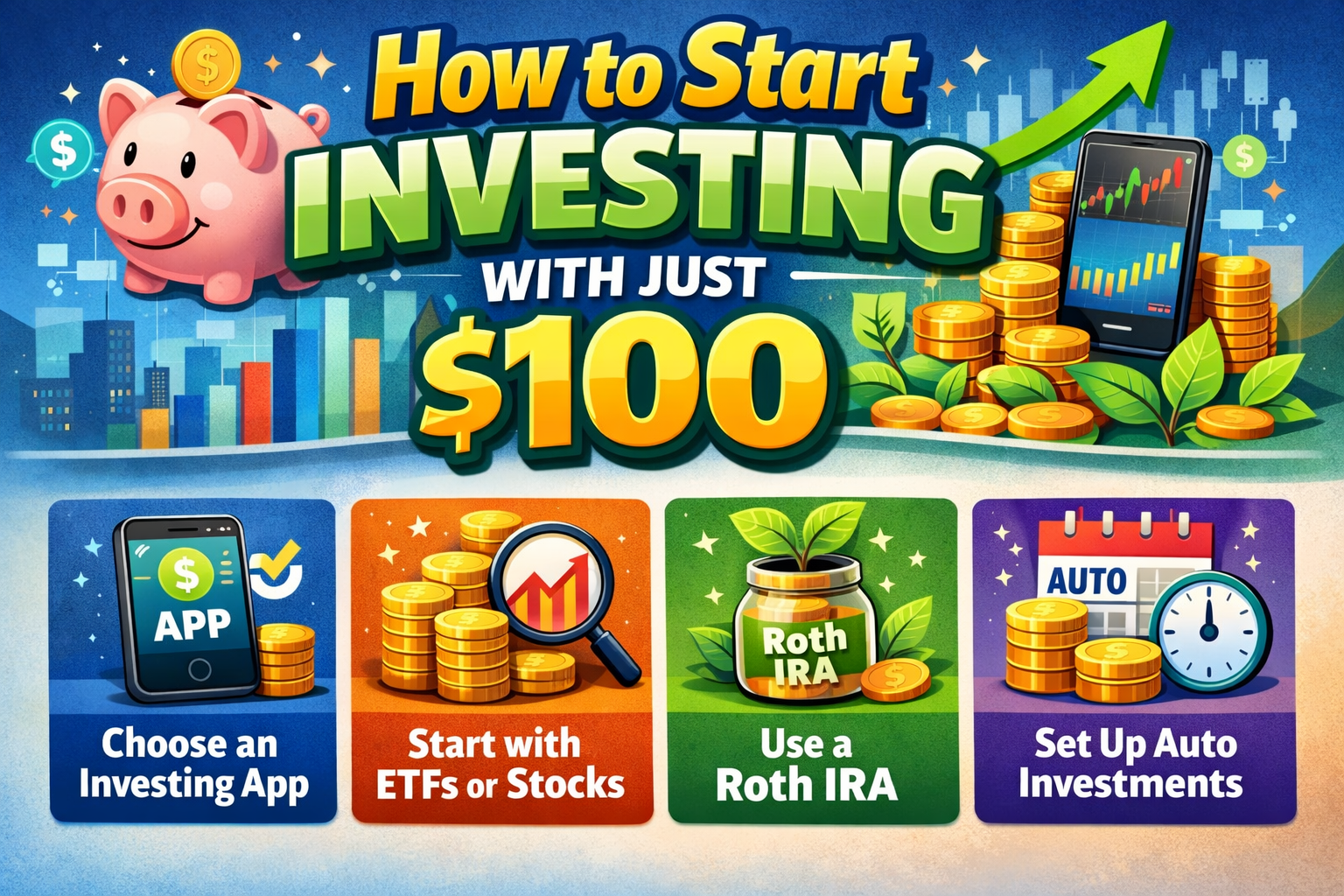
Title: How to Start Investing with Just $100
Think about your first trip to the gym. Intimidating, right? You don’t know the machines after one visit, and you’re certainly not in marathon shape when you walk out the door. But you don’t need a personal trainer or a $200 monthly membership to get started. You just need the mindset to show up and build momentum over time .
Investing works exactly the same way.
Yet somehow, we’ve convinced ourselves that investing requires thousands of dollars, decades of experience, and maybe a finance degree. The 2025 Charles Schwab Modern Wealth Survey found that 49% of non-investors cite insufficient funds as the reason they don’t invest, with the typical person believing they need around $1,000 to start investing . Younger Australians think it takes more than $20,000 .
Here’s the truth that could change your financial life: you can start investing with just $100.
Not $10,000. Not $1,000. One hundred dollars.
Thanks to zero-commission brokerages, fractional shares, and micro-investing apps, the barriers that kept previous generations out of the market have crumbled . You don’t need to wait until you’ve “made it” or until you have a five-figure sum gathering dust in your checking account. In fact, starting small might actually be better than starting big. Small money means small mistakes, small lessons, and small stakes while you’re learning .
In this guide, I’ll walk you through exactly how to start investing with just $100—the practical steps, the best options, the common pitfalls, and the mindset that turns modest beginnings into lasting wealth. No jargon, no judgment, just a friendly roadmap to your first investment.
Let’s get started.
Part 1: Before You Start Investing with Just $100—The Foundation
I know you’re eager to jump in and start investing with just $100. But let’s pause for just a moment and make sure the foundation is solid. Investing is powerful, but it works best when the rest of your financial house is in order.
Step 1: Secure Your Emergency Fund
You might be thinking, “This isn’t an investment.” And you’re right. But what if you buy stocks with your $100 and then need to buy a new tire for your car next week? You’ll have to sell the investments you just bought, possibly at a loss .
That’s why having a small cash buffer matters. If you don’t have any savings yet, consider using your first $100 to start an emergency fund instead. Interest rates on savings accounts have improved dramatically—as of late 2025, you can easily earn 3% or more from high-yield savings accounts .
Money expert Jaspreet Singh suggests having at least $2,000 set aside before you start investing, but if you’re starting from zero, even $500 or $1,000 makes a difference . The point is to have something so that when life happens, you don’t have to derail your investments.
Step 2: Deal with High-Interest Debt
If you’re carrying credit card debt at 18%, 21%, or higher, that’s your first priority. In August 2025, the Federal Reserve reported a national average credit card rate of 21.39% . Compare that to the stock market’s historical average return of around 10%, and the math becomes clear: paying off that debt is the best guaranteed return you’ll ever find .
The general rule: if your debt interest rate is above 7-8%, focus on eliminating it before you start investing with just $100 or any significant amounts. Credit card debt is an emergency—treat it like one.
Step 3: Look for Free Money
Before you put a dollar into the stock market, check if your employer offers a 401(k) match. If they do, contributing at least enough to get the full match is the single best investment you can make .
Think about it: if your employer matches 50% of your contributions up to a certain amount, that’s an instant 50% return on your money. Professor Robert R. Johnson, a finance expert at Creighton University, puts it bluntly: not contributing enough to obtain that match “is turning down free money” . No stock in history guarantees that kind of return, and it’s an even better deal than learning how to start investing with just $100 on your own.
Part 2: Why You Should Start Investing with Just $100
Before we dive into the how, let’s talk about the why. Because if you’re like most people, you probably think starting to invest with just $100 isn’t worth the trouble. The fees will eat you alive. The returns will be tiny. What’s the point?
I get it. But this thinking misses something crucial.
Investing Is a Habit, Not a One-Time Event
Think about exercise again. Nobody walks into the gym on day one and deadlifts three hundred pounds. They start with small weights, learn the movements, build the routine. The goal isn’t the first workout. The goal is becoming the kind of person who shows up consistently .
When you start investing with just $100, you’re not just buying assets. You’re building the muscle of regular investing. You’re learning how markets move while the stakes are low. You’re discovering your own risk tolerance without losing sleep .
Small Amounts Compound into Big Ones
Here’s a number that stopped me in my tracks: if you start investing with just $100 at a 10% average annual return, in 30 years it becomes nearly $1,750—without depositing another dollar . Add a modest $50 monthly contribution to that same scenario, and after 30 years you’re looking at over $115,000 .
That’s not magic. That’s compound interest. And the only way to access it is to start investing with just $100 early.
As Jaspreet Singh puts it, “If you have $4 a day, that’s about $100 a month, you can retire a millionaire, assuming you have enough time” . Even a 13% return could turn that same $100 monthly into $2.8 million over 45 years .
Mistakes Are Cheaper When You Start Investing with Just $100
Every investor makes mistakes. You’ll buy something that drops. You’ll sell something that soars. You’ll second-guess yourself. That’s not failure—that’s tuition . And when you start investing with just $100, that tuition is affordable. You learn the lessons without derailing your financial future.
So no, starting to invest with just $100 isn’t pointless. It’s the smartest way to begin.
Part 3: Your Options When You Start Investing with Just $100
Once the prerequisites are handled, it’s time to choose where to put your money. The good news: you have more options than ever when you start investing with just $100.
Option 1: Fractional Shares of Stocks
Remember when buying a share of a company meant paying the full share price? If Amazon was $3,000 a share, you needed $3,000 to own it. Those days are over.
Fractional shares let you buy a piece of a stock for as little as one dollar . If a company’s stock trades at $500 a share, you could invest $100 to own one-fifth of a share. You’ll get the same proportional return as someone who owns a full share—just scaled to the amount you invested. If that stock doubles to $1,000, your $100 investment doubles to $200 .
With fractional ownership comes proportional rights to dividends and voting. If you own 50% of a share, you receive 50% of the dividend, and your vote carries half the weight .
Best for: People who want to own specific companies they believe in but can’t afford full shares—a perfect option when you start investing with just $100.
Option 2: Index Funds and ETFs
If you’d rather not pick individual companies—and honestly, most people shouldn’t—index funds and ETFs are your friends .
An ETF (exchange-traded fund) is like a basket of investments. When you buy one share of an ETF, you’re buying tiny pieces of dozens, hundreds, or even thousands of different companies . That’s instant diversification with a single purchase.
Take the Vanguard Total Stock Market ETF (VTI). With one investment, you own a slice of essentially the entire U.S. stock market, and you can buy it for as little as $1 . The SPDR S&P 500 ETF Trust (SPY) gives you ownership in all 500 companies of the S&P 500 .
Why experts love them for beginners who want to start investing with just $100:
| Advantage | Explanation |
|---|---|
| Diversification | Own thousands of companies, not a handful |
| Low costs | Expense ratios as low as 0.03% |
| Simplicity | One decision, automated, forever |
| Accessibility | Most brokers allow fractional ETF shares |
Professor Johnson says that “hands down, the winner is a low-cost index ETF” for new investors. “You are investing in a diversified portfolio at a low cost. Additionally, picking winners in the stock market is difficult. An ETF removes this hassle” .
Option 3: Retirement Accounts (IRAs)
If your goal is long-term wealth, an Individual Retirement Account (IRA) gives you tax advantages that regular brokerage accounts don’t .
With a traditional IRA, your contributions may be tax-deductible now, and your money grows tax-deferred until retirement. With a Roth IRA, you contribute after-tax money, but withdrawals in retirement are completely tax-free .
Many brokers let you open an IRA with no minimum balance. Your first $100 can be the start of your retirement nest egg. If you start investing with just $100 in a Roth IRA and add $100 monthly for 30 years, the $36,000 you invest would be worth almost $180,000 based on historical returns . That’s the power of compounding gains over time.
Option 4: Micro-Investing Apps
Apps like Acorns, Raiz, and Stash have made investing almost passive. They connect to your debit or credit card, round up your purchases to the nearest dollar, and invest the spare change .
Buy a coffee for $4.50? Your card is charged $5, and fifty cents goes into your investment account. It doesn’t feel like saving, but over time, it adds up . This is an effortless way to start investing with just $100 and build from there.
Professor Johnson is a fan of this “forced savings” approach, especially for younger people. “When tied to a debit or credit card, the app rounds up your purchase to the nearest dollar and invests your spare change in a diversified portfolio. It’s a way to build retirement savings as you consume” .
Caveat: Watch the fees. Some micro-investing apps charge monthly fees that can eat into very small balances. Raiz, for example, charges $5.50 per month for accounts under $26,000—which could wipe out gains on a tiny balance .
Option 5: Money Market Funds
If you’re not quite ready for stock market volatility when you start investing with just $100, money market funds offer a middle ground. They invest in short-term, high-quality debt like U.S. Treasuries, providing stability and modest returns .
Think of them as a stepping stone—a place to park cash while you learn and build confidence.
Part 4: Step-by-Step—How to Start Investing with Just $100
Enough theory. Let’s walk through the actual steps to start investing with just $100 and get your money into the market.
Step 1: Choose a Brokerage
You need a place to buy investments. Look for a broker that offers:
- No minimum balance fees
- No commissions or low fees
- Fractional share investing
- A user-friendly app or website
Popular options include Fidelity, Charles Schwab, Vanguard, and newer apps like Robinhood or Webull . Compare a few and pick one that feels right for your goal to start investing with just $100.
Step 2: Fund Your Account
Link your bank account and transfer your first $100. Many platforms let you do this instantly . Congratulations—you’re about to start investing with just $100.
Step 3: Pick Your First Investment
Start simple. A broad market ETF like VTI or SPY gives you instant diversification with one click . You can always add individual stocks later as you learn. This is the ideal first move when you start investing with just $100.
Step 4: Place Your Order
Decide how many shares or dollars’ worth you want to buy. With fractional shares, you can just type “$100 of VTI” and own exactly that amount .
Step 5: Set Up Automatic Contributions
This is the secret sauce. Set up an automatic transfer from your bank to your brokerage every month—$25, $50, whatever fits . Then set up automatic investments into your chosen fund.
Now you’re investing on autopilot. No willpower required. Just consistent contributions month after month, building on that first decision to start investing with just $100.
Step 6: Reinvest Dividends
If your investments pay dividends, opt for automatic reinvestment . That way, your dividends buy more shares, which generate more dividends, which buy more shares—compounding in action.
Part 5: What Not to Do When You Start Investing with Just $100
Just as important as knowing what to do is knowing what to avoid when you start investing with just $100.
Avoid Penny Stocks
One trap to be aware of is investing in penny stocks—typically low-priced stocks of smaller or thinly traded companies. While it may seem logical that tiny companies or stocks trading for pennies have the highest return potential, the reality is that the world of penny stocks is full of fraudulent companies and pump-and-dump schemes .
Think The Wolf of Wall Street. If you’re wondering how to start investing with just $100 in penny stocks, the answer is simple: don’t.
Avoid FOMO (Fear of Missing Out)
Kalee Boisvert, an investment adviser at Raymond James, warns that young investors often gravitate toward stocks that are gaining popularity. But if a stock is already soaring, chances are you’re a bit too late to the game .
She suggests a Warren Buffett-style approach: put your money to work in companies you’re comfortable owning for years . This is especially wise when you start investing with just $100—you want to protect that initial capital.
Don’t Try to Get Rich Quick
It might be tempting to throw your $100 at a flashy stock or a trendy cryptocurrency. But that’s more like gambling than investing . If you’re just starting out, keep things boring. Slow and steady wins the race.
Part 6: The Mindset That Makes It Work When You Start Investing with Just $100
The technical side of investing is simple. The psychological side is where most people stumble.
Focus on What You Can Control
You can’t control the market. You can’t control the economy. What you can control is your savings rate, your investment choices, and your decision to stay invested . This mindset matters most when you start investing with just $100.
Think in Decades, Not Days
The stock market is the only place where people run for the exits when things go on sale. If you’re investing for the long term, market drops are just temporary markdowns on the companies you’re buying . Remember that when you start investing with just $100, you have time on your side.
Automate and Ignore
The best investors are often the most bored. They set up automatic investments, ignore the financial news, and let compounding do its work . You don’t need to check your portfolio daily. Monthly is plenty.
Use Your Investment to Learn
Many investment apps and brokerage platforms have extensive educational tools. Use your first $100 as an excuse to learn—read articles, watch videos, understand how markets work .
Make It a Habit
That first $100 is just the beginning. Try to add to your investments each month, even if it’s only $10 or $20. Small, regular contributions can lead to big results over time .
Vince Scully, founder of financial advice service Life Sherpa, puts it simply: “Get invested, stay invested, then invest some more—consistency matters” .
Part 7: The Power of Patience—A Real-World Example
Let’s make this concrete with numbers. This is why it’s so powerful to start investing with just $100.
Suppose you’re 25 years old. You start investing with just $100 today in a low-cost S&P 500 index fund. Historically, the S&P 500 has returned about 10% annually on average over long periods .
Here’s what happens:
- In 10 years (age 35): $259
- In 20 years (age 45): $673
- In 30 years (age 55): $1,745
- In 40 years (age 65): $4,525
That’s from a single $100 investment, never adding another dime.
Now imagine you make it a habit. You start investing with just $100 and add $100 every month from age 25 to 65. At 10% annual returns:
- Total invested: $48,000
- Final value: over $530,000
That’s not hypothetical. That’s math. And it all starts with the decision to start investing with just $100.
Conclusion
Let’s bring this all together.
Starting to invest with just $100 isn’t just possible—it’s one of the smartest financial moves you can make. The barriers that once kept small investors out have crumbled. Fractional shares, zero-commission brokerages, and micro-investing apps have democratized investing .
The key steps to start investing with just $100:
- Secure your foundation—a small emergency fund and no high-interest debt
- Choose your vehicle—index ETFs, fractional shares, IRAs, or micro-investing apps
- Open an account with a low-cost, beginner-friendly broker
- Make your first purchase—keep it simple with a broad market ETF
- Set up automation so you invest regularly without thinking
- Stay patient and let compounding do its work
The people who succeed financially aren’t the ones who made the most money. They’re the ones who started early, stayed consistent, and let time work in their favor .
You don’t need to be perfect. You don’t need to understand everything. You just need to start investing with just $100.
Your first $100 won’t make you a millionaire overnight. But the habit it builds, the lessons it teaches, and the compound growth it unlocks can change your financial future forever .
The best time to start investing with just $100 was twenty years ago. The second best time is today.
Your future self—the one with the growing portfolio and the compound interest tailwind—is counting on you to start investing with just $100 right now.
Related Post

Value Investing vs Growth Investing: Which Is Better?
The debate has raged for decades. On one side, the value investors—disciples of Benjamin Graham…