

The Ultimate Guide to Personal Finance for Beginners
Money Strategy Lab >> Finance>>Investing>> The Ultimate Guide to Personal Finance for Beginners
The Ultimate Guide to Personal Finance for Beginners
Let me ask you something uncomfortable. When was the last time you lay in bed at 3 a.m., staring at the ceiling, wondering if you’re doing money right? If you’re like most people, the answer is probably “last night” or “more often than I’d like to admit.”
Money is weird that way. We use it every single day, yet most of us never received any formal education about it. School taught us algebra and Shakespeare (both valuable, don’t get me wrong), but never explained how taxes work, what a credit score actually is, or how to make our savings grow. We’re expected to figure it out as we go, making expensive mistakes along the way.
I know because I was there. My financial journey began with a maxed-out credit card, a confused look at my first 401(k) form, and the vague sense that everyone else had received a memo I missed. They hadn’t. They were just as lost, pretending otherwise.
Here’s what I’ve learned since then: personal finance for beginners isn’t complicated. It’s actually quite simple. The hard part isn’t understanding what to do—it’s filtering out the noise, ignoring the get-rich-quick schemes, and sticking with boring, proven principles over decades.
This guide is my attempt to give you the memo I wish I’d received. We’ll start from absolute zero—no assumptions about what you already know. We’ll cover budgeting, saving, debt, credit, investing, insurance, and the psychological side of money. By the end, you’ll have a complete framework for managing your finances with confidence.
Let’s demystify personal finance for beginners together.
Part 1: The Foundation—Where Are You Starting?
Before we talk about budgets and investments, we need to know where you stand. This isn’t about judgment. It’s about gathering data.
Step 1: Calculate Your Net Worth
Your net worth is the simplest measure of your financial health: everything you own minus everything you owe.
Assets (what you own):
- Cash in checking and savings accounts
- Investments (brokerage accounts, retirement accounts)
- Home equity (current value minus mortgage)
- Vehicles (be realistic—use Kelley Blue Book)
- Other valuables (only if you’d actually sell them)
Liabilities (what you owe):
- Credit card balances
- Student loans
- Car loans
- Mortgage
- Personal loans
- Medical debt
- Money borrowed from family or friends
Net Worth = Total Assets — Total Liabilities
This number might be negative—especially if you’re early in your career with student loans. That’s okay. It’s not a score of your worth as a human. It’s just a baseline. Tracking it over time shows whether you’re moving in the right direction .
Step 2: Know Your Cash Flow
For one month, track every dollar that comes in and goes out. Every coffee, every subscription, every ATM withdrawal. Use an app, a spreadsheet, or a notebook—whatever works for you.
At month’s end, categorize your spending. You’re looking for patterns. Most people are shocked to discover where their money actually goes versus where they thought it went.
Common categories:
- Housing (rent/mortgage, utilities, insurance)
- Transportation (car payment, gas, maintenance, public transit)
- Food (groceries, restaurants, coffee)
- Debt payments (minimums plus extra)
- Subscriptions (streaming, apps, gyms)
- Personal care
- Entertainment
- Miscellaneous (the “where did that come from?” category)
Step 3: Get Your Credit Reports
You’re entitled to one free credit report annually from each of the three major bureaus (Equifax, Experian, TransUnion) at AnnualCreditReport.com . Pull them, check for errors, and dispute anything incorrect. This isn’t about your score yet—just making sure the underlying data is accurate.
Part 2: Budgeting—Giving Every Dollar a Job
Budget is a word that makes people flinch. It sounds restrictive, like a financial diet where you can never have fun again. But here’s a reframe: a budget isn’t a restriction. It’s permission to spend without guilt.
When you know your money is allocated to what matters, you can spend freely on those things. The guilt comes from not knowing—from that vague sense that you might be overspending, might be falling behind, might be making a mistake.
The 50/30/20 Framework
This is the simplest effective budget for most people:
| Category | Percentage | What It Covers |
|---|---|---|
| Needs | 50% | Housing, utilities, groceries, transportation, minimum debt payments, insurance |
| Wants | 30% | Dining out, entertainment, hobbies, travel, streaming services |
| Savings & Debt | 20% | Emergency fund, retirement accounts, extra debt payments, investments |
If 50% for needs isn’t realistic where you live, adjust the percentages. The point isn’t rigid adherence—it’s having a framework that makes trade-offs visible .
Zero-Based Budgeting
Another approach: every dollar gets assigned a job before the month begins. If you earn $4,000, you allocate $4,000 to categories—rent, groceries, savings, fun money, everything—until zero remains. You’re telling your money where to go instead of wondering where it went .
Tools That Help
| Tool | Type | Best For |
|---|---|---|
| Mint | Free app | Automated tracking |
| YNAB | Paid app | Proactive budgeting |
| EveryDollar | Free/paid | Zero-based budgeting |
| Spreadsheet | DIY | Total control |
The most important thing: Pick one and use it. The tool matters less than the habit.
Part 3: The Emergency Fund—Your Financial Airbag
Life happens. Your car breaks down. Your laptop dies. You lose your job. Without a buffer, these normal events become financial crises that push you into debt and derail your progress.
What Is an Emergency Fund?
An emergency fund is cash set aside specifically for unexpected expenses. It’s not for planned expenses like vacations or Christmas gifts. It’s for the stuff you can’t predict.
How Much Do You Need?
| Stage | Amount | Why |
|---|---|---|
| Starting out | $1,000 | Covers most small emergencies |
| Stable but building | 3 months of expenses | Provides real security |
| Full security | 6 months of expenses | Handles job loss or major crisis |
Where to Keep It
A high-yield savings account (HYSA) is the sweet spot. Your money is accessible within days, earns some interest (currently 4-5% at many banks), and isn’t at risk of losing value like investments can.
When to Use It
If you lose your job, use it for essentials. If your car needs major repairs, use it. If there’s a sale on sneakers, you don’t use it. That’s what the “wants” category in your budget is for .
Pro tip: After you use it, rebuilding the fund becomes your top priority before resuming other savings goals.
Part 4: Debt—The Weight That Holds You Back
Debt isn’t inherently evil. A mortgage on a home you can afford, student loans for a degree that increases your earning potential, a car loan that enables reliable transportation—these can be tools. But high-interest debt, especially credit card debt, is an emergency.
The Debt Avalanche Method
List all your debts by interest rate, highest to lowest. Pay minimums on everything, then throw every extra dollar at the highest-rate debt. When that’s gone, move to the next highest.
Why it works: Mathematically optimal. You pay the least total interest over time.
The Debt Snowball Method
List debts by balance, smallest to largest. Pay minimums on everything, then attack the smallest balance first. When it’s gone, roll that payment to the next smallest.
Why it works: Psychologically motivating. Quick wins keep you going.
Which One Should You Choose?
The mathematically correct answer is avalanche. The behaviorally effective answer depends on you . If you need momentum to stay motivated, snowball wins. If you’re disciplined and want to minimize interest, go avalanche. The best method is the one you’ll actually stick with.
A Note on Interest Rates
- Credit cards (15-30%): Emergency-level debt. Prioritize paying it off before investing beyond any employer match .
- Student loans (4-7%): Manageable. Make payments while also investing .
- Mortgages (3-6%): Generally fine to pay gradually while investing for higher returns .
Part 5: Credit—Your Financial Reputation
Your credit score affects whether you can rent an apartment, buy a car, get a mortgage, and sometimes even land a job. It’s worth understanding.
What Makes Up Your Credit Score
| Factor | Weight | What It Means |
|---|---|---|
| Payment history | 35% | Pay your bills on time, always |
| Credit utilization | 30% | Keep credit card balances low (under 30% of limit) |
| Length of history | 15% | Older accounts help |
| Credit mix | 10% | Different types of credit (cards, loans) |
| New credit | 10% | Don’t open many accounts quickly |
How to Build Credit From Scratch
- Get a secured credit card. You deposit money as collateral, use the card responsibly, and graduate to an unsecured card after 6-12 months.
- Become an authorized user on a family member’s card with good history.
- Pay your statement balance in full every month. Never carry a balance.
- Keep old accounts open even if you don’t use them much.
Common Myths
- “Checking my score hurts it.” Checking your own score is a soft inquiry and doesn’t affect it.
- “I need to carry a balance to build credit.” False. Paying in full monthly builds credit just fine.
- “Closing a card helps my score.” Usually the opposite—it reduces your available credit and shortens your history.
Part 6: Banking—Where Your Money Lives
Checking Accounts
This is your everyday money—for bills, spending, and transfers. Look for accounts with:
- No monthly fees
- No minimum balance requirements
- Free ATM access
- Mobile app with mobile check deposit
Savings Accounts
This is where your emergency fund and short-term savings live. Look for:
- High yield (online banks typically offer the best rates)
- No monthly fees
- Easy transfers to checking
Current landscape: Online banks like Ally, Marcus, and SoFi consistently offer competitive rates. Don’t keep large balances in accounts earning 0.01% .
Should You Use a Bank or Credit Union?
| Banks | Credit Unions | |
|---|---|---|
| Pros | Better technology, more branches, higher rates on savings | Often lower fees, more personal service |
| Cons | Can have more fees | May have fewer branches/ATMs |
Many people use both—an online bank for savings, a local credit union for checking.
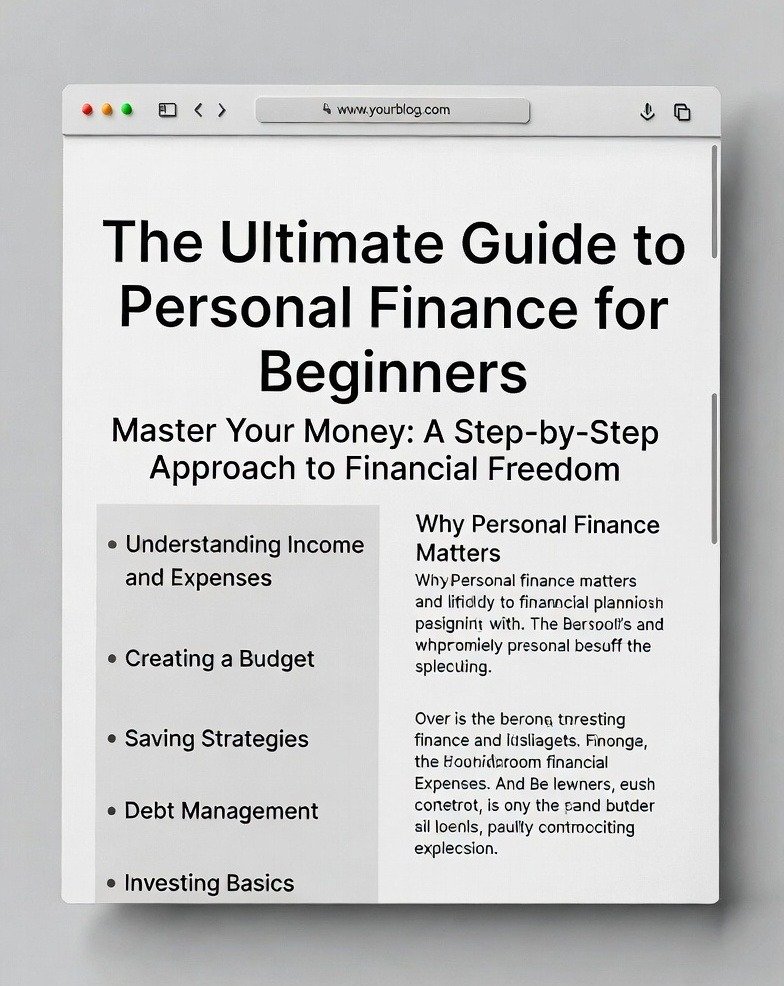
Part 7: Investing—Making Your Money Work
This is where your money stops sitting still and starts growing. You don’t need to be an expert. You need to understand a few core principles.
Why Invest?
Inflation slowly eats the purchasing power of cash. At 3% inflation, money loses half its value in about 24 years . Investing in productive assets (like stocks) has historically outpaced inflation and built wealth over time.
The Simple Starting Portfolio
For beginners, broad market index funds and ETFs are the answer. They give you instant diversification, low costs, and no need to pick individual winners.
| Fund | What It Does | Example |
|---|---|---|
| Total US Stock Market | Owns a slice of thousands of US companies | VTI, VTSAX |
| Total International Stock | Owns companies outside the US | VXUS, VTIAX |
| Total Bond Market | Owns government and corporate bonds | BND, VBTLX |
A simple starter portfolio: 80% total US stock + 20% total international stock. Adjust based on your risk tolerance and timeline.
Tax-Advantaged Accounts First
Before investing in a regular brokerage account, max out these:
| Account | Best For | 2024 Limits |
|---|---|---|
| 401(k) (especially with match) | Retirement through employer | $23,000 |
| IRA (Traditional or Roth) | Retirement on your own | $7,000 |
| HSA (Health Savings Account) | Medical expenses + retirement | $4,150 (individual) |
The order matters: 401(k) match → HSA (if eligible) → IRA → back to 401(k) → taxable brokerage .
How Much to Invest?
General guideline: 15-20% of your gross income toward retirement. Start where you can (even 5%) and increase as your income grows.
Part 8: Insurance—Protecting What You’ve Built
Insurance isn’t exciting, but it’s essential. The goal is to protect against catastrophic losses that would derail your finances.
What You Probably Need
| Type | Purpose | Who Needs It |
|---|---|---|
| Health insurance | Medical costs | Everyone |
| Renters/homeowners | Belongings, liability | Renters and owners |
| Auto insurance | Cars, liability | Drivers |
| Disability insurance | Replace income if you can’t work | Anyone depending on their income |
| Life insurance | Support dependents if you die | People with families who rely on their income |
| Umbrella policy | Extra liability coverage | Those with significant assets |
Term Life vs. Whole Life
Term life is what you want. It’s simple, affordable insurance for a specific period (say, 20 or 30 years). Whole life is complicated, expensive, and generally not a good investment . If someone tries to sell you whole life, run.
Deductibles
Higher deductible = lower premium. The trade-off: you pay more out of pocket if something happens. Make sure you have enough emergency fund to cover your deductibles.
Part 9: The Psychology of Money
This might be the most important section. Because we all know what we should do. The hard part is actually doing it.
Know Your Biases
- Loss aversion: Losing $100 feels worse than gaining $100 feels good. This causes people to sell investments when they drop—locking in losses—instead of holding.
- Recency bias: Assuming recent trends will continue. Markets go up and down; don’t get fooled.
- Social comparison: Comparing your financial situation to others is a trap. You see their highlight reel, not their full picture.
Automate Everything
Willpower is a limited resource. Automate savings, automate investments, automate bill payments. Remove yourself from as many decisions as possible .
Define Your “Why”
Saving and investing are hard without a compelling reason. What are you actually working toward? Early retirement? A home? Financial independence? Freedom to change careers? Travel? Write it down and revisit it regularly .
Practice Gratitude
Contentment is a skill. The ability to be satisfied with enough—rather than constantly wanting more—is perhaps the most valuable financial trait of all .
Part 10: A Practical Timeline
Here’s what your financial journey might look like:
Year 1:
- Build $1,000 emergency fund
- Contribute enough to 401(k) for full employer match
- Pay off credit card debt
- Start tracking spending
Years 2-3:
- Build 3-6 months emergency fund
- Increase retirement contributions to 10-15%
- Open and fund an IRA
- Pay down high-interest debt
Years 4-5:
- Max out retirement accounts if possible
- Start taxable investing
- Consider home down payment saving
- Review insurance coverage
Ongoing:
- Increase savings with every raise
- Rebalance investments annually
- Update beneficiaries and estate documents
- Ignore financial news
Conclusion
Let’s bring this all together. Personal finance for beginners isn’t about becoming a Wall Street expert or getting rich quick. It’s about mastering a few simple principles and applying them consistently over time.
The core framework:
- Know your numbers—net worth, cash flow, credit reports
- Give every dollar a job through a budget that reflects your values
- Build an emergency fund so life doesn’t derail you
- Eliminate high-interest debt with a focused plan
- Use credit wisely—pay statements in full, build history slowly
- Bank smart—no fees, high yield for savings
- Invest consistently in low-cost index funds through tax-advantaged accounts
- Protect what matters with appropriate insurance
- Understand your psychology—automate, define your why, practice gratitude
- Stay patient—wealth is built slowly, then suddenly
The people who succeed financially aren’t the ones who made the most money. They’re the ones who made consistent, boring, intelligent choices year after year. They started early, stayed invested, and let compounding do its work.
You don’t need to be perfect. You just need to start.
Pick one thing from this guide—just one—and do it this week. Open that savings account. Set up that automatic transfer. Cancel that subscription. Read that credit report.
Your future self will thank you.
Related Post

Value Investing vs Growth Investing: Which Is Better?
The debate has raged for decades. On one side, the value investors—disciples of Benjamin Graham…