Passive Income vs Active Income: Key Differences
Money Strategy Lab >> Investing>>Finance>> Passive Income vs Active Income: Key Differences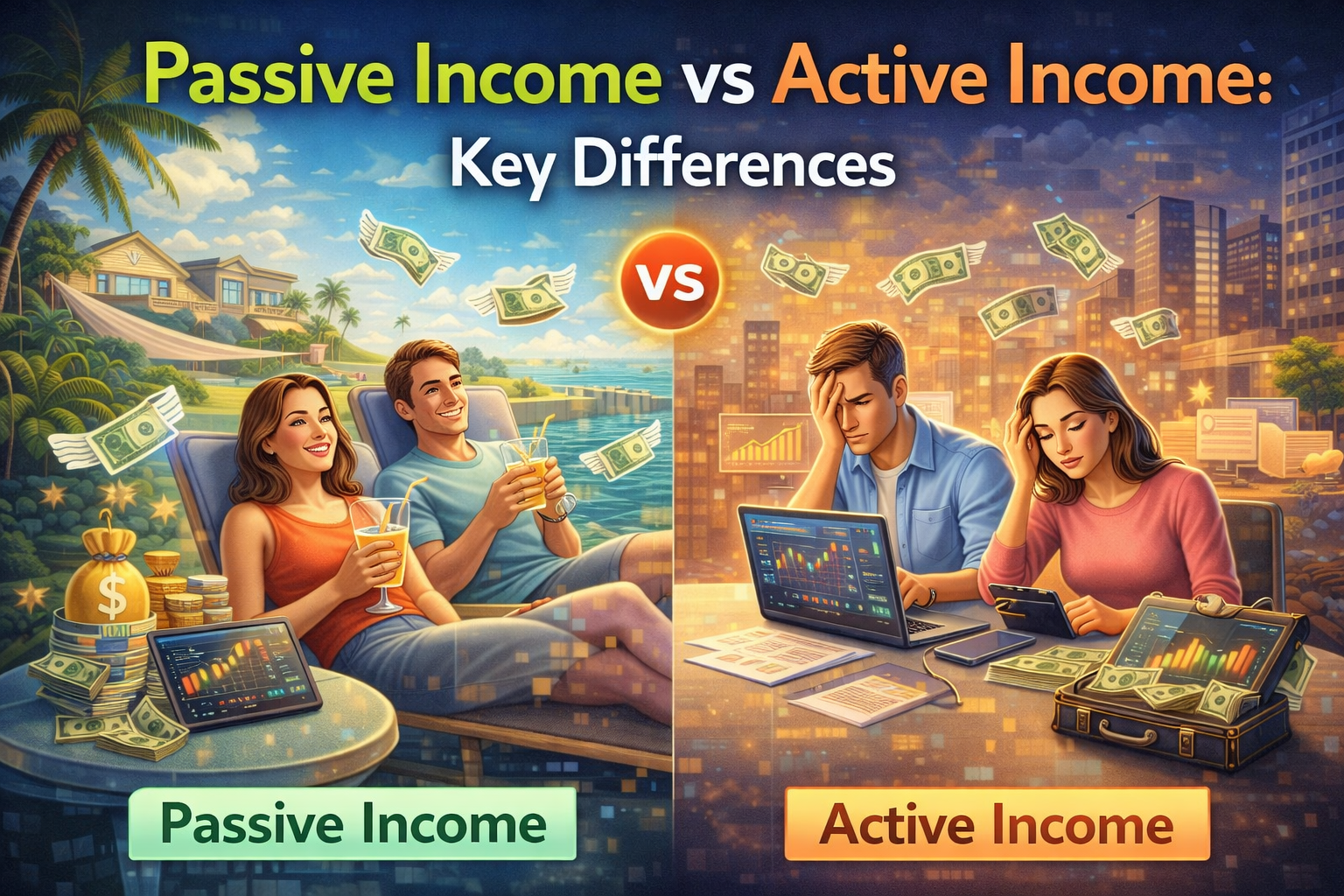
Passive Income vs Active Income: Key Differences
I used to believe that the only way to make money was to work for it. Hour by hour. Day by day. Trade my time for dollars, rinse, repeat. That’s what I’d been taught. That’s what everyone around me did. The equation seemed simple: more hours worked equals more money earned.
Then I met someone who changed my thinking. He was a former teacher who’d spent ten years building a portfolio of rental properties and dividend stocks. He still worked—but he worked because he wanted to, not because he had to. When I asked how he did it, he said something I’ve never forgotten: “I stopped trading time for money. I started trading effort for assets that produce money on their own.”
That conversation planted a seed that grew into a decade-long exploration of passive income vs active income. I’ve built passive streams, abandoned others that didn’t work, and watched friends succeed (and fail) at both. And I’ve learned that the difference between these two income types isn’t just about how you earn—it’s about how you live.
In this guide, we’ll explore the fundamental differences between passive income vs active income. We’ll look at real-world examples, the pros and cons of each, and how to build a mix that works for your life. Whether you’re just starting your career or looking to build financial freedom, understanding this distinction is essential.
Let’s dive into the two ways money comes into our lives.
Part 1: What Is Active Income?
Active income is the money you earn in exchange for your time and effort. It’s the paycheck you get from your job. The fee you charge for a consulting project. The hourly rate you earn freelancing. If you’re doing something to earn it, it’s active income.
Characteristics of Active Income
| Characteristic | What It Means |
|---|---|
| Time-bound | You earn only when you’re working |
| Effort-based | Income correlates with hours invested |
| Limited scalability | You can only work so many hours |
| Predictable | Regular paychecks (usually) |
| Taxed as ordinary income | Higher tax rates than some passive income |
| Requires your presence | You can’t step away without stopping income |
Common Forms of Active Income
| Type | Examples |
|---|---|
| Employment | Salary, wages, commissions, bonuses |
| Freelancing | Consulting, design, writing, programming |
| Self-employment | Running a business where your time is the product |
| Gig work | Driving, delivery, task-based work |
| Professional services | Law, accounting, medicine, therapy |
The Trade-Off
Active income is reliable. You know when you’ll be paid. You can predict your earnings. But it comes with an upper limit. There are only 24 hours in a day. You can only work so many before burnout. No matter how valuable your time, there’s a ceiling on what you can earn through active income.
Part 2: What Is Passive Income?
Passive income is money you earn with minimal ongoing effort. It’s income from assets you’ve built, bought, or created that continue to generate returns without your constant involvement.
What Passive Income Is NOT
Before we go further, let’s clear up a common misconception. Truly passive income is rare. Most “passive” income streams require significant upfront work and ongoing maintenance. The term is better understood as “income that doesn’t require your constant presence” rather than “income that requires no work at all.”
Characteristics of Passive Income
| Characteristic | What It Means |
|---|---|
| Decoupled from time | You can earn while sleeping, traveling, or working on other things |
| Asset-based | Income comes from something you own or created |
| Scalable | No theoretical upper limit |
| Upfront investment | Requires time, money, or skills to build |
| Maintenance required | Rarely completely “set and forget” |
| Tax-advantaged | Some forms taxed at lower rates |
Common Forms of Passive Income
| Type | Examples |
|---|---|
| Investment income | Dividends, interest, capital gains |
| Rental income | Real estate, equipment, vehicles |
| Business ownership | Profits from businesses you don’t actively manage |
| Digital products | Courses, books, software, templates |
| Royalties | Music, patents, intellectual property |
| Affiliate marketing | Commissions from promoting products |
| Peer-to-peer lending | Interest from loans |
Part 3: Active Income vs Passive Income at a Glance
Let’s put passive income vs active income side by side.
| Factor | Active Income | Passive Income |
|---|---|---|
| Time required | You work, you earn. You stop, you don’t. | Income continues with minimal ongoing effort |
| Scalability | Limited by hours available | Unlimited potential |
| Startup effort | Low to moderate | High upfront investment |
| Risk | Job loss, illness, burnout | Investment risk, market changes, obsolescence |
| Control | High (you control your effort) | Lower (depends on assets, markets) |
| Predictability | Regular, predictable | Variable, can fluctuate |
| Tax treatment | Ordinary income rates | Often preferential (dividends, capital gains) |
| Wealth building | Slower (trading time for money) | Faster (money works for you) |
Part 4: The Active Income Advantage
Despite the allure of passive income, active income has significant advantages—especially early in your career.
Advantage #1: Predictability
A steady paycheck is powerful. It covers your bills, funds your investments, and provides psychological security. You know when money is coming and roughly how much.
Advantage #2: Skill Development
Active work builds skills that increase your earning potential. A doctor early in her career earns modestly. After years of practice, her hourly rate increases dramatically. The same is true for lawyers, software developers, consultants, and many other professions.
Advantage #3: Capital to Invest
You can’t build passive income streams without capital. Active income provides the fuel. The money you save from your job becomes the down payment on a rental property, the seed capital for a business, the investment in dividend stocks.
Advantage #4: Benefits and Stability
Employment often comes with benefits—health insurance, retirement contributions, paid time off. These add significant value beyond your paycheck.
The Strategy
For most people, the optimal approach isn’t choosing passive income vs active income. It’s using active income to build passive income. You work, save, invest, and gradually replace active income with passive streams.
Part 5: The Passive Income Advantage
Passive income offers benefits that active income simply can’t match.
Advantage #1: Freedom
This is the big one. When your passive income covers your expenses, work becomes optional. You can:
- Take a lower-paying, more meaningful job
- Start a business without financial pressure
- Take time off to travel or spend with family
- Retire early
- Weather unemployment without panic
Advantage #2: Unlimited Scalability
Active income has a ceiling. Passive income doesn’t. A digital product can sell to 10 people or 10,000 with similar effort. A rental property’s income isn’t limited by your time. Investments compound without your involvement.
Advantage #3: Tax Efficiency
Long-term capital gains and qualified dividends are taxed at lower rates than ordinary income. Real estate offers depreciation deductions. Business ownership allows expense deductions. The tax code favors passive income.
Advantage #4: Wealth Building
Passive income isn’t just about current cash flow—it’s about asset appreciation. The rental property that generates $500 monthly may also increase in value. The stock portfolio that pays dividends also grows. Passive income builds wealth while you sleep.
Part 6: The Active Income Traps
Active income isn’t all upside. There are traps that keep people working longer than necessary.
Trap #1: Lifestyle Inflation
As your active income grows, your spending often grows with it. The $80,000 earner spends like an $80,000 earner. The $150,000 earner spends like a $150,000 earner. You’re running faster but staying in place.
Trap #2: The Golden Handcuffs
High-paying jobs can be hard to leave—even when they make you miserable. The salary, the benefits, the status—they keep you locked in. You’re trading happiness for a paycheck.
Trap #3: Burnout
Active income requires your time and energy. Burnout is real. The toll on health, relationships, and well-being can be high.
Trap #4: Vulnerability
Active income depends on one thing: your ability to work. If you get sick, lose your job, or face an industry downturn, the income stops. There’s no cushion.
Part 7: The Passive Income Traps
Passive income isn’t a magic solution. It comes with its own traps.
Trap #1: The “Passive” Myth
Most passive income streams require significant upfront work—and ongoing maintenance. Rental properties have tenants, toilets, and taxes. Blogs need content, SEO, and promotion. Courses need updates. Dividends require monitoring. The idea of “set it and forget it” is largely fantasy.
Trap #2: Upfront Capital
Building passive income takes money. Rental properties require down payments. Dividend portfolios need capital to generate meaningful income. Businesses need investment. If you don’t have savings, passive income is hard to build.
Trap #3: Risk
Passive income carries risk. Real estate values can fall. Stocks can crash. Businesses can fail. Digital products can become obsolete. There’s no guarantee your passive stream will continue.
Trap #4: Illiquidity
Many passive income assets are hard to sell quickly. Real estate takes months. Private business stakes can take years to exit. If you need cash, you may be stuck.
Part 8: The Spectrum—It’s Not Either/Or
The passive income vs active income framing is useful, but it’s not binary. Most income streams fall somewhere on a spectrum.
The Spectrum of Passivity
| Income Type | Passivity Level | Effort Required |
|---|---|---|
| Employment | Very low | You work, you earn |
| Freelancing | Low | Project-based, active |
| Consulting | Low to moderate | Active, but higher rates |
| Business ownership (active) | Moderate | You manage day-to-day |
| Affiliate marketing | Moderate | Content creation, updates |
| Digital products | Moderate to high | Create once, sell many |
| Dividend stocks | High | Research, occasional rebalancing |
| Index funds | Very high | Set and forget |
| Rental property (managed) | High | Passive after management hired |
| Royalties | Very high | Residual income from past work |
Real-World Example
A freelance web developer (active income) creates a course about web development (passive income). She still takes client work (active) while the course sells (passive). She uses her course income to buy dividend stocks (more passive). Over time, the mix shifts.
This is how most people build financial freedom—not by choosing one, but by gradually shifting the balance.
Part 9: How to Build Passive Income While Working
The most realistic path for most people is to build passive income while maintaining active income. Here’s how.
Phase 1: Stabilize Active Income
| Action | Why |
|---|---|
| Build emergency fund | Prevents selling passive assets during emergencies |
| Pay off high-interest debt | Debt payments kill cash flow |
| Maximize retirement contributions | Tax-advantaged passive income |
| Develop skills | Increase active income to fund passive investments |
Phase 2: Invest Passive Income from Active Work
| Action | Example |
|---|---|
| Automate savings | 10-20% of each paycheck to investments |
| Start with index funds | $500/month into VTI or VOO |
| Learn about real estate | Read, network, prepare for first property |
| Create a digital product | Write a short ebook or create a template |
Phase 3: Scale Passive Income
| Action | Example |
|---|---|
| Reinvest passive income | Let dividends compound; reinvest rental profits |
| Diversify streams | Add a second passive income type |
| Consider active-passive mix | Take on a rental property, start a side business |
| Track and optimize | Monitor returns, cut what isn’t working |
Phase 4: Achieve Optionality
When your passive income covers your basic expenses, you’ve reached a milestone. You can:
- Quit a job you hate
- Take a lower-paying, more meaningful role
- Start a business
- Travel for extended periods
- Work part-time
Part 10: Common Mistakes in Building Passive Income
Avoid these pitfalls on your journey.
Mistake #1: Trying to Go Passive Too Fast
Quitting your job to pursue passive income before it’s sustainable is risky. Build passive streams while keeping active income until they’re reliable.
Mistake #2: Ignoring Active Income Growth
The best way to fund passive income is a growing active income. Don’t neglect your career while chasing passive streams.
Mistake #3: Falling for “Get Rich Quick” Schemes
If it sounds too good to be true, it is. Legitimate passive income takes time and work. There are no shortcuts.
Mistake #4: Lack of Diversification
All your passive income in one asset (a single rental property, one stock, one business) is risky. Diversify across types.
Mistake #5: Underestimating Maintenance
Every passive income stream requires ongoing attention. Budget time for maintenance. Don’t assume “set and forget.”
Mistake #6: Chasing High Returns Without Understanding Risk
High returns usually come with high risk. Understand what you’re investing in. Don’t chase yield without understanding the downside.
Part 11: The Tax Differences
Tax treatment is a key difference between passive income vs active income.
| Income Type | Tax Rate | Notes |
|---|---|---|
| Active income | 10-37% (federal) + state | Ordinary income rates |
| Short-term capital gains | Ordinary income rates | Held <1 year |
| Long-term capital gains | 0%, 15%, or 20% | Held >1 year |
| Qualified dividends | 0-20% | Same as capital gains |
| Ordinary dividends | Ordinary income rates | |
| Rental income | Ordinary income (with deductions) | Depreciation can offset |
| Business income | Ordinary income (with deductions) | Expenses deducted |
| Royalties | Ordinary income | |
| Interest (savings, bonds) | Ordinary income |
Tax-Efficient Passive Income Strategies
| Strategy | Benefit |
|---|---|
| Hold investments long-term | Lower capital gains rates |
| Use tax-advantaged accounts | 401(k), IRA, HSA shield from taxes |
| Real estate depreciation | Paper losses offset rental income |
| Municipal bonds | Tax-free interest |
| Qualified dividends | Lower rates than ordinary income |
Part 12: Which One Should You Focus On?
The answer depends on where you are in your journey.
Early Career (20s-30s)
Focus: Active income
| Priority | Why |
|---|---|
| Build skills | Increase earning potential |
| Save aggressively | Create capital for future passive streams |
| Start small passive | Begin with index funds, small digital products |
| Avoid lifestyle inflation | Keep expenses low while income grows |
Mid-Career (30s-50s)
Focus: Balanced
| Priority | Why |
|---|---|
| Maximize active income | Peak earning years |
| Scale passive income | Use active income to fund passive investments |
| Diversify streams | Add real estate, business, digital products |
| Monitor progress | Track passive income vs expenses |
Late Career (50s+)
Focus: Passive income replacement
| Priority | Why |
|---|---|
| Shift to passive | Reduce active work as passive grows |
| Simplify | Consolidate streams, reduce complexity |
| Protect assets | Focus on preservation |
| Achieve optionality | Work by choice, not necessity |
Part 13: Real-World Case Studies
Let’s look at how real people have balanced passive income vs active income.
Case Study 1: The Corporate Employee
Name: Sarah
Career: Marketing manager
Active income: $120,000/year
Sarah started investing 20% of her salary in index funds at age 25. By 35, her portfolio was worth $300,000, generating $12,000/year in dividends and growth. At 45, with $800,000 invested, her passive income reached $30,000/year. She continues working, but with the security that she could take a lower-paying role if she wanted.
Lesson: Consistent investing from active income builds significant passive income over time.
Case Study 2: The Side Hustle Entrepreneur
Name: James
Career: Software developer
Active income: $100,000/year
James built a software tool on nights and weekends. After two years, it was generating $5,000/month. He quit his job to focus on it full-time. Now it generates $20,000/month, and he’s building other tools.
Lesson: Active side work can become the primary passive income source.
Case Study 3: The Real Estate Investor
Name: Maria
Career: Teacher
Active income: $60,000/year
Maria bought her first rental property at 28. She lived frugally, saved, and bought another property every 2-3 years. By 45, she owned 5 properties generating $6,000/month in net income—enough to replace her teaching salary.
Lesson: Active income funded real estate that became substantial passive income.
Part 14: Actionable Steps to Start Today
Ready to build your own mix of passive income vs active income? Here’s your starting point.
Step 1: Maximize Active Income
- Negotiate your salary
- Develop high-value skills
- Consider job changes every 2-4 years
- Start a side hustle
Step 2: Automate Savings
- Set up automatic transfers to investments
- Start with 10% of income, increase with raises
- Use tax-advantaged accounts first
Step 3: Start One Passive Stream
Don’t try to do everything. Pick one:
- Investing: Open a brokerage account, buy VTI
- Digital product: Create a simple template or guide
- Real estate: Start researching your market
- Side business: Build something in your spare time
Step 4: Track Progress
- Calculate your passive income monthly
- Track your “passive income coverage” (passive income / expenses)
- Celebrate milestones
Step 5: Scale What Works
- Reinvest passive income
- Add a second stream when the first is stable
- Cut what isn’t working
Conclusion
Let’s bring this together.
The distinction between passive income vs active income isn’t just about how you earn money—it’s about how you live. Active income trades time for money. Passive income trades assets for money. One has limits. The other has potential.
But this isn’t an either/or choice. The most successful people use active income to build passive income. They work, save, invest, and gradually replace the time-for-money equation with assets that work for them.
Your path might look like this:
- Years 1-5: Focus on active income, build skills, save aggressively
- Years 5-15: Invest savings, start small passive streams
- Years 15-25: Scale passive income, diversify
- Years 25+: Achieve optionality—work by choice, not necessity
The journey takes time. There are no shortcuts. But the destination—financial freedom, options, peace of mind—is worth the effort.
Start today. Open that investment account. Create that digital product. Research that rental market. Take one step toward passive income while you continue to earn active income.
Your future self will thank you.
Read Also:
Related Post
How to Build a Diversified Investment Portfolio
Let me tell you about the worst investment decision I ever made. It was 2015,…
One thought on “Passive Income vs Active Income: Key Differences”