

15 Passive Income Ideas That Actually Work
Money Strategy Lab >> Investing>>Finance>> 15 Passive Income Ideas That Actually Work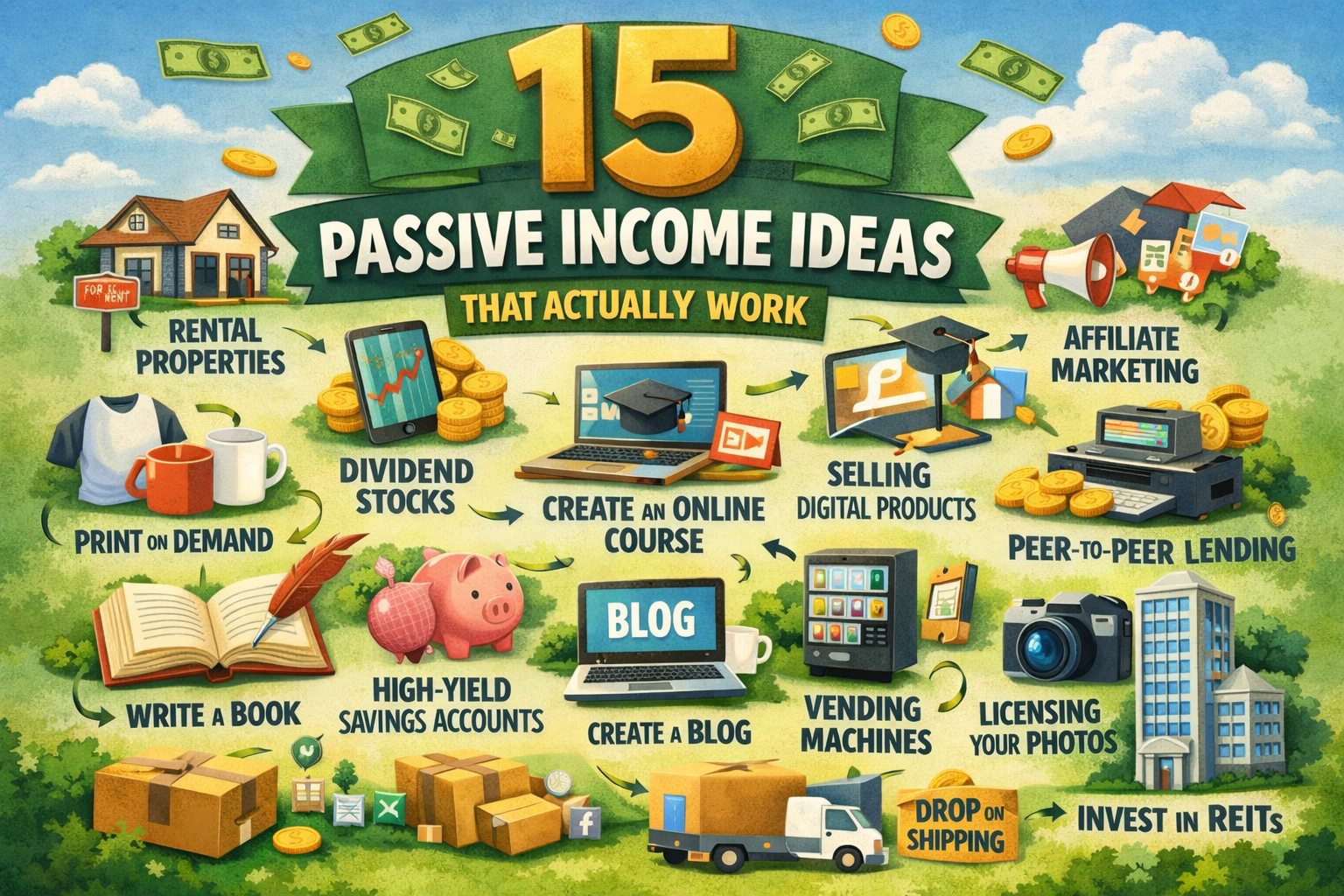
15 Passive Income Ideas That Actually Work
Let’s be honest about something. “Passive income” is one of the most overhyped phrases on the internet. Scroll through social media, and you’ll find endless promises of automated money, “set it and forget it” systems, and gurus selling dreams from rented Airbnbs. The reality, as with most things, is more nuanced—and more achievable.
I’ve spent the last decade exploring, testing, and talking to people who’ve built genuine passive income ideas that actually work. Not the “get rich quick” schemes. Not the multi-level marketing pitches disguised as opportunity. The real, boring, sustainable methods that real people use to build financial freedom.
Here’s what I’ve learned: truly passive income is rare. Most income streams require upfront work—sometimes months or years of it—before they generate anything. But once they’re built, they can produce money with minimal ongoing effort, freeing your time and attention for what matters most.
The ideas we’ll explore span a wide range: some require capital, others require creativity, some need technical skills, others just need consistency. The common thread is that they’ve worked for real people, and they can work for you.
Whether you’re looking to replace your paycheck, supplement your income, or build long-term wealth, these passive income ideas that actually work offer a roadmap. Let’s dive in.
Part 1: What Passive Income Actually Means
Before we get to the list, we need to be clear about what we’re discussing. Passive income ideas that actually work share certain characteristics:
- Upfront investment. Every passive income stream requires something upfront—time, money, skills, or (usually) a combination.
- Scalable effort. The work-to-income ratio improves over time. You might earn nothing for months, then see returns grow with minimal additional effort.
- Systems, not transactions. You’re building something that can run without your constant presence.
The ideas below range from truly passive (dividend stocks, where money works without you) to “lightly active” (a blog you update monthly, a course you refresh annually). All are worth considering, depending on your goals and resources.
Idea #1: Dividend Stocks
Dividend investing is the classic passive income strategy—and for good reason.
How it works: You buy shares of companies that distribute a portion of their profits to shareholders, typically quarterly. Over time, as you reinvest dividends and buy more shares, your income compounds.
What makes it work: Quality companies with long histories of paying and increasing dividends—often called “Dividend Aristocrats”—provide reliable income that grows faster than inflation. Companies like Coca-Cola, Johnson & Johnson, and Procter & Gamble have paid dividends for decades through wars, recessions, and market crashes.
Getting started:
- Open a brokerage account at Vanguard, Fidelity, or Schwab
- Focus on dividend-focused ETFs like VYM (Vanguard High Dividend Yield) or SCHD (Schwab U.S. Dividend Equity) for instant diversification
- Reinvest dividends automatically to harness compounding
- Target a 3-4% yield as a reasonable starting point
Realistic expectations: With $100,000 invested at 3.5%, you’d generate $3,500 annually—about $292 monthly. Build over time, and the income grows.
Idea #2: High-Yield Savings Accounts
This isn’t exciting, but it’s the safest passive income you’ll find.
How it works: Online banks offer savings accounts with competitive interest rates—currently 4-5% at many institutions—because they don’t have branch overhead.
What makes it work: Your money earns interest while sitting in an FDIC-insured account. No risk, no volatility, no effort.
Getting started:
- Compare rates at banks like Ally, Marcus, CIT, or SoFi
- Open an account (takes minutes)
- Transfer your emergency fund or short-term savings
- Watch interest accrue monthly
Realistic expectations: On $25,000 at 4.5%, you’ll earn about $1,125 annually—$94 monthly. Not life-changing, but effortless.
Idea #3: Create an Online Course
If you have expertise others want, an online course can generate income for years.
How it works: Package your knowledge into video lessons, worksheets, and resources. Sell through platforms like Teachable, Kajabi, or Udemy.
What makes it work: People will always pay to learn skills that improve their lives—career advancement, hobbies, personal development. Once created, a course can sell indefinitely with minimal updates.
Getting started:
- Identify a topic you know well that others want to learn
- Research existing courses to understand pricing and positioning
- Create an outline and record your content (smartphone is fine)
- Launch on a platform and promote through your network
- Collect feedback and improve
Realistic expectations: A $100 course selling 10 copies monthly generates $1,000 monthly. Top creators earn six figures annually.
Idea #4: Write a Book
Self-publishing has democratized book authorship. Anyone with a story or expertise can become a published author.
How it works: Write your book (or hire a ghostwriter), format it for Amazon Kindle, and publish through Kindle Direct Publishing. You earn royalties on every sale.
What makes it work: Amazon handles printing, delivery, and customer service. Your book sits in the world’s largest bookstore indefinitely, generating passive income year after year.
Getting started:
- Choose a topic with proven demand (research Amazon categories)
- Write a quality manuscript—hire an editor
- Design a professional cover (Fiverr or Canva)
- Publish on KDP and promote through your network
- Consider an audiobook version through ACX
Realistic expectations: Most books sell modestly—50-100 copies monthly is a success. At $2.99 royalty per ebook, that’s $150-300 monthly. Some authors hit bestseller lists and earn much more.
Idea #5: Print on Demand
No inventory, no upfront costs, no shipping—just your designs on products.
How it works: You create designs, upload them to platforms like Printful, Redbubble, or Merch by Amazon. When someone orders, the platform prints your design on a t-shirt, mug, or phone case and ships it directly. You keep a royalty.
What makes it work: The platform handles everything—printing, shipping, customer service. You focus on creating designs that resonate with specific audiences.
Getting started:
- Identify a niche audience (dog lovers, gamers, teachers)
- Create designs using Canva or hire a designer on Fiverr
- Upload to multiple platforms to maximize exposure
- Promote through social media or Pinterest
- Analyze what sells and create more in that style
Realistic expectations: Most sellers earn pocket money—$50-500 monthly. Successful niche sellers earn thousands.
Idea #6: Peer-to-Peer Lending
Become the bank and earn interest on loans to individuals or small businesses.
How it works: Platforms like LendingClub, Prosper, or Funding Circle connect borrowers with investors. You fund portions of loans and earn interest as they’re repaid.
What makes it work: Returns historically range from 4-8%, though defaults happen. Diversification across many loans reduces risk.
Getting started:
- Open an account on a P2P lending platform
- Start small to understand the mechanics
- Diversify across many loans ($25-50 each)
- Reinvest payments to compound returns
- Monitor performance and adjust strategy
Realistic expectations: With $10,000 diversified across hundreds of loans, you might earn $500-800 annually. Higher risk loans offer higher potential returns—and higher default rates.
Idea #7: Real Estate Investment Trusts (REITs)
Real estate without the hassle of tenants, toilets, or termites.
How it works: REITs are companies that own and operate income-producing real estate—apartments, offices, malls, warehouses. They’re required by law to distribute 90% of taxable income to shareholders as dividends.
What makes it work: You get real estate exposure with professional management, diversification, and liquidity. Publicly traded REITs trade like stocks; you can buy and sell anytime.
Getting started:
- Research REITs in sectors you understand (residential, healthcare, industrial)
- Consider REIT ETFs like VNQ or SCHH for instant diversification
- Focus on dividend history and payout ratios
- Reinvest dividends to compound
Realistic expectations: REITs typically yield 4-7%. On $50,000 invested, that’s $2,000-3,500 annually.
Idea #8: Create a Blog
Blogging isn’t dead—it’s just evolved. Quality content consistently published can generate significant passive income.
How it works: You write articles around topics people search for. Over time, content ranks in search engines, attracting readers. You monetize through ads, affiliate links, digital products, or sponsored posts.
What makes it work: Once written, an article can attract visitors for years. A single high-ranking post can generate passive income indefinitely.
Getting started:
- Choose a niche you’re passionate about (personal finance, travel, parenting, hobbies)
- Set up a WordPress site with hosting
- Research keywords your audience searches
- Write comprehensive, helpful content (1,500-2,500 words per post)
- Apply for ad networks (AdSense, Mediavine, Raptive) once you have traffic
- Add affiliate links where relevant
Realistic expectations: Most bloggers earn nothing for 6-12 months. With consistency, $500-2,000 monthly is achievable. Top bloggers earn five figures monthly.
Idea #9: Licensing Your Photos
If you have an eye for composition and a decent camera (or even a modern smartphone), your photos can earn passive income.
How it works: Upload your best images to stock photography sites like Shutterstock, iStock, or Adobe Stock. Each time someone downloads your photo, you earn a royalty.
What makes it work: Quality images are always in demand for websites, marketing materials, and publications. One photo can sell hundreds of times over years.
Getting started:
- Learn basic photography and editing skills
- Shoot what’s in demand—business, lifestyle, nature, food
- Upload consistently (quantity matters)
- Write descriptive keywords so buyers can find your images
- Track what sells and create more like it
Realistic expectations: Most contributors earn modestly—$50-200 monthly. Successful contributors with large portfolios earn thousands.
Idea #10: Vending Machines
Old-school passive income that still works in 2026.
How it works: You buy vending machines, place them in high-traffic locations, and collect the cash. Modern machines accept credit cards and report inventory remotely.
What makes it work: Once placed and stocked, machines generate income with minimal intervention. Technology has made management easier—you can monitor sales and inventory from your phone.
Getting started:
- Research local regulations and permit requirements
- Find a used machine to start (Facebook Marketplace, Craigslist)
- Secure a location (offer the business owner a commission)
- Stock popular items and track sales
- Expand as you learn
Realistic expectations: A well-placed machine can generate $200-400 monthly after costs. With 5-10 machines, that’s meaningful passive income.
Idea #11: Affiliate Marketing
Earn commissions promoting other people’s products.
How it works: You join affiliate programs (Amazon Associates, ShareASale, individual company programs). You promote products through content, emails, or social media. When someone buys through your link, you earn a commission.
What makes it work: You don’t create products, handle inventory, or manage customer service. You just connect buyers with sellers and earn a cut.
Getting started:
- Build an audience (blog, YouTube, email list, social media)
- Promote products you genuinely use and recommend
- Disclose affiliate relationships transparently
- Create helpful content that naturally includes affiliate links
- Track performance and double down on what works
Realistic expectations: Commissions range from 1-20% depending on product. A site with 10,000 monthly visitors might earn $500-2,000 monthly from affiliates.
Idea #12: Dropshipping
E-commerce without inventory.
How it works: You set up an online store (Shopify, WooCommerce). When a customer orders, you purchase the item from a supplier who ships directly to the customer. You never touch the product.
What makes it work: Low startup costs, no inventory risk, and the ability to test many products quickly. Success depends on marketing and customer experience.
Getting started:
- Choose a niche with passionate buyers
- Find reliable suppliers (Oberlo, Spocket, AliExpress)
- Set up your store with quality product photos and descriptions
- Drive traffic through social media ads or SEO
- Test and optimize continuously
Realistic expectations: Most dropshippers earn little; successful operators earn $1,000-5,000 monthly. Competition is fierce.
Idea #13: Rental Property
The classic passive income vehicle—with caveats.
How it works: You buy property and rent it to tenants. Monthly rent covers your mortgage, taxes, insurance, and maintenance—with profit left over.
What makes it work: Real estate appreciates over time, tenants build your equity, and rents typically rise with inflation. With good property management, it can be genuinely passive.
Getting started:
- Research markets with strong rental demand and reasonable prices
- Run the numbers—can you cash flow with 20-25% down?
- Consider a property manager (8-10% of rent) for true passivity
- Start with one property and learn before expanding
- Build a team: agent, lender, inspector, contractor, property manager
Realistic expectations: A well-chosen property might cash flow $200-500 monthly after all expenses, plus equity build and appreciation.
Idea #14: Digital Products (Templates, Printables, Tools)
Create once, sell forever.
How it works: Design digital products—resume templates, budgeting spreadsheets, social media graphics, planners, checklists—and sell them on platforms like Etsy, Gumroad, or your own site.
What makes it work: Digital products have zero marginal cost. You create once, and every sale is pure profit. Platforms handle delivery and payment.
Getting started:
- Identify a need your audience has
- Create a high-quality template or tool
- Set up a shop on Etsy or Gumroad
- Write compelling descriptions and keywords
- Promote through social media and Pinterest
Realistic expectations: A $10 product selling 50 copies monthly generates $500. Multiple products scale the income.
Idea #15: Invest in a Blog or Website
Buy existing passive income streams.
How it works: Platforms like Flippa, Empire Flippers, and Acquire.com connect buyers and sellers of online businesses. You purchase a site with existing traffic and income, then maintain or improve it.
What makes it work: You skip the startup phase and buy proven assets. With multiple revenue streams (ads, affiliates, products), you diversify risk.
Getting started:
- Research platforms and learn valuation metrics (typically 2-4x annual profit)
- Start with smaller sites to learn the ropes
- Conduct thorough due diligence (traffic sources, revenue verification, SEO health)
- Have a plan to maintain and improve after purchase
- Consider partnering with experienced operators
Realistic expectations: A $20,000 site earning $500 monthly pays for itself in 3-4 years, then generates pure profit.
Part 2: How to Choose Your Path
With 15 passive income ideas that actually work, how do you choose?
Consider Your Resources
| Resource | Best-Fit Ideas |
|---|---|
| Capital | Dividend stocks, REITs, rental property, vending machines, buying a site |
| Time | Blog, online course, book, digital products, affiliate marketing |
| Skills | Course creation, book writing, licensing photos, digital products |
| Risk tolerance | High-yield savings (low risk) vs. dropshipping (higher risk) |
Consider Your Timeline
- Immediate income (weeks): High-yield savings, dividend stocks (already purchased)
- Medium-term (months): Peer-to-peer lending, REITs, vending machines
- Long-term (years): Blog, online course, book, rental property, website investment
Consider Your Interests
The best passive income stream is one you’ll actually work on. If you hate writing, a blog is a terrible choice. If you love photography, licensing photos feels like fun, not work.
Part 3: Common Mistakes to Avoid
Mistake #1: Believing it’s truly passive. Everything requires upfront work. The “passive” part comes later.
Mistake #2: Spreading too thin. Start with one idea, master it, then expand. Doing fifteen things poorly leads nowhere.
Mistake #3: Ignoring taxes. Passive income is taxable. Understand your obligations and set aside money.
Mistake #4: Overestimating returns. Be realistic. Most ideas generate modest income; the outliers you hear about are exceptions.
Mistake #5: Quitting too soon. Building passive income takes time. The people who succeed are those who persist through the early months of zero returns.
Conclusion
Let’s bring this together.
The dream of passive income—money flowing in while you sleep—is real. But it’s not magic. It’s the result of deliberate effort, smart choices, and patience.
The 15 passive income ideas that actually work we’ve explored span the spectrum from traditional (dividend stocks, rental property) to modern (digital products, print on demand). Some require capital. Some require creativity. Some require technical skills. All require work upfront to build the machine that later runs without you.
The key is to start. Pick one idea that fits your resources, timeline, and interests. Learn everything you can about it. Take imperfect action. Adjust as you go. And give it time.
A year from now, you could have a blog generating affiliate income. A course selling while you sleep. A portfolio of dividend stocks compounding toward freedom. Or you could be exactly where you are, having read articles but never acted.
The choice is yours.
Related Post
The Ultimate Guide to Personal Finance for Beginners
Let me ask you something uncomfortable. When was the last time you lay in bed…