

15 Habits That Will Make You Financially Successful
Money Strategy Lab >> Finance>>Investing>> 15 Habits That Will Make You Financially Successful
15 Habits That Will Make You Financially Successful
I used to believe that financial success was about making the right big decisions. Pick the right career. Buy the right stocks. Launch the business at exactly the right moment. Get lucky with that one investment that multiplies overnight.
Then I spent a decade watching people build wealth—real, lasting wealth—and I realized I had it completely backwards.
Financial success isn’t determined by the handful of dramatic moments in your life. It’s determined by the thousands of invisible moments. The small choices you make daily, weekly, monthly, that compound over years into something extraordinary. The habits you practice when nobody’s watching.
Think about it this way: Two people with identical incomes and identical opportunities can end up in radically different financial positions twenty years later. The difference isn’t luck. It isn’t inheritance. It’s the cumulative effect of their daily habits.
The person who automatically saves before spending. The person who reads instead of scrolls. The person who questions every subscription instead of letting them pile up. The person who invests consistently through bull and bear markets. These aren’t heroic acts. They’re small disciplines that, repeated thousands of times, create financial independence.
I’ve studied the habits of people who achieve genuine financial success—not the Instagram kind with rented jets and borrowed watches, but the quiet kind with paid-off houses and meaningful options. And I’ve distilled what I learned into fifteen habits you can start practicing today.
Some will feel easy. Some will feel uncomfortable. All of them work.
Let’s dive in.
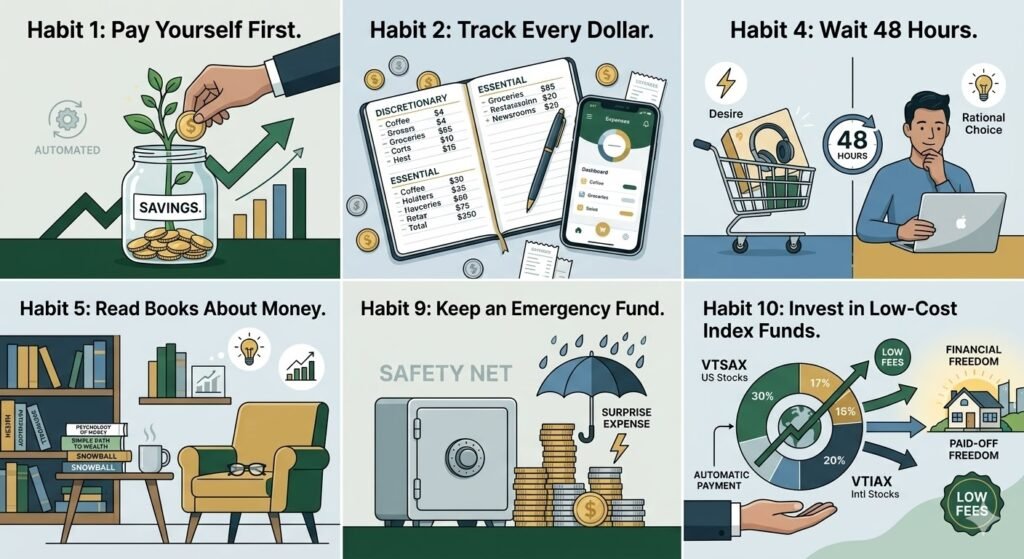
Habit 1: Pay Yourself First
Most people handle money backward. They earn their paycheck, pay all their bills, spend on various wants, and then—if anything happens to be left—they save it. This approach virtually guarantees that saving will be inconsistent at best and nonexistent at worst.
Financially successful people flip the script. They pay themselves first.
The moment their paycheck arrives, they automate a transfer to savings and investments. Not after the bills. Not after the weekend spending. First. Before anything else.
This habit leverages a powerful psychological truth: we adapt quickly to whatever we have. If your savings happen automatically, you simply learn to live on what remains. You don’t miss money you never saw.
How to implement this habit for financial success today:
| Action | Example |
|---|---|
| Set up automatic transfer on payday | $500 moves to investment account before you see it |
| Increase gradually | Raise the amount by 1% every three months |
| Treat it as non-negotiable | This isn’t saving “if possible”—it’s required |
The specific amount matters less than the consistency. Save 10% automatically and you’ll eventually be wealthy. Save 20% and you’ll be wealthy faster. Save 30% and you’ll have options most people can’t imagine.
Financial success tip: Start with whatever you can—even $50 per paycheck—and increase it every time you get a raise. Your future self will thank you.
Habit 2: Track Every Dollar for 30 Days
Here’s an uncomfortable truth: most people have no idea where their money actually goes. They have a vague sense—”I spend about $400 on eating out”—but when they actually track it, the real number is often double.
Financially successful people know their numbers. Not because they’re obsessive, but because you can’t optimize what you don’t measure.
Take thirty days and track absolutely every expense. Every coffee, every subscription, every online order, every cash purchase. Use an app, a spreadsheet, or a notebook—whatever works for you.
At the end of thirty days, categorize your spending and prepare to be surprised. You’ll almost certainly find leaks you didn’t know existed. Small amounts that add up to hundreds or thousands annually.
Common leaks people discover on their path to financial success:
- Subscriptions they forgot about (average American has $200+ monthly in forgotten subscriptions)
- Takeout and delivery fees that double the cost of meals
- Convenience purchases at gas stations and corner stores
- Banking fees and ATM charges
- Impulse Amazon orders for things they never use
Financial success habit: Make this a quarterly practice. Spend thirty days tracking every dollar, then use what you learn to reset your spending targets. The awareness alone will change your behavior.
Habit 3: Question Every Subscription
The subscription economy is quietly bleeding millions of people dry. Streaming services, gym memberships, software tools, box subscriptions, meal kits, delivery memberships—each one seems small, but together they often consume hundreds monthly.
Financially successful people audit their subscriptions ruthlessly.
They ask three questions about every recurring charge:
- Do I actually use this? If you haven’t opened the app in thirty days, cancel it.
- Could I achieve the same benefit for free? Many paid services have free alternatives that are “good enough.”
- Is this serving my goals or just my impulses? That premium productivity app you bought but never opened isn’t making you more productive.
The annual subscription audit for financial success:
Set a calendar reminder for the first of every quarter. Spend one hour reviewing all recurring charges. Cancel everything that doesn’t pass the three-question test. You’ll likely save $500-$2,000 annually with minimal effort.
Financial success insight: The money you save by canceling unused subscriptions isn’t just money saved—it’s money that can now be invested, where it will grow and compound. A $30 monthly subscription canceled at age thirty is worth over $20,000 by retirement age if invested instead.
Habit 4: Wait 48 Hours Before Non-Essential Purchases
Impulse spending is the enemy of financial success. The modern economy is designed to separate you from your money as quickly as possible—one-click ordering, buy-now-pay-later, limited-time offers, flash sales.
Financially successful people build a buffer between desire and purchase.
For any non-essential purchase over a certain threshold (you choose the amount—$50, $100, whatever fits your situation), they wait 48 hours before buying. They add it to a cart or a list, then walk away.
What happens in those 48 hours is fascinating. The initial dopamine hit fades. Rational thinking returns. Often, you realize you don’t actually want the thing—you just wanted the feeling of wanting it.
How to implement this financial success habit:
| Threshold | Wait Time | Action |
|---|---|---|
| Under $50 | 24 hours | Add to cart, revisit tomorrow |
| $50-$200 | 48 hours | Note the item, wait two full days |
| $200-$1000 | 1 week | Research thoroughly, compare options |
| Over $1000 | 30 days | If you still want it after a month, it’s probably meaningful |
Financial success tip: Use a “wish list” document where you record everything you want to buy with the date. Review it monthly. You’ll be shocked how many items you delete without ever purchasing.
Habit 5: Read Books About Money
The average millionaire reads about 12 books per year on topics related to business, investing, and personal development. The average person reads one—if that.
Financially successful people are perpetual learners. They understand that financial education is an ongoing process, not a one-time event.
You don’t need a finance degree. You don’t need to understand options trading or cryptocurrency speculation. You need a solid foundation of principles that have worked for generations.
Essential reading for financial success:
| Category | Book | Key Lesson |
|---|---|---|
| Mindset | The Psychology of Money | Financial success is behavior, not knowledge |
| Investing | The Simple Path to Wealth | Low-cost index funds beat almost everything |
| Philosophy | Your Money or Your Life | Money is time; spend both intentionally |
| Biography | The Snowball | Warren Buffett’s life illustrates compounding in action |
| Practical | I Will Teach You to Be Rich | Systems over willpower |
Financial success habit: Read one book about money per month. That’s twelve per year. After three years, you’ll know more than 99% of the population about building wealth. After five years, you’ll have internalized principles that guide every decision.
Habit 6: Automate Everything Possible
Willpower is a limited resource. Every decision you make—what to eat, what to wear, whether to save—depletes it slightly. By the end of the day, your ability to make good choices is significantly reduced.
Financially successful people don’t rely on willpower. They rely on automation.
They automate their savings. Their investments. Their bill payments. Their retirement contributions. They set these systems up once, then let them run indefinitely.
What to automate for financial success:
- Savings transfer from checking to savings/investments on payday
- Investment contributions into index funds monthly
- Bill payments for everything possible (to avoid late fees)
- Credit card payments in full (to avoid interest)
- Annual subscription reviews (calendar reminder)
- Net worth tracking (spreadsheet or app update)
Financial success insight: Every dollar you automate is a dollar you don’t have to think about. And thinking less about money decisions—once the systems are right—is actually the goal. You want your wealth building to happen in the background while you focus on living.
Habit 7: Talk About Money Openly
Money is the last taboo. We’ll discuss intimate details of our relationships, our health struggles, our family drama—but ask someone what they earn or what they’ve saved, and the conversation stops cold.
This silence is costly. It means we never learn what’s normal, what’s possible, or what strategies actually work. We compare ourselves to curated social media highlights rather than real people with real numbers.
Financially successful people find ways to talk about money constructively.
This doesn’t mean bragging or prying. It means finding a small circle of trusted friends or family who share your goals and being transparent with each other about progress, struggles, and strategies.
How to build your money circle for financial success:
- Identify 2-3 people who are also interested in financial success
- Set monthly or quarterly check-ins to discuss goals and progress
- Share resources—books, podcasts, articles you’ve found helpful
- Be vulnerable about mistakes so others can learn
- Celebrate wins together to maintain motivation
Financial success tip: If you can’t find people in your immediate circle, look online. Communities like the ChooseFI forum, r/financialindependence, or local FIRE meetups provide connection with like-minded people at all stages of the journey.
Habit 8: Define Your “Why”
Saving money is hard. Investing consistently is hard. Passing up immediate gratification for future freedom is hard. Without a compelling reason, you won’t sustain the effort.
Financially successful people have a clear, personal, emotionally resonant vision of why they’re doing this.
Not “I want to be rich.” That’s too vague. Something like:
- “I want to quit my job by 45 and spend summers traveling with my kids.”
- “I want the freedom to take a lower-paying, more meaningful role without stress.”
- “I want to sleep soundly knowing I could survive a year of unemployment.”
- “I want to leave a legacy that helps my grandkids afford college.”
Your why needs to be:
| Quality | Why It Matters |
|---|---|
| Specific | Vague goals produce vague effort |
| Personal | Must resonate with your values, not someone else’s |
| Visual | You should be able to picture it clearly |
| Emotional | Should connect to feelings, not just numbers |
| Written | Put it somewhere you’ll see regularly |
Financial success habit: Write your why on a sticky note and put it on your bathroom mirror. Or set it as your phone wallpaper. Or create a vision board. The point is to make it visible so it counteracts the constant messaging telling you to spend today.
Habit 9: Keep an Emergency Fund
Life happens. Cars break. Roofs leak. Jobs disappear. Health issues arise. Without a buffer, these normal life events become financial catastrophes that derail years of progress.
Financially successful people maintain an emergency fund—cash set aside specifically for unexpected expenses.
This fund serves two purposes. First, it prevents you from going into debt when surprises occur. Second, it provides psychological security that makes long-term investing easier. When you know you have a safety net, you don’t panic-sell investments during market downturns.
Emergency fund guidelines for financial success:
| Factor | Recommendation |
|---|---|
| Size | 3-6 months of essential expenses |
| Location | High-yield savings account (not investments) |
| Access | Liquid and accessible within 24-48 hours |
| Definition | Only for true emergencies, not planned expenses |
| Replenishment | If used, rebuild before resuming aggressive investing |
Financial success insight: The emergency fund is boring money. It earns minimal interest. It sits there doing nothing most of the time. That’s exactly what you want. Its job isn’t growth—its job is protection.
Habit 10: Invest in Low-Cost Index Funds
The investment industry spends billions convincing you that picking winning stocks or timing the market is both possible and necessary. The evidence says otherwise.
Over any meaningful time horizon, the vast majority of professional investors fail to beat simple market indexes. And after fees and taxes, the gap widens further.
Financially successful people ignore the noise and invest in low-cost index funds that own the entire market.
Why index funds are essential for financial success:
| Advantage | Explanation |
|---|---|
| Diversification | Own thousands of companies, not a handful |
| Low costs | Expense ratios of 0.03%-0.10% vs. 1%+ for active funds |
| Tax efficiency | Low turnover means fewer taxable events |
| Simplicity | One decision, automated, forever |
| Historical performance | Consistently beats most active managers |
The simple portfolio for financial success:
- 60-80% total US stock market index fund (VTSAX or similar)
- 20-40% total international stock market index fund (VTIAX or similar)
- Optionally, add bonds as you approach retirement
That’s it. Two funds. Automatic contributions. Hold for decades. This simple approach has built more wealth than all the complex trading strategies combined.
Financial success tip: When markets drop—and they will—keep buying. Lower prices mean your future contributions buy more shares. This is the single most important investing discipline.
Habit 11: Ignore Financial Media
Financial media has one goal: to keep you watching, reading, and clicking. The best way to do that is to make you feel anxious, excited, fearful, or greedy—preferably all four in rapid succession.
Every day brings a new crisis. Markets are crashing! No, they’re soaring! This sector is dead! No, it’s the opportunity of a lifetime! The noise is endless and, for building wealth, utterly useless.
Financially successful people tune it out.
They understand that their investment strategy shouldn’t change based on today’s headlines. They know that market timing is a fool’s errand. They recognize that the more frequently they check their portfolio, the more likely they are to make bad decisions.
How to reduce financial media consumption on your path to financial success:
- Unsubscribe from financial newsletters and alerts
- Stop checking your portfolio daily (monthly is plenty)
- Ignore stock tips from friends, family, and internet strangers
- Remember that nobody knows what markets will do tomorrow
- Focus on what you can control: savings rate, career, spending
Financial success insight: The less attention you pay to financial news, the better your long-term results will be. This sounds counterintuitive, but decades of data support it. The most successful investors are often the most bored.
Habit 12: Continuously Increase Your Income
Saving and investing are powerful, but they have limits. You can only cut spending so far. Your income, however, has no theoretical ceiling.
Financially successful people treat their career and income as an engine to be continuously optimized.
This doesn’t mean grinding yourself to burnout. It means being strategic about your most valuable asset: your ability to earn.
Income growth strategies for financial success:
| Strategy | Example | Potential Impact |
|---|---|---|
| Skill development | Learn high-value skills in your field | 10-20% raises |
| Job switching | Change employers every 2-4 years | 15-30% increases each move |
| Negotiation | Always negotiate offers and raises | 5-10% one-time gains |
| Side business | Start a venture in your spare time | $500-$5000+ monthly |
| Promotion path | Target roles with clear advancement | 20-50% over 3-5 years |
Financial success tip: The most valuable investment you can make is often in yourself—courses, certifications, coaching, networking. These investments compound in ways that stock market returns can’t match.
Habit 13: Practice Contentment
Here’s a paradox: the people who accumulate the most wealth are often the least interested in accumulating things.
Financially successful people have learned to be satisfied with enough. They’ve broken the link between consumption and happiness.
This isn’t deprivation. It’s liberation. When you stop trying to fill an emotional hole with material purchases, you free up massive resources—money, time, attention—for things that actually matter.
How to practice contentment on your journey to financial success:
- Distinguish needs from wants honestly
- Savor what you have rather than craving what you don’t
- Wait before buying (see Habit 4)
- Compare down occasionally, not just up
- Cultivate gratitude through journaling or reflection
Financial success insight: The ability to be happy with less is a superpower. It means you need less money to feel secure, which means you reach financial success faster. And when you get there, you’re already content—so the destination fulfills as much as the journey.
Habit 14: Surround Yourself With the Right People
You are the average of the five people you spend the most time with. This is as true for money as for any other area of life.
If your closest friends see debt as normal, spend beyond their means, and never talk about saving or investing, you’ll absorb those attitudes. If they’re intentional about money, discuss strategies, and celebrate progress, you’ll rise to that level.
Financially successful people consciously curate their influences.
How to build a supportive environment for financial success:
| Action | Why It Helps |
|---|---|
| Find your people | Connect with others on the same path |
| Limit time with negative influences | Protect your mindset |
| Share goals publicly | Accountability increases follow-through |
| Celebrate non-consumption wins | Reinforce that freedom matters more than stuff |
| Give back | Teaching others solidifies your own knowledge |
Financial success tip: If you can’t find financially intentional people locally, find them online. The financial independence community is vast, supportive, and full of practical wisdom.
Habit 15: Start Today, Not Tomorrow
The single biggest mistake people make with money is waiting. Waiting until they earn more. Waiting until debt is paid. Waiting until they understand everything perfectly. Waiting for the “right time.”
There is no right time. There is only now.
Financially successful people start where they are with what they have. They open the investment account with $50. They save 1% if they can’t save 10%. They read one book if they can’t read twelve. They take imperfect action immediately rather than waiting for perfect conditions later.
The cost of waiting for financial success:
| Start Age | Monthly Savings | Annual Return | Value at 65 |
|---|---|---|---|
| 25 | $500 | 7% | $1.2 million |
| 35 | $500 | 7% | $567,000 |
| 45 | $500 | 7% | $245,000 |
Waiting ten years costs over $600,000. The best time to start was twenty years ago. The second best time is today.
Financial success call to action: Right now, do one thing. Open that savings account. Set up that automatic transfer. Buy that book. Cancel that subscription. Read one article. Whatever it is, do it now. Not tomorrow. Not Monday. Now.
Conclusion
Financial success isn’t about making one brilliant move. It’s about making hundreds of small, correct moves consistently over time. It’s about habits—the invisible architecture of daily life—that compound into wealth.
Let’s recap the fifteen habits that lead to financial success:
- Pay yourself first – Automate savings before anything else
- Track every dollar – Know where your money goes
- Question every subscription – Eliminate waste
- Wait 48 hours – Kill impulse purchases
- Read about money – Invest in financial education
- Automate everything – Remove decision fatigue
- Talk about money – Break the taboo
- Define your why – Connect saving to meaning
- Keep an emergency fund – Build a safety net
- Invest in index funds – Own the market cheaply
- Ignore financial media – Tune out the noise
- Increase your income – Optimize your earning engine
- Practice contentment – Want what you have
- Surround yourself wisely – Choose your influences
- Start today – Take action now
Some of these habits will feel natural. Some will feel like work. All of them will compound over time into something remarkable.
The people who achieve genuine financial success aren’t smarter than you. They aren’t luckier than you. They simply practice different habits, day after day, year after year.
And habits can be learned.
Start with one. Just one. Practice it until it becomes automatic. Then add another. Over time, you’ll transform not just your finances, but your entire relationship with money.
The life you want—the freedom, the security, the options—is built one habit at a time.
Start today.
Related Post

The Ultimate Guide to Personal Finance for Beginners
Let me ask you something uncomfortable. When was the last time you lay in bed…