

10 Best Long-Term Investment Strategies That Work
Money Strategy Lab >> Finance>>Investing>> 10 Best Long-Term Investment Strategies That Work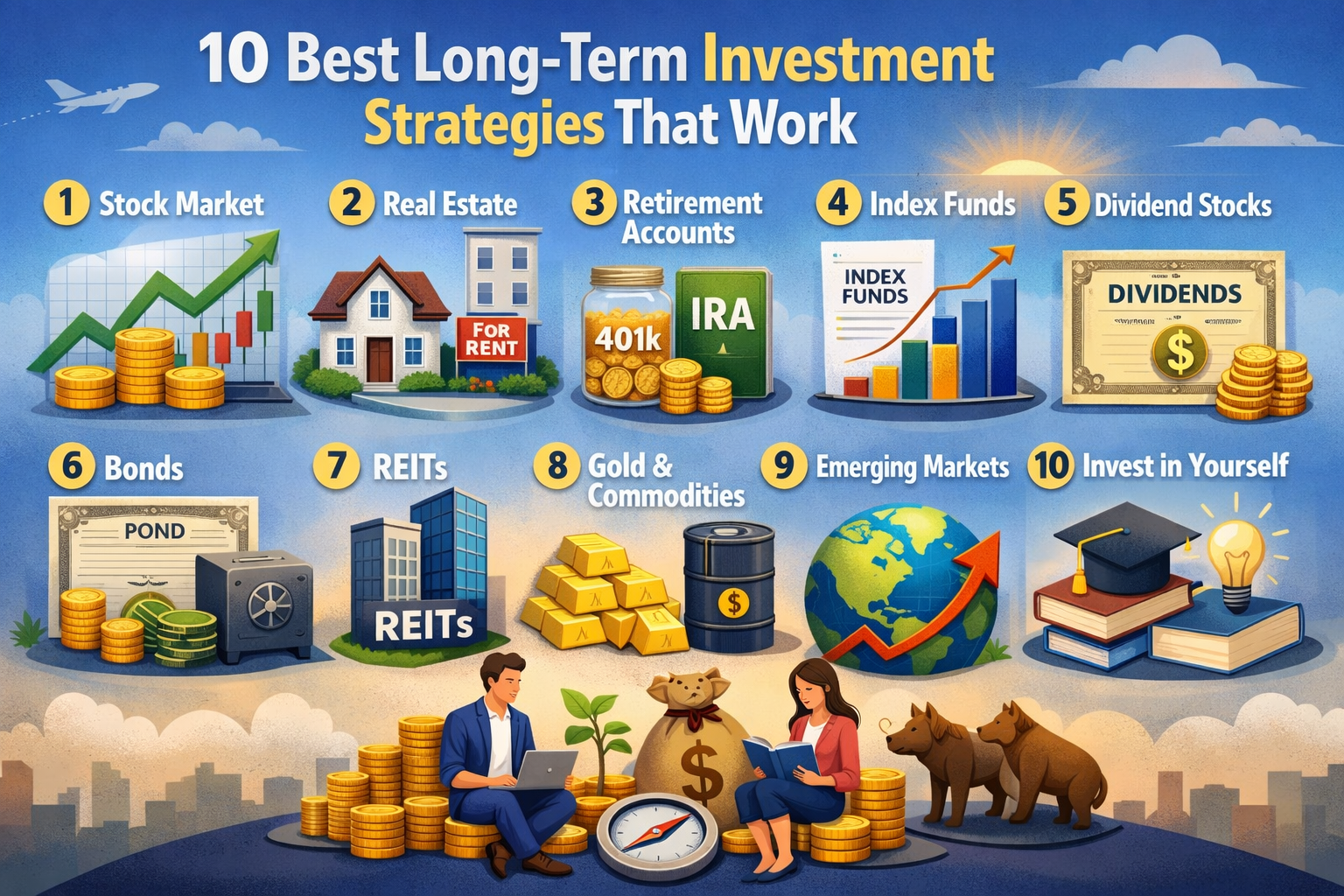
10 Best Long-Term Investment Strategies That Work
I have a confession to make. For the first five years of my investing life, I had absolutely no strategy. I bought things because they sounded exciting. I sold things because I got nervous. I chased tips from friends, articles I’d read, and the occasional “hot stock” my uncle mentioned at Thanksgiving. My portfolio was less an investment plan and more a collection of financial impulses.
The result? I underperformed the market. By a lot. And I gave myself a generous amount of unnecessary anxiety along the way.
Here’s what I eventually learned: long-term investment strategies aren’t complicated. In fact, the ones that work best are almost boring. They don’t require timing the market, picking the next Amazon, or decoding complex charts. They require patience, consistency, and the ability to ignore the noise.
The data backs this up. Studies consistently show that the average investor significantly underperforms the market—not because they’re unlucky, but because they buy high (when excited) and sell low (when scared). The antidote to this isn’t genius. It’s a proven long-term investment approach that removes emotion from the equation.
In this guide, I’ll walk you through ten long-term investment strategies that actually work. Some you can implement in minutes. Others require more planning. All of them are grounded in evidence, not hype. Whether you’re just starting out or looking to refine an existing portfolio, these strategies will give you a framework for building lasting wealth.
Let’s dive in.
Strategy 1: Stock Market Investing
The stock market has been the primary wealth-building engine for generations. Stock market investing remains the cornerstone of most long-term investment strategies.
What It Is
Stock market investing means buying ownership shares in publicly traded companies. When you own a stock, you own a piece of that business—its profits, its growth, and its risks.
Why It Works
Over the long term, stocks have outperformed every other major asset class. Since 1926, U.S. stocks have returned an average of about 10% annually . Not every year—there have been crashes, bear markets, and lost decades—but every 20-year period in history has been profitable .
The magic is compounding. When you reinvest dividends and hold for decades, small investments grow into substantial wealth.
How to Implement
| Approach | Description | Best For |
|---|---|---|
| Individual stocks | Research and buy specific companies | Active investors willing to do homework |
| Index funds | Buy baskets of stocks tracking an index | Most investors |
| ETFs | Trade like stocks, offer diversification | Easy, low-cost access |
For most people, low-cost index funds and ETFs are the smartest choice. They provide instant diversification and eliminate the need to pick individual winners.
Strategy 2: Real Estate Investing
Real estate has built more millionaires than almost any other asset class. Real estate investing offers unique advantages you can’t get from stocks.
What It Is
Real estate investing means owning physical property—residential homes, apartment buildings, commercial spaces, or land—with the goal of generating income and appreciation.
Why It Works
| Advantage | Explanation |
|---|---|
| Leverage | Buy property with borrowed money (mortgages) |
| Cash flow | Rent provides monthly income |
| Appreciation | Properties tend to increase in value over time |
| Tax benefits | Depreciation, deductions, and 1031 exchanges |
| Inflation hedge | Rents and property values rise with inflation |
| Control | You can improve the property to increase value |
How to Implement
| Method | Description | Capital Needed |
|---|---|---|
| Rental properties | Buy and hold residential or commercial | High (down payment) |
| REITs | Real Estate Investment Trusts (trade like stocks) | Low |
| Crowdfunding | Pool money with other investors | Medium |
| Fix-and-flip | Buy, renovate, sell quickly | High, active |
For beginners, REITs offer a way to own real estate without the hassles of tenants and toilets.
Strategy 3: Retirement Accounts
Before you invest anywhere else, take advantage of retirement accounts. These vehicles provide tax benefits that can supercharge your returns.
What It Is
Retirement accounts are specialized investment accounts with tax advantages. The two most common are 401(k)s (offered by employers) and IRAs (Individual Retirement Accounts, which you open yourself).
Why They Matter
| Account | Tax Treatment | 2024 Limits |
|---|---|---|
| Traditional 401(k)/IRA | Tax-deductible now, taxed later | $23,000 / $7,000 |
| Roth 401(k)/IRA | Taxed now, tax-free later | $23,000 / $7,000 |
| Employer match | Free money—always take it | Varies |
The math is compelling. If you’re in the 24% tax bracket, a $10,000 contribution to a traditional 401(k) saves you $2,400 in taxes immediately. That’s an instant return before your investments even grow.
The Order of Operations
- Contribute enough to 401(k) to get full employer match – This is free money
- Max out an IRA (Roth or traditional) – More control, often lower fees
- Go back to 401(k) – Increase contributions up to the limit
- Taxable brokerage account – After tax-advantaged space is full
Strategy 4: Index Funds

If you do nothing else on this list, do this. Index funds are the foundational long-term investment strategy that has built more wealth than any other approach.
What They Are
Index funds are baskets of investments that track a market index—the S&P 500, the total U.S. stock market, or global markets. When you buy an index fund, you’re not betting on any single company. You’re betting on the entire economy.
Why They Work
Warren Buffett made a famous bet: he wagered $1 million that a simple S&P 500 index fund would outperform a collection of hand-picked hedge funds over ten years. He won easily. The index fund returned 7.1% compounded annually; the hedge funds averaged just 2.2% .
The reasons are simple:
| Advantage | Explanation |
|---|---|
| Low costs | Expense ratios of 0.03%-0.10% vs. 1%+ for active funds |
| Diversification | Own thousands of companies instantly |
| Tax efficiency | Low turnover means fewer taxable events |
| Simplicity | One decision, automated, forever |
How to Implement
| Step | Action |
|---|---|
| 1 | Open a brokerage account (Vanguard, Fidelity, Schwab) |
| 2 | Choose a broad market fund like VTI (total U.S. stock market) or VOO (S&P 500) |
| 3 | Set up automatic monthly investments |
| 4 | Ignore the account except to add money |
The key: Don’t check daily. Don’t panic during downturns. Just keep buying.
Strategy 5: Dividend Stocks
Some investors want more than just price appreciation—they want cash flow. Dividend stocks focus on companies that pay regular income to shareholders.
What They Are
Dividend stocks are shares in companies that distribute a portion of their profits to shareholders, usually quarterly. Some companies not only pay dividends but increase them consistently year after year.
Why They Work
Dividend growers have historically outperformed the broader market with less volatility . The list of “Dividend Aristocrats”—companies that have increased dividends for 25+ consecutive years—includes names like Coca-Cola, Johnson & Johnson, and Procter & Gamble.
The compounding effect is powerful. When you reinvest dividends, you buy more shares, which generate more dividends, which buy more shares. Over decades, this snowball becomes massive.
How to Implement
| Approach | Description |
|---|---|
| Individual stocks | Research and buy dividend aristocrats |
| Dividend ETFs | VYM (Vanguard High Dividend Yield), SCHD (Schwab U.S. Dividend Equity) |
| Automatic reinvestment | Set dividends to reinvest automatically |
The key: Focus on dividend growth, not just current yield. A company paying 8% today that never raises dividends is worse than one paying 3% that doubles it every decade.
Strategy 6: Bonds
When stocks get scary, bonds provide stability. Bonds aren’t about getting rich—they’re about staying rich and sleeping well.
What They Are
Bonds are loans you make to governments or corporations. In return, they pay you interest and promise to repay your principal at a set date.
Why They Work
| Role | Why It Matters |
|---|---|
| Stability | Bonds are less volatile than stocks |
| Income | Regular interest payments |
| Diversification | Bonds often rise when stocks fall |
| Ballast | Reduces portfolio swings, helping you stay invested |
Types of Bonds
| Type | Risk Level | Best For |
|---|---|---|
| U.S. Treasuries | Lowest (government-backed) | Safety, stability |
| Municipal bonds | Low (often tax-free) | High tax brackets |
| Corporate bonds | Medium (company risk) | Higher income |
| High-yield bonds | Higher (“junk” bonds) | Aggressive income seekers |
How to Implement
| Method | Options |
|---|---|
| Individual bonds | Buy directly from TreasuryDirect or through brokers |
| Bond ETFs | BND (total bond market), AGG (aggregate bonds) |
| Target-date funds | Automatically adjust bond allocation as you age |
A common rule of thumb: your bond allocation should roughly equal your age. At 30, hold 30% in bonds; at 60, hold 60%.
Strategy 7: REITs (Real Estate Investment Trusts)
Real estate without the landlord hassles. REITs offer a way to own property through the stock market.
What They Are
Real Estate Investment Trusts (REITs) are companies that own and operate income-producing real estate. By law, they must distribute at least 90% of their taxable income to shareholders as dividends.
Why They Work
| Benefit | Description |
|---|---|
| Passive income | High dividend yields (typically 4-8%) |
| Diversification | Real estate behaves differently than stocks and bonds |
| Liquidity | REITs trade on exchanges—sell anytime |
| Professional management | No dealing with tenants |
| Inflation hedge | Rents rise with inflation |
Types of REITs
| Type | Examples |
|---|---|
| Equity REITs | Own physical properties (apartments, malls, warehouses) |
| Mortgage REITs | Own real estate debt (riskier) |
| Hybrid REITs | Own both properties and mortgages |
How to Implement
| Method | Options |
|---|---|
| Individual REITs | Research specific REITs |
| REIT ETFs | VNQ (Vanguard Real Estate ETF), SCHH (Schwab U.S. REIT ETF) |
Tax note: REIT dividends are generally taxed as ordinary income. Consider holding them in IRAs or 401(k)s.
Strategy 8: Gold and Commodities
Gold has been a store of value for thousands of years. Gold and commodities won’t generate dividends or earnings, but they serve a specific role.
What They Are
Commodities investing means owning physical assets like gold, silver, oil, agricultural products, or industrial metals—or financial instruments backed by them.
Why They Work
| Role | Explanation |
|---|---|
| Inflation hedge | Commodities often hold value when currencies lose purchasing power |
| Crisis insurance | During economic turmoil, gold can provide stability |
| Diversification | Commodities often move differently than stocks and bonds |
| Tangible asset | You own something real |
How Much to Allocate
Most experts suggest 5-10% of a portfolio in commodities as a hedge, not a core holding. Enough to matter, not so much that it drags returns in good times.
How to Implement
| Method | Pros | Cons |
|---|---|---|
| Physical bullion | Tangible ownership, no counterparty risk | Storage, insurance |
| ETFs (GLD, SLV) | Easy to trade, no storage | Fees, counterparty risk |
| Mining stocks | Leverage to metal prices | Company risk |
| Commodity futures | Direct exposure | Complex, risky |
For most people, a small allocation to a gold ETF like GLD makes sense.
Strategy 9: Emerging Markets
The fastest-growing economies aren’t in the U.S. or Europe. Emerging markets offer exposure to countries with younger populations, rising middle classes, and rapid industrialization.
What They Are
Emerging markets include countries like China, India, Brazil, South Korea, Taiwan, and Mexico—nations transitioning from developing to developed status.
Why They Work
| Factor | Explanation |
|---|---|
| Higher growth | Emerging economies often grow faster than developed |
| Demographics | Younger populations mean more workers, more consumers |
| Valuations | Often cheaper than developed market stocks |
| Diversification | Different economic drivers than U.S. |
Risks to Consider
| Risk | Mitigation |
|---|---|
| Political instability | Diversify across countries |
| Currency fluctuations | Long-term holding smooths effects |
| Less regulation | Stick to larger, established companies |
| Volatility | Expect bigger swings; hold for long term |
How to Implement
| Method | Options |
|---|---|
| Broad ETFs | VWO (Vanguard Emerging Markets), IEMG (iShares) |
| Country-specific | For those with strong conviction |
| Active funds | If you trust a manager’s expertise |
A reasonable allocation: 10-20% of your stock portfolio in emerging markets.
Strategy 10: Invest in Yourself

This might be the most important strategy on the list. Investing in yourself—your skills, knowledge, health, and relationships—often yields higher returns than any stock market investment.
What It Is
Personal development and entrepreneurial growth aren’t typical “investments,” but they should be. Every dollar spent on learning a new skill, building a business, or improving your health can multiply your earning potential and quality of life.
Why It Works
Consider the math:
- A course costing $500 that leads to a $5,000 raise pays for itself immediately and keeps paying forever.
- Starting a side business with $1,000 that grows to $50,000 annual profit is a 5,000% return.
- Investing in your health reduces medical costs and adds productive years to your life.
Unlike stocks, these investments aren’t subject to market volatility. They’re entirely within your control.
Areas to Invest In
| Area | Examples | Potential Return |
|---|---|---|
| Skills | Certifications, degrees, online courses | Higher income |
| Health | Gym, nutrition, preventive care | Lower costs, more energy |
| Business | Startup costs, marketing, tools | Business income |
| Network | Conferences, memberships, coaching | Opportunities |
| Mindset | Therapy, coaching, books | Better decisions |
How to Implement
- Identify gaps: What skill would most increase your income?
- Allocate budget: Treat personal development like any investment
- Track returns: Not everything pays off, but the ones that do can be life-changing
Putting It All Together: A Balanced Portfolio
Here’s how these ten strategies might combine into a complete long-term investment plan:
| Strategy | Allocation | Implementation |
|---|---|---|
| Index funds | 25% | VTI or VOO (core U.S. market) |
| Dividend stocks | 10% | SCHD or VYM |
| REITs | 10% | VNQ |
| Bonds | 15% | BND |
| Retirement accounts | (method) | Max out 401(k) and IRA first |
| Real estate | 10% | Rental property or REITs |
| Gold/commodities | 5% | GLD or physical |
| Emerging markets | 10% | VWO |
| Stock market (other) | 5% | Individual picks or sector ETFs |
| Invest in yourself | Ongoing | Courses, health, business |
Recurring actions:
- Monthly automatic investments
- Quarterly rebalancing
- Annual skill assessment
- Ignore financial news
Common Mistakes to Avoid
Even the best long-term investment strategies can be undermined by common behavioral errors.
Mistake 1: Checking Too Often
The more frequently you check, the more likely you are to make bad decisions. Daily price movements are noise. Check quarterly at most.
Mistake 2: Panicking During Downturns
Markets drop. It’s normal. The S&P 500 has experienced a 10%+ decline roughly once every two years . If you sell during drops, you lock in losses and miss recoveries.
Mistake 3: Chasing Past Performance
The best-performing asset class last year is often the worst-performing this year. Stick to your allocation.
Mistake 4: Ignoring Costs
A 1% fee might not sound like much, but over 30 years, it consumes nearly 25% of your potential returns .
Mistake 5: Neglecting Retirement Accounts
Tax-advantaged accounts are free money. Max them out before taxable investing.
Mistake 6: Forgetting to Invest in Yourself
The highest returns often come from your own skills. Don’t neglect this.
The Role of Time
If there’s one theme running through all these strategies, it’s time. Time is the secret ingredient that makes every approach work.
Consider this: $10,000 invested at an 8% average annual return grows to:
| Time Horizon | Value |
|---|---|
| 10 years | $21,589 |
| 20 years | $46,610 |
| 30 years | $100,627 |
| 40 years | $217,245 |
The first decade adds $11,000. The fourth decade adds over $116,000. That’s the power of compounding—and it only works if you stay invested.
The best long-term investment strategies aren’t about brilliant stock picks or market timing. They’re about giving your money enough time to grow.
Conclusion
Let’s bring this together. The ten best long-term investment strategies we’ve covered are:
- Stock Market Investing – Own shares in growing companies
- Real Estate Investing – Property for income and appreciation
- Retirement Accounts – Tax-advantaged wealth building
- Index Funds – Broad market exposure at low cost
- Dividend Stocks – Passive income that compounds
- Bonds – Stability and regular income
- REITs – Real estate without the hassles
- Gold and Commodities – Inflation hedge and crisis insurance
- Emerging Markets – Growth in developing economies
- Invest in Yourself – The highest-return investment of all
Notice what’s not on this list: day trading, cryptocurrency speculation, options trading, penny stocks, or any “get rich quick” scheme. Those aren’t strategies. They’re gambling.
The strategies that work share common characteristics: they’re evidence-based, they’re simple, they’re boring, and they require patience. They don’t promise excitement. They promise results over time.
You don’t need to implement all ten at once. Pick one—just one—and start today. Maybe it’s setting up automatic investments into an S&P 500 index fund. Maybe it’s opening a retirement account. Maybe it’s enrolling in a course to learn a new skill.
Whatever you choose, the important thing is to begin. The best time to start investing was twenty years ago. The second best time is today.
Your future self—the one with the compound interest tailwind and the growing portfolio—is counting on you.
Related Post
How to Start Investing with Little Money
I still remember the exact moment I convinced myself I couldn't invest. I was twenty-three,…